Материал: The_Future_of_Hydrogen-IEA-2020
The Future of Hydrogen |
Chapter 2: Producing hydrogen and hydrogen-based products |
Tlili, O. et al. (submitted), “A multi-regional overview of current and future hydrogen markets based on governmental roadmaps: Fostering the hydrogen potential through adequate policies”, Energy Policy .
Tractebel (2018), “Oportunidades para el desarrollo de una industria de hidrógeno solar en las regiones de Antofagasta y Atacama: Innovación para un sistema energético 100% removable” “[Opportunities for the development of a solar hydrogen industry in the Atacama and Antofagasta regions:
Innovations for 100% renewable energy system]”, report prepared for Comité Solar – CORFO, www.comitesolar.cl/wp-content/uploads/2018/08/Comite-Solar-2018-Oportunidades-Industria- del-Hidr%C3%B3geno_Informe-Final.pdf.
US DOE (United States Department of Energy) (2018), “Energy Department announces up to $3.5m for nuclear-compatible hydrogen production”, www.energy.gov/eere/articles/energy-department- announces-35m-nuclear-compatible-hydrogen-production.
World Energy Council (2018), “Hydrogen an enabler of the Grand Transition”, Future Energy Leaders Hydrogen Taskforce, World Energy Council.
PAGE | 66
IEA. All rights reserved.

The Future of Hydrogen |
Chapter 3: Storage, transmission and distribution of hydrogen |
Chapter 3: Storage, transmission and distribution of hydrogen
Transport and storage costs will play a significant role in the competitiveness of hydrogen.
If hydrogen can be used close to where it is made, these costs could be close to zero. However, if the hydrogen has to travel a long way before it can be used, the costs of transmission and distribution could be three times as large as the cost of hydrogen production.
The smooth operation of large-scale and intercontinental hydrogen value chains will depend on the availability of adequate storage capacity and functionality. Various storage options are available today, with underground facilities that can hold tens of thousands of tonnes of hydrogen already in operation. Further research is needed to assess what storage is likely to be needed in the future in terms of volume, duration, price, and speed of discharge, and to examine options to promote their development.
Long-distance transmission and local distribution of hydrogen is difficult given its low energy density. Compression, liquefaction or incorporation of the hydrogen into larger molecules are possible options to overcome this hurdle. Each option has advantages and disadvantages, and the cheapest choice will vary according to geography, distance, scale and the required end use.
Blending hydrogen into existing natural gas pipeline networks would provide a boost to hydrogen supply technologies without incurring the investment costs and risks of developing new hydrogen transmission and distribution infrastructure. Action to update and harmonise national regulations that set limits on allowed concentrations of hydrogen in natural gas streams would help to facilitate such blending.
If hydrogen needs to be shipped overseas, it generally has to be liquefied or transported as ammonia or in liquid organic hydrogen carriers (LOHCs). For distances below 1 500 km, transporting hydrogen as a gas by pipeline is likely to be the cheapest delivery option; above 1 500 km, shipping hydrogen as ammonia or an LOHC is likely to be more cost-effective. These alternatives are cheaper to ship, but the costs of conversion before export and reconversion back to hydrogen before consumption are significant. They may also sometimes give rise to safety and public acceptance issues.
Pipelines are likely to be the most cost-effective long-term choice for local hydrogen distribution if there is sufficiently large, sustained and localised demand. However, distribution today usually relies on trucks carrying hydrogen either as a gas or liquid, and this is likely to remain the main distribution mechanism over the next decade.
There are a number of regions where hydrogen imports could be cheaper than domestic production. In Japan domestic production of hydrogen using electrolysers and its distribution
could cost around USD 6.5 per kgH2 in 2030; hydrogen imported from Australia could cost around USD 5.5/kgH2. Similar opportunities may develop in Korea and parts of Europe. Using ammonia directly in end-use sectors could further improve the competitiveness of imports. Even where importing hydrogen is not the cheapest option, some energy-importing countries may wish to consider imports to increase their energy diversity and access to low-carbon energy.
PAGE | 67
IEA. All rights reserved.
The Future of Hydrogen |
Chapter 3: Storage, transmission and distribution of hydrogen |
If hydrogen is to play a meaningful role in clean, flexible energy systems, it will be largely because it can be used to store energy in large quantities for long periods and to move it over very long distances. Delivery infrastructure choices and costs are thus critically important.
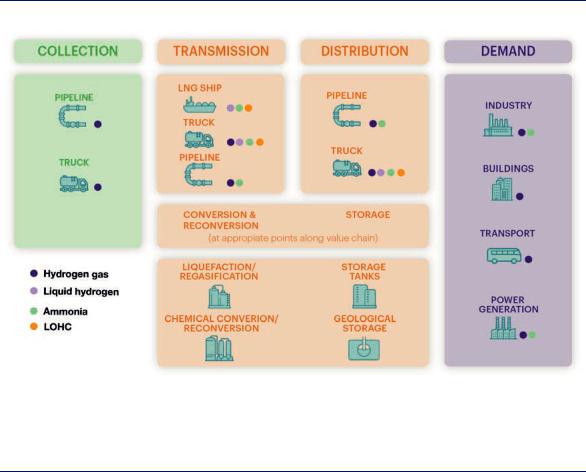
Today hydrogen is usually stored and delivered in compressed gas or liquid form. The majority is either produced and consumed on-site (around 85%) or transported via trucks or pipelines (around 15%). In the future the balance between these options could change and new alternatives could emerge. The competitiveness of the different options will depend on the distance over which hydrogen is transported, and on scale and end use. Long-distance transport would enable the export of hydrogen from low-cost production regions to high-cost ones (Figure 24). For energy import-dependent countries, it could also improve the diversity of energy sources and increase energy security.
This chapter first looks at possible storage options for hydrogen and hydrogen carriers. It then examines the possibility of using existing natural gas grids to transport and distribute hydrogen. This is followed by a discussion of the various delivery options and costs for long-distance transmission and local distribution. It finishes with an assessment of the total cost of storage, transmission and distribution for a number of different trade routes. Our assessment of costs is based on the most recent data from industry and scientific literature; however, there is inevitably a high degree of uncertainty about many of these estimates including those relating to future technology developments.
Figure 24. Transmission, distribution and storage elements of hydrogen value chains
Note: LOHC = liquid organic hydrogen carrier.
Source: IEA 2019. All rights reserved.
Depending on the context and type of hydrogen carrier, various components can be combined in value chains for hydrogen transmission and distribution, leading to location-specific costs.
PAGE | 68
IEA. All rights reserved.

The Future of Hydrogen |
Chapter 3: Storage, transmission and distribution of hydrogen |
Hydrogen storage
Today hydrogen is most commonly stored as a gas or liquid in tanks for small-scale mobile and stationary applications. However, the smooth operation of large-scale and intercontinental hydrogen value chains in the future will require a much broader variety of storage options. At an export terminal, for example, hydrogen storage may be required for a short period prior to shipping. Hours of hydrogen storage are needed at vehicle refuelling stations, while days to weeks of storage would help users protect against potential mismatches in hydrogen supply and demand. Much longer-term and larger storage options would be required if hydrogen were used to bridge major seasonal changes in electricity supply or heat demand, or to provide system resilience.17 The most appropriate storage medium depends on the volume to be stored, the duration of storage, the required speed of discharge, and the geographic availability of different options. In general, however, geological storage is the best option for large-scale and long-term storage, while tanks are more suitable for short-term and small-scale storage.
Geological storage
Salt caverns, depleted natural gas or oil reservoirs and aquifers are all possible options for largescale and long-term hydrogen storage (HyUnder, 2014; Kruck et al., 2013). They are currently used for natural gas storage and provide significant economies of scale, high efficiency (the quantity of hydrogen injected divided by the quantity that can be extracted), low operational costs and low land costs. These characteristics mean that they are likely to be the lowest-cost option for hydrogen storage even though hydrogen has low energy density compared to natural gas (Bünger et al., 2014).
Salt caverns have been used for hydrogen storage by the chemical sector in the United Kingdom since the 1970s and the United States since the 1980s. They typically cost less than USD 0.6/kgH2, have an efficiency of around 98%, and have a low risk of contaminating the hydrogen that is stored (H21, 2018; Bünger et al., 2014; Lord, Kobos and Borns, 2014). Their high pressures enable high discharge rates, making them attractive for industrial and power sector applications. Because salt cavern storage is generally operated as a series of separate, adjacent caverns, natural gas storage facilities could be converted to hydrogen stores one at a time as hydrogen use increases, reducing upfront costs. The United States has the largest salt cavern hydrogen storage system currently in operation; it can store around 30 days of hydrogen output from a nearby steam methane reformer (between 10 and 20 thousand tonnes of H2 (ktH2)) to help manage the supply and demand for refining and chemicals. The United Kingdom has three salt caverns that can store 1 ktH2, while a 3.5 ktH2 storage demonstration project in a salt cavern is under preparation in Germany (planned for 2023).
Depleted oil and gas reservoirs are typically larger than salt caverns, but they are also more permeable and contain contaminants that would have to be removed before the hydrogen could be used in fuel cells. Water aquifers are the least mature of the three geological storage options, and there is mixed evidence for their suitability (although they were previously used for years to store town gas with 50–60% hydrogen). As with oil and gas reservoirs, natural barriers trap the vast majority of the hydrogen deep underground. However, reactions with microorganisms, fluids and rocks can lead to losses of hydrogen. As they have not previously been
17 An additional option would be for hydrogen to provide short-duration electricity storage, for example for less than a day. However, it is likely that pumped-storage hydropower, compressed air storage and/or batteries will outcompete hydrogen where they are available.
PAGE | 69
IEA. All rights reserved.
The Future of Hydrogen |
Chapter 3: Storage, transmission and distribution of hydrogen |
investigated for commercial use with pure hydrogen, many aquifers would also incur exploration and development costs. The feasibility and cost of storing hydrogen in depleted reservoirs and aquifers have still to be proven. If they could overcome the challenges and establish themselves as viable, both would be options to provide storage on the scale required for seasonal hydrogen storage, especially in locations without access to salt caverns.
Although geological storage offers the best prospects for long-term and large-scale storage, the geographical distribution, large size and minimum pressure requirements of sites make them much less suitable for short-term and smaller-scale storage. For these applications, tanks are the most promising option.
Storage tanks
Tanks storing compressed or liquefied hydrogen have high discharge rates and efficiencies of around 99%, making them appropriate for smaller-scale applications where a local stock of fuel or feedstock needs to be readily available.
Compressed hydrogen (at 700 bar pressure) has only 15% of the energy density of gasoline, so storing the equivalent amount of energy at a vehicle refuelling station would require nearly seven times the space. Ammonia has a greater energy density and so would reduce the need for such large tanks, but these advantages have to be weighed against the energy losses and equipment for conversion and reconversion when end uses require pure hydrogen (see below). When it comes to vehicles rather than filling stations, compressed hydrogen tanks have a higher energy density than lithium-ion batteries, and so enable a greater range in cars or trucks than is possible with battery electric vehicles.
Research is continuing with the aim of finding ways to reduce the size of the tanks, which would be especially useful in densely populated areas. This includes looking at the scope for underground tanks that can tolerate 800 bar pressure and so enable greater compression of hydrogen. Hydrogen storage in solid-state materials such as metal and chemical hydrides is at an early stage of development, but could potentially enable even greater densities of hydrogen to be stored at atmospheric pressure.
Hydrogen transmission and distribution
The low energy density of hydrogen means that it can be very expensive to transport over long distances. Nonetheless, a number of possible options are available to overcome this hurdle, including compression, liquefaction or incorporation of the hydrogen into larger molecules that can be more readily transported as liquids. In many countries there is an extensive existing natural gas pipeline network that could be used to transport and distribute hydrogen. New infrastructure could also be developed, with dedicated pipeline and shipping networks potentially allowing large-scale overseas hydrogen transport. Each possible option has a variety of advantages and disadvantages, and the cheapest choice will vary according to geography, distance, scale and the required end use of the hydrogen. This section discusses the opportunities and issues related to each of the main transmission and distribution options.
Blending hydrogen in existing natural gas grids
Developing a new hydrogen value chain would be contingent upon successfully completing and connecting production, transmission, distribution, storage and end-use infrastructure. This would require co-ordinated investment by many different market participants, which could be
PAGE | 70
IEA. All rights reserved.