Материал: The_Future_of_Hydrogen-IEA-2020

The Future of Hydrogen |
Chapter 6: Policies to boost momentum in key value chains |
|
Policy |
|
Policy needs |
|
|
|
|
category |
|
|
|
|
|
|
|
|
|
|
|
|
|
|
|
|
|
|
|
|
|
|
|
|
|
|
|
|
|
|
|
|
|
|
|
|
|
|
|
|
Measures that help |
|
|
|
|
tip the balance in |
|
|
|
|
favour of private |
|
|
|
|
investment in |
|
|
|
|
discrete facilities in |
|
|
3. Investment |
|
the earlier stages of |
|
|
risk mitigation |
|
scale-up when risks |
|
|
|
|
are dominated by |
|
|
|
|
uncertain demand, |
|
|
|
|
unfamiliarity and |
|
|
|
|
value chain |
|
|
|
|
complexity. |
|
|
|
|
|
|
|
|
Governments need |
|
to continue playing |
|
a central role in |
|
setting the research |
|
agenda for early- |
|
stage high-risk |
|
projects, taking |
|
early-stage risks and |
|
crowding in private |
4. R&D, |
investment in |
strategic |
projects. |
demonstration |
|
projects and |
For technologies at |
knowledge |
the point of market |
sharing |
scale-up and lower- |
|
risk projects, a |
|
range of policy tools |
|
can incentivise the |
|
private sector to |
|
take the lead in |
|
driving innovation |
|
based on market |
|
needs and |
|
competition. |
Cross-cutting examples
Chinese policy bank loans; Australia's Clean Energy Finance Corporation; EU projects of common European interest; EIB Energy Lending Policy; multilateral bank financing; EU Connecting Europe Facility; Southern California Gas Company renewable natural gas certification.
PAGE | 176
IEA. All rights reserved.

The Future of Hydrogen Chapter 6: Policies to boost momentum in key value chains
|
Policy |
|
Policy needs |
|
Purpose |
|
|
|
Cross-cutting |
|
|
category |
|
|
|
|
|
examples |
|
||
|
|
|
|
|
|
|
|
|
||
|
|
|
|
|
|
|
|
|
|
|
|
|
|
|
|
|
|
|
|
|
|
Lower or remove unnecessary regulatory barriers and establish common standards that facilitate trade
5.and ensure safety for all the elements
Harmonising |
in the value chain. |
|
standards, |
||
|
||
removing |
Engage local |
|
barriers |
||
communities to |
||
|
||
|
ensure they can |
|
|
make informed |
|
|
decisions about the |
|
|
risks and impacts of |
|
|
new hydrogen |
|
|
projects. |
Assist the market uptake of hydrogen |
|
|
technologies by removing barriers that |
|
Hydrogen Technology |
prevent adoption or increase risks, and |
|
Collaboration |
address potential public concerns. |
|
Programme; |
|
|
International |
Cross-cutting issues include safety |
|
Partnership for |
standards, avoiding double taxation of |
|
Hydrogen and Fuel |
energy where applicable, and distribution |
|
Cells in the Economy |
purity and pressure. A key issue is the |
|
(IPHE); International |
certification of CO2 intensity and |
|
Organization for |
provenance of hydrogen supplies, as well |
|
Standardization (ISO) |
as benchmarks for the incumbent |
|
TC 197; International |
processes they replace. An international |
|
Electrotechnical |
framework is needed that is robust against |
|
Commission TC 105; |
mislabelling or double-counting of |
|
CEN Sector Forum |
environmental impacts (so-called |
|
Energy Management; |
“guarantees of origin”) and covers CO2 |
|
HySafe; EU CertifHy; |
inputs to hydrogen-based fuels and |
|
CSA Group. |
feedstocks. |
|
|
1. Coastal industrial clusters: Gateways to building clean hydrogen hubs
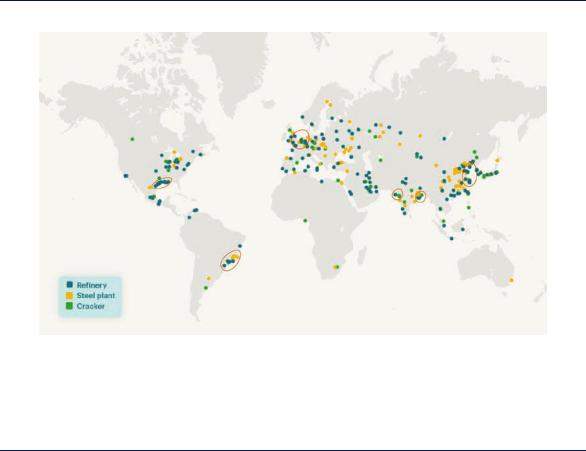
Clusters of industrial activity offer a major opportunity for ramping up the deployment of lowcarbon hydrogen. They reduce the need for upfront investment in transmission and distribution infrastructure because demand and supply of hydrogen can be co-located (Figure 66). They reduce the need to develop demand and equipment for hydrogen use in new sectors because many industrial hubs already have large established users of hydrogen for refining and chemicals, including ammonia. And they offer large and rising volumes of hydrogen demand, reflecting the fact that the use of hydrogen for refining, ammonia, methanol and steelmaking is set to grow in all IEA scenarios and in many existing industrial hubs (Chapter 4).
Replacing even a small percentage of current hydrogen use in refining, steel or ammonia production would, however, require a large step-up in supply of low-carbon hydrogen from electrolysis or CCUS. The largest water electrolysers proposed today are around 100 MW, equivalent to around 10% of a single steel plant’s hydrogen demand.
The reasons why coastal industrial hubs are of particular interest for hydrogen value chains are fourfold:
•Much of the 74 Mt of existing demand for pure hydrogen is already at coastal hubs, as is much of the 45 Mt of demand for hydrogen in mixtures of gases and almost all of the dedicated hydrogen pipeline and storage infrastructure. In several cases – such as the US Gulf Coast and in Belgium, France and the Netherlands – these clusters already have hydrogen pipeline networks that might be built upon for trade in new hydrogen sources. The global distribution of existing refining, steelmaking and chemicals production indicates several such clusters (Figure 66), and these sectors are all growing: annual
PAGE | 177
IEA. All rights reserved.
The Future of Hydrogen |
Chapter 6: Policies to boost momentum in key value chains |
demand for hydrogen for refining, ammonia and methanol is already set to rise nearly 20% to 96 Mt by 2030.
•There is the potential to integrate industry or transport applications at coastal hubs with nearby sites for offshore wind and solar PV in locations such as the North Sea in Europe, Southeast China, Western Australia and Northwest India.
•Coastal industrial hubs are often located near oil and gas operations and potential CO2 storage sites (including enhanced oil recovery operations) in locations such as the Gulf of Mexico, the Persian Gulf, Australia’s Victorian and Pilbara coasts and the North Sea.
•There is future potential to use port facilities to support both international hydrogen trade by ship and the use of hydrogen and hydrogen-based fuels for trucks and fleet vehicles and as maritime and inland shipping fuel.
Figure 66. Global distribution of existing refining, steelmaking and chemical cracking plants
Notes: This map is without prejudice to the status of or sovereignty over any territory, to the delimitation of international frontiers and boundaries and to the name of any territory, city or area. Sites shown are those with capacities of over 0.2 mb/d for refineries, over 2 Mt/yr for steel plants and over 0.3 Mt/yr for steam crackers.
Sources: IEA analysis based on Oil & Gas Journal (2018), Worldwide Refinery Survey – 2018; Platts (2018), Olefins Database; Steel Institute VDEh (2018), Plantfacts Database.
The distribution of industrial hydrogen demand today is concentrated in key coastal clusters.
Several of today’s major industrial clusters have already independently recognised this potential, and public and private initiatives for hydrogen have been put in place, sometimes by national governments and sometimes by regional communities. These include H2V Industry in France, HyNet North West in the United Kingdom, the Northern Netherlands Innovation Board, and Taranaki in New Zealand.
In the long term, industrial hubs are particularly promising locations for expanding hydrogen use into other sectors. For example, supplying hydrogen to residential heating, hydrogen refuelling stations or dispatchable power generation could build on the production facilities and infrastructure built for industrial applications. These potential sources of hydrogen demand often exist close to industrial hubs and offer many potential synergies. A single 500 MW power plant
PAGE | 178
IEA. All rights reserved.

The Future of Hydrogen |
Chapter 6: Policies to boost momentum in key value chains |
would, for example, create hydrogen demand equivalent to 650 000 FCEVs or the heat demand of 2 million homes (Chapter 5). Hydrogen use could spread gradually from coastal hubs further inland by truck, barge or pipeline (since industrial clusters are often well-integrated with existing natural gas pipelines).
There are already examples of plans that show the potential for costal hubs as hydrogen users. At the ports of Los Angeles and Long Beach, for example, the Zero and Near Zero Emissions Freight Facilities project is planning two heavy-duty hydrogen refuelling stations and ten hydrogenfuelled trucks to distribute goods around the ports with the aim of improving air quality as well as addressing climate concerns.
Potential exists for a variety of coastal industrial clusters to support the commercial-scale demand and supply of hydrogen, including by retrofitting CCUS to existing hydrogen plants. The North Sea is one candidate, but others include South East China, the US Gulf Coast, Australia and the Persian Gulf, where Saudi Arabia plans to explore hydrogen production for shipment to Japan. Some inland industrial clusters could also support hydrogen developments where this makes sense, for example for fertiliser production in inland China (Chapter 2) or for steel production in Austria. The production of hundreds of thousands of tonnes of hydrogen for industrial applications is a major opportunity for expanding electrolyser production and capacity, as well as for CCUS projects.
Box 18. Focus on the North Sea region
The North Sea region exhibits many of the features that can make coastal industrial hubs an attractive starting point for scaling-up (and cleaning up) hydrogen supply and demand:
strong industrial base with nine key industrial hubs
strong driver for low-carbon investment in the shape of ambitious climate policies
hydrogen pipelines
proximity to CO2 storage potential
high potential for offshore wind power
political interest in hydrogen as fuel and feedstock in the context of maintaining a strong industrial base in the region.
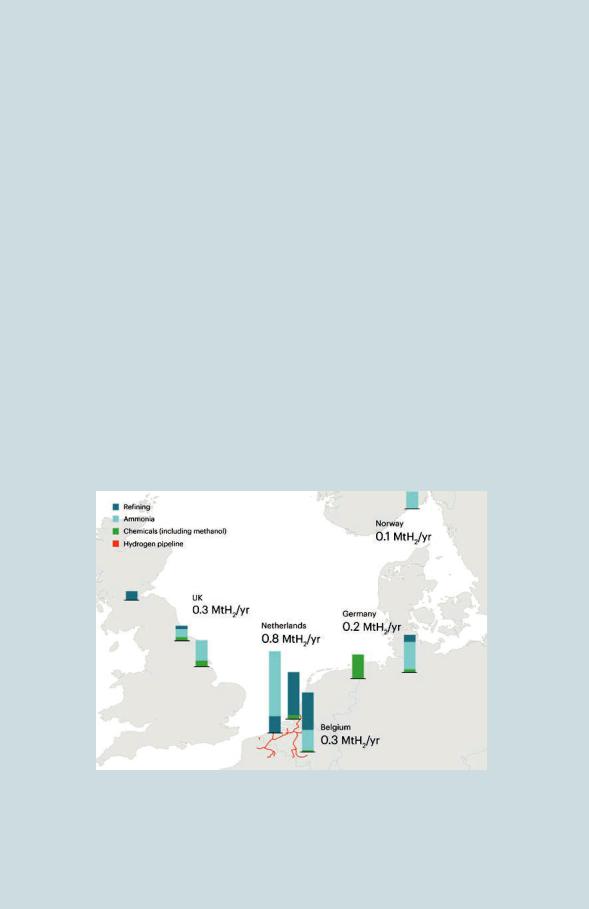
The nine industrial hubs around the North Sea currently consume a total of 1.7 MtH2 annually, nearly half of which is for ammonia (0.8 Mt), and most of the rest for refining (0.6 Mt) and chemicals (0.2 Mt). Production of this hydrogen is currently responsible for the emission of 15 MtCO2, equivalent to one-third of Germany’s CO2 emissions from the manufacturing and industrial sectors.
The North Sea has some of the best-developed CO2 storage resources in the European Union. Since 1996 CO2 has been injected into the Norwegian continental shelf at a rate of 1 MtCO2/yr, more than twice the amount needed to abate emissions from a large-scale hydrogen production plant. While progress since then has been slow, North Sea projects to capture and store CO2 from natural gasbased hydrogen production are now among the leading candidates for CCUS in Europe. While no final investment decisions have yet been taken, projects at the feasibility study stage with ambitions to be operational by 2030 include: the H21 project in the North and North East of England, which would involve nine hydrogen production units of 0.2 MtH2/yr capacity each (H21, 2018); the Magnum Project in the Netherlands, which could create demand for 0.2 MtH2/yr for each of the three gas power plant units converted to hydrogen (NIB, 2018); the H-Vision project, which aims to retrofit CO2
PAGE | 179
IEA. All rights reserved.
The Future of Hydrogen |
Chapter 6: Policies to boost momentum in key value chains |
|
|
|
|
capture to up to 0.6 MtH2/yr for industrial use in Rotterdam, the Netherlands (PoR, 2018); and the
HyNet project in North West England, which proposes 0.2 MtH2/yr capacity for industrial use and injection into the gas grid (Cadent, 2018).
Several of these projects plan to use domestic natural gas resources and store the CO2 under territorial waters, but in some cases the project proponents intend to import natural gas for local hydrogen production and re-export the CO2 for storage, for example in the Norwegian continental shelf. Another alternative is to import the hydrogen from hydrogen production close to the overseas CO2 storage site. Policies and public funding conditions can be instrumental in determining which approach is followed, for example by supporting only local hydrogen supplies.
The North Sea already hosts 13 GW of offshore wind, and national targets for 2030 could take this above 50 GW. By creating new demand for electricity on the coast, electrolysers can prevent the power generated by offshore wind going to waste where electricity grid connections are not sufficient to transmit all of the output to demand centres at windy times. If 5% – the level of wind electricity subject to curtailment in Germany today – of the targeted North Sea offshore wind output in 2030 were used to produce hydrogen, around 0.2 MtH2/yr of low-carbon hydrogen could be supplied. This could satisfy more than 10% of the today’s industrial hydrogen demand around the North Sea. Several proposals have already been made to link offshore wind output to industrial clusters and, as part of this, to make use of large-scale hydrogen storage, including in North East England (H21, 2018), Northern Netherlands (EnergyStock, 2019; ReNews, 2019) and facilities on an artificial island (NSWPH, 2019). In the longer term, pairing renewable electricity capacity with hydrogen production for transport and industry could be attractive for matching electricity demand with supply.
Sources: H21 (2018), H21 North of England; NIB (2018), “The green hydrogen economy”; PoR (2018), “H-Vision: Blue hydrogen for a green future”; Cadent (2018), HyNet North West: From Vision to Reality; EnergyStock (2019), “The hydrogen project HyStock”; ReNews (2019), ; NSWPH (2019), “Planning the future today”.
North Sea hydrogen demand capacity by sector and pipeline infrastructure, 2018
Notes: This map is without prejudice to the status of or sovereignty over any territory, to the delimitation of international frontiers and boundaries and to the name of any territory, city or area. Tjeldbergodden in Norway, which consumes 0.1 MtH2/yr for methanol, not shown on map.
Sources: Air Liquide (2019), “Supply modes”; CF Industries (2017), More Ways to Win: 2017 Annual Report; Integraal waterstofplan Noord-Nederland (2019), Investeringsagenda Waterstof Noord-Nederland; Roads2Hy.com (2007), “European hydrogen infrastructure atlas” and “Industrial surplus hydrogen and markets and production”; Yara (2018),”Annual production capacity”; data provided directly to IEA by Port of Rotterdam.
There is already substantial demand for hydrogen in North Sea industrial clusters.
PAGE | 180
IEA. All rights reserved.