Материал: UPSTREAM

Внимание! Если размещение файла нарушает Ваши авторские права, то обязательно сообщите нам

26 Underline the correct word and then explain each of the phrases in bold.

1 Publishing his new cookery book has brought him into the public eye/tongue.

2His grandparents would tell him

all sorts of stories about the good/past old days.

3Jane is very happy with her new job as a chef. She seems to have

found her place in the sky/sun.

4The company donated í5000 to Feed the Children, which was very generous but unfortunately just a drop in the sea/ocean compared to what they actually need.

27 a. Match the American words to their corresponding British ones. Which of these are the same in your language?

American

British

meat grinder

biscuit

candy

sweets

jelly

tin

chips

mincer

can

crisps

cookie/cracker

mincemeat

eggplant

chips

french fries

courgette

zucchini

aubergine

ground meat

jam

b.In a minute make a list of foods which you use in your language but come from another language.

28 Fill in the correct word then make up sentences.

ñ loaf

ñ bunch ñ piece ñ grain

ñ clove

ñ pinch

1a piece of cake

2

a ....................

of rice

3

a ....................

of bread

4

a ....................

of grapes

5

a ....................

of salt

6a .................... of garlic

Would you like another piece of cake?

8

Key-word Transformations

29 Complete the second sentence using the word in bold. You must use between two and fivewords,includingtheword given.Donotchangethe word in bold.

1There is only a little milk left in the bottle.

much

There ......................................................

in the bottle.

2He said to us, "I can give you a lift to the station if you like."

offered

He .................................................

a lift to the station.

3"Don’t forget to take an umbrella with you,” she said to him.

reminded

She ..............................................................................


.................................................. an umbrella with him.

4I’m sorry, there’s no coffee left.

run

I’m sorry, we .....................................................

coffee.

5The fridge is almost empty.

hardly

There ......................................................

in the fridge.

6“I’d cut down on salt if I were you, Tim,” said Jo.

advised

Jo ....................................................................

on salt.

7What is the price of that saucepan?

much

How

..............................................................., please?

8“Why don’t we invite Lisa to the party?” Rob asked.

suggested Rob...........................................................

to the party.

Error Correction

30 Read the text below and look carefully at each line. If the line is correct, put a tick ( ). If it has a word which should not be there, write this word on the line, as in the example.

Did you know that what you eat can have been a

0

been

drastic effect on how you feel? We all know

00


that what we eat it affects us physically but did

1

....................................

you know some foods affect us mentally, too? Studies

2 ....................................


have been shown that chocolate can lift your spirits

3 ....................................


and make you feel happier. However, the effect

4 ....................................


lasts only for a short time. The high fibre foods

5 ....................................


on the other hand can be make people feel positive,

6 ....................................


energetic and think quicker. Research shows that

7 ....................................


people who they eat a high fibre diet tend to be less

8 ....................................


stressed, less tired and less depressed than people are

9 ....................................


who don’t. Also, they are able to think lots more

10 ....................................


quickly. Nevertheless, other foods can that have a

11 ....................................


negative effect on us such as coffee, eggs, sugar

12 ....................................


and foods that they contain a lot of artificial

13 ....................................


flavourings and preservatives. These all foods can

14 ....................................


make us feel sad, anxious and prone to panic

15 ....................................


attacks. Foods that have been proven to lift up your

16 ....................................


spirits are oily fish, salads, fruit, cereals and nuts.

17 ....................................


123

Listening & Speaking skills

31 You will hear a conversation between three friends talking about eating out versus cooking at home. Listen and decide who said what. Write Gfor Gary, Sfor Sarah or Ffor Frank.

1

This speaker wants to go out for dinner.

........

2

This speaker says that eating out is


unhealthy.

........

3This speaker thinks that restaurant food


tastes good.

........

4

This speaker says eating out is expensive.

........

5

This speaker thinks someone is making


excuses.

........

6

This speaker thinks someone is lazy.

........

7

This speaker can’t cook well.

........

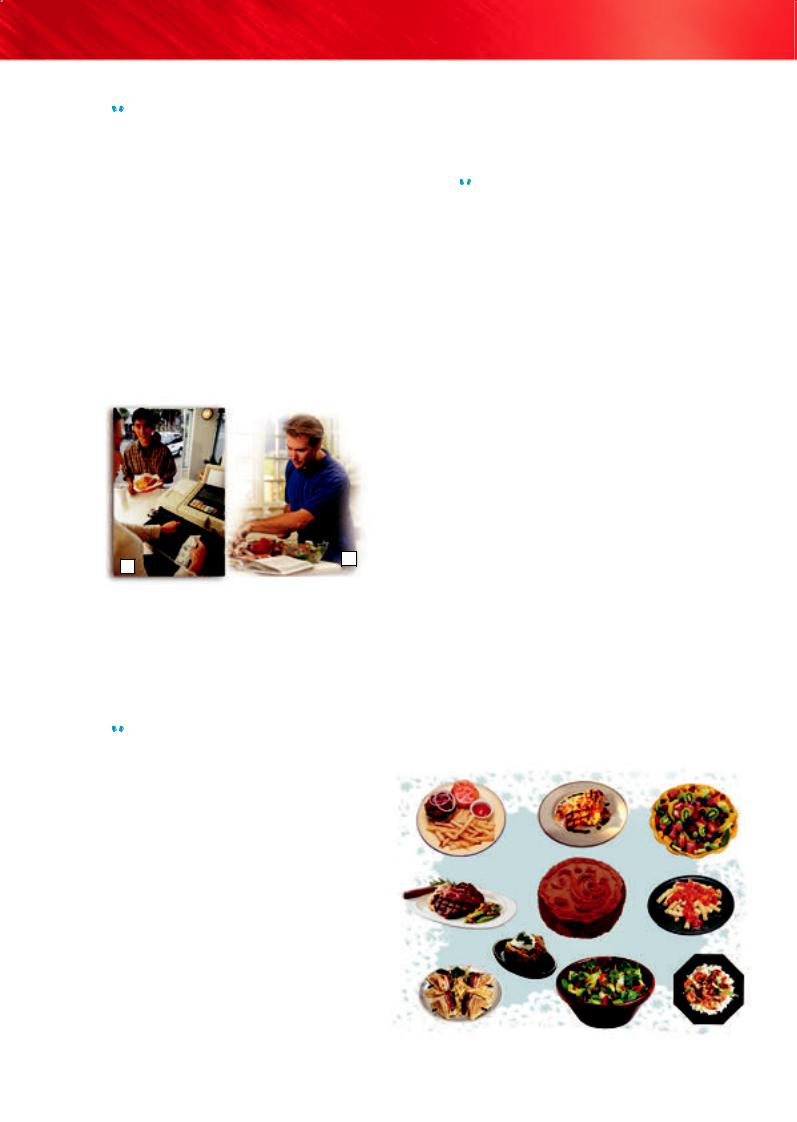
32 Describe the pictures. Compare and contrast them, then answer the questions.

B

A

Picture A shows a person at a takeaway restaurant whereas

Picture B shows a man preparing a salad at home.

aWhy do some people prefer eating out to eating at home?

b Why is junk food so popular?

33 You will hear a radio interview with a famous cardiologist. For questions 1-6 decide whether the statements are true (T) or false (F).

1Heart attacks are more common now

than they were in the past.

........

2Dr Shaw says most people would eat a

healthier diet if they had more time.

........

3If you have a healthy diet, with lots of fruit

and vegetables, you don’t have to exercise. ........

4 Dr Shaw recommends joining a gym. ........

5Dr Shaw says men in their 50s tend to

smoke and drink too much coffee.

........

6Dr Shaw implies men are more at risk

of heart attacks than women.

........

34 Your friend has put on a lot of weight recently and wantstodosomethingaboutit.Talktoyourfriendand

ñadvise him/her on what to do in order to lose weight in a healthy way;

124

ñtell him/her about a diet/exercise programme that has worked for you;

ñencourage him/ her to try it.

35 You are going to hear a news report on young people’s eating habits. Listen and choose the best answer to the questions below.

1The speaker says young people a had a healthier diet in the past. b think fast food is nutritious.

c would be healthy if they didn’t eat fast food.

2Modern day families a prefer to eat out.

b don’t have time to prepare healthy food. c eat more than they should.

3The speaker says

a people should skip breakfast instead of eating doughnuts or croissants.

b home cooked meals are very nutritious.

c no fixed meal times lead to bad eating habits.

4Young people eat junk food at lunchtime a because it is convenient.

b because it is filling.

c because they can’t afford anything else.

5The speaker says teenagers

a eat unhealthy snacks all day long.

b sometimes eat nothing healthy all day. c need to learn to cook healthy food.

6Young people today a don’t eat fresh food.

b usually have a healthy evening meal. c only drink sugary soft drinks.

36 Lucy’s son has invited his friends from the football team over for dinner. In pairs, decide which would be appropriate for Lucy to cook for her guests.

A:Ithinksheshouldn’tcookburgersbecausethey’retoooily.

B:I couldn’t agree more. A good idea would be ...

Accepting/Refusing Invitations

37a. Listen to the dialogues. In which one is the invitation accepted more enthusiastically?

b.Complete the dialogues 1-4 using one of the expressions from the boxes below.

Accept

Enthusiastically: Thanks, I’d love to ...; Thanks, that sounds great/like fun ...; I’d love to, thank you very much for asking/ inviting me. Unenthusiastically: I guess so; I suppose so; I might as well; Why not?

Refuse

Politely: Thanks for asking/thinking of me but ...; It sounds

lovely/great/wonderful but I’m afraid I ...; Sorry, I can’t ...; I would

love to, but I’m afraid I can’t because ...; Thanks, but I’d rather

not/I’m not very keen on ...

Firmly: No thanks, I don’t enjoy/fancy/ feel like ...

Impolitely: No, I don’t want to/I hate ...

1A: We are all going out to that new Chinese restaurant tonight. Would you like to join us?

B: .......................................................................

(accept enthusiastically)

2A: I’m having a party on Saturday night. I hope you can make it.

B: .......................................................................

(accept unenthusiastically)

3A: I’m having a dinner party on Tuesday. Would you like to come?

B: .......................................................................

(refuse politely)

4A: It’s my daughter’s birthday party on Sunday and all the children from her class will be there. You are coming, aren’t you?

B: .......................................................................

(refuse firmly)

c.In pairs, use the phrases from the table and the prompts below to act out similar dialogues.

Invite somebody to:

ña wedding reception ñ a fancy dress party

ña barbecue ñ an Italian restaurant

Doing your Shopping

38a. Listen to the dialogue. Where does it take place?

b.Read the dialogue and fill in the questions, then use the prompts to act out similar dialogues.

ñWill that be all? ñ Who’s next, please?

ñWould you like anything else?

ñWhat would you like?

8

A:Number 54, please.

B:Yes, that’s me.

A:1) .........................................................................

B:Can I have 250 grams of Camembert cheese, please?

A:Here you are. 2) ....................................................

B:Yes, I’d like half a kilo of smoked salmon and 300

grams of coleslaw, please.

A:Right. 3) ...............................................................

B:Yes, that’s it. Thank you.

A: Here you are. Thank you very much. 4) .................

ñhalf a kilo of Lancashire cheese/150 grams of potato salad/3 Scotch eggs

ñ100 grams of cheese dip/250 grams of sliced roast beef/2 slices of cheese and tomato quiche

Ordering Fast Food

39a. Listen to the dialogue. How many people is the food for? Listen again and check.

b.Read the dialogue and fill in the missing parts.

A:1) .........................................................................

B:No, I haven’t.

A:2) .........................................................................

B:Erm, 2 cheeseburgers and 2 large Cokes, please.

A:3) .........................................................................

B:Yes, 2 medium fries and a child’s portion of chicken nuggets.

A:4) .........................................................................

B:No, that’s it, thanks.

A:5) .........................................................................

B:Here you are.

A: Thank you. It’ll just be a couple of minutes.

c.Use the prompts to act out similar dialogues.

ñMargarita pizza with extra cheese/any garlic bread?/yes, 1 and 2 tins of lemonade/í8.20

ñ6 pieces of chicken and 2 tubs of coleslaw/any chips/yes, 3 large portions/í10.50

Intonation

40 Listen and repeat, then say how we form exclamations.

ñ That’s expensive! ñ How tasty!

ñ What nice sauce!

ñ What excellent roast beef! ñ What impolite waiters!

ñ What a delicious dish!

125
Charles Dickens (1812-1870) is generally considered to be the greatest English novelist, enjoying immense popularity throughout his career. Dickens wrote novels that exposed the terrible lives of the poor during the nineteenth century in England.

Novels such as David Copperfield,

Great Expectations, Bleak House, A

Christmas Carol and A Tale of Two Cities draw attention to the dreadful conditions in which so many of London’s poor lived at that time. These novels reflect Dickens’ own childhood, when his father was unable to pay his debts and Dickens himself was sent out to work in a factory when he was just twelve years old. Oliver Twist (1838) is set in the underworld of poverty and crime which existed in early Victorian London. It tells the story of an orphan, Oliver, who, after spending his early life in a workhouse is sent to work for a hard taskmaster. Oliver runs away to London, where he joins a gang and becomes a pickpocket. By chance, a wealthy gentleman takes pity on Oliver and takes him into his house. Although Oliver is forced to return for a time to the gang, he eventually is reunited with his family and lives happily ever after.

Reading

41 Read the biography and the title. Who do you think Dickens describes in Oliver Twist? Why?

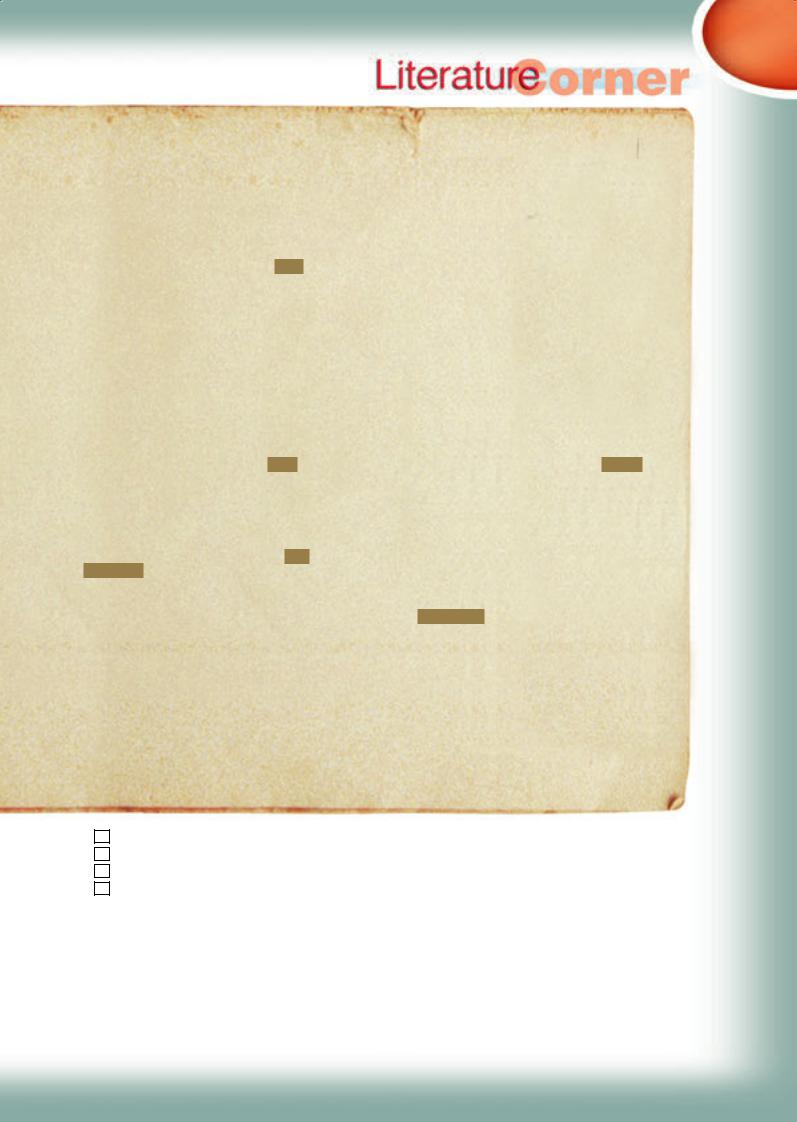
42 a. Look at the pictures and describe them. How do you think people lived in early Victorian London? Was life easy for children then? How do you know?

b.Look at the pictures again. Who do you think Oliver Twist is? What kind of life did he have? Was it happy? Read the extract and find out.

43 Read the extract again. Which picture is described?

44 Match the opposites in the list to the highlighted words and then explain the words in bold.

ñ hot ñ loud ñ unafraid ñ indifferent ñ light ñ calmly ñ rosy-cheeked

At the age of nine, Oliver was a pale, thin child. He and the other workhouse boys never had enough warm clothes or food. They were given only three meals of thin soup every day. On Sundays they had a small piece of bread.

They were fed in a big hall. A large pot stood at one end of the room, and the soup was served by the master. Each boy had one small bowl of soup and no more. The bowls never needed washing, because the boys cleaned them with their spoons until they shone. But there was not enough food. Oliver and the other boys were always hungry, so one day they decided that one boy would walk up to the master after supper and ask for more soup. Oliver was chosen.

In the evening, the boys sat down at the tables.

45 a. Read the extract again and put the sentences in the correct order.

Mr Bumble put Oliver in a dark room.

The master served the soup.

The boys whispered to each other.

Oliver asked for some more soup.

The boys made signs to Oliver.

Oliver asked for some more soup a second time.

Oliver stood up.

The soup disappeared quickly.

The master was surprised.

126

8

The master stood by the pot, and the soup was served. It disappeared quickly. The boys whispered and made signs to Oliver. He stood up from the table and went to the master, with his bowl and spoon in his hands.

“Please, sir,” he said, “I want some more.”

The master was a fat, healthy man, but he went very pale. He looked with surprise at the small boy.

“What?” said the master at last in a quiet voice. “Please, sir,” repeated Oliver, “I want some

more.”

The master hit Oliver with his spoon, then seized him and cried for help. Mr Bumble rushed into the room, and the master told him what Oliver had said.

“He asked for more?” Mr Bumble cried. “I cannot believe it. One day they will hang the boy.”

He took Oliver away and shut him in a dark room. The next morning a notice appeared on the workhouse gate. Five pounds were offered to anybody who would take Oliver Twist.

Oliver was a prisoner in that cold, dark room for a whole week. Every morning he was taken outside to wash, and Mr Bumble beat him with a stick. Then he was taken into the large hall where the boys had their soup. Mr Bumble beat him in front of everybody. He spent every day crying. When night came he tried to sleep, but he was cold, lonely and frightened.

One day, outside the high workhouse gate, Mr Bumble met Mr Sowerberry. Mr Sowerberry was a tall, thin man who wore black clothes and made coffins. Many of his coffins were for the poor people who died in the workhouse.

“I have prepared the coffins for the two women who died last night,” he said to Mr Bumble.

“Good,” said Mr Bumble. “You will be rich one day, Mr Sowerberry! Do you know anybody who wants a boy? And five pounds?” He raised his stick and pointed to the notice on the gate.

The arrangements were soon made, and Mr Bumble took Oliver to Mr Sowerberry’s shop that

The boys sat down at the tables in the big hall. Mr Bumble came into the room.

Oliver went to the master.

The master called out for help.

b.Match the characters with the descriptions. What do you think Mr Bumble looks like? Why do you think so?

Oliver Twist

fat and healthy

The master

tall and thin with black clothes

Mr Sowerberry

short and thin with a narrow face

Mrs Sowerberry

pale, thin and very small

evening. Oliver did not want to go.

“I will be good, sir!” he said. “I am a very little boy and it is so – so – lonely! Please don’t be angry with me, sir!” To Mr Bumble’s surprise, Oliver had tears in his eyes. He told the boy not to complain, to dry his eyes and to be good. He took Oliver’s hand, and they continued walking in silence.

Mr Sowerberry had closed the shop, and he was writing by the light of a candle when they arrived.

“Here, Mr Sowerberry, I have brought the boy,” said Mr Bumble. Oliver bowed.

“Oh, that is the boy, is it?” said Mr Sowerberry. “Mrs Sowerberry, come here, my dear.” A short thin woman with a narrow face came out from a little room behind the shop. “My dear,” said Mr Sowerberry, “this is the boy from the workhouse that I told you about.”

Oliver bowed again.

“Oh!” said the woman. “He is very small.”

“Yes, he is rather small!” said Mr Bumble. “But he will grow, Mrs Sowerberry, he will grow.”

“Yes, I expect he will,” said the lady angrily, “on our food and our drink. Here, get downstairs, you little bag of bones. You can have some of the cold meat that we saved for the dog. The dog hasn’t come home since this morning.”

Mrs Sowerberry opened a door and pushed Oliver down some stairs into a dark room.

Oliver’s eyes shone at the thought of meat. They gave him a plate of the dog’s food, and he ate very quickly. Mrs Sowerberry was not pleased that he was so enthusiastic.

“Come with me,” she said, taking a dirty lamp and leading him upstairs again. “Your bed is in the shop.”

Oliver was left alone in the shop. He was alone in a strange place. He climbed quickly into his narrow bed and fell asleep.

From “Oliver Twist” in the Penguin Readers series, retold by Deborah Tempest

46 a. Make a list of the things that happened in the story, then take turns to retell the story in your own words.

b.Discuss what you would have done in Oliver Twist’s place.

Project

Choose one of the scenes from the extract and draw a picture for your class’s OliverTwistDrawing Competition.

127

Источник: https://studfile.net/preview/16430601/