Материал: UPSTREAM

Grammar in use
Past tenses
Grammar Reference
14 a. Identify the tenses in bold, then match them to their use.
1She left university six years ago.
2He was waiting for the bus when the accident happened.
3He had just finished his report when his boss asked to see him.
4She had been working as a clerk for two years before she got promoted.
a happened before another past action with emphasis on continuation b happened at a specific time in the past
chappened before another past action
d was in progress at a certain time in the past
b.Underline the time adverbs used with each tense. What other adverbs can you think of which can be used with these tenses? Make up three sentences using them.
15 Match the prompts from each column to make sentences.
1 |
They had been |
while |
|
|
looking for a house |
||
|
|
||
|
for six months |
when |
|
2 |
Martin has been |
||
|
|||
|
living in Thailand |
since |
|
3 |
|
||
Janet was working |
|
||
|
on her computer |
for |
|
4 |
I haven’t seen Joanne |
|
|
5 |
Joe was cooking |
before |
|
6 |
Gail has been abroad |
|
three times
the lights went off.
two years now.
this year.
they found what they were looking for.
Ann was laying the table.
she got married.
16 Put the verbs in brackets into the correct past tense. Justify your answers.
1 |
Paul ........................ |
(break) his arm while he ..................................... |
|
|
(paint) the wall. |
|
|
2 |
Sandra |
finally .................................... |
(pass) the exam. She .......... |
|
............................................................ |
|
(study) really hard for months. |
3 |
A: How long ...................................................................................... |
|
|
|
(Mary/work) here before she ................................................ |
(retire)? |
|
|
B: More than twenty years. |
|
|
4 |
While I ............................................................ |
|
(walk) home last night, |
|
I ................................................................ |
|
(bump) into Sally. |
5 |
The sun |
.............................................. |
(shine) and the birds ............... |
|
................................ |
(sing) as we ........................................... |
(drive) |
|
towards the village. |
|
|
6 |
We .......................................................... |
|
(finish) the main course and |
|
....................................................................... |
|
(wait) for dessert when |
|
the fire alarm ........................................... |
(ring). |
|
7“...............................................
(you/work) late last night?”
“Yes, actually I ..........................
....................... (not/leave) until 11 pm.”
8She ..........................................
(visit) France before but she
only .................................. |
(go) |
to Paris last month. |
|
9 A: ............................................
(you/see) Jamie at the party last night?
B:No, by the time I .................
(get) there, he ...................
.................. (already/leave).
10 Amy .........................................
........... (walk) home when she
................................ (hear) her mobile phone ring.
17 Underline the correct words.
1When she entered her flat she had found/found that someone had broken/broke in.
2He had been driving/was driving home when/after he crashed into a tree.
3When Laura arrived/had arrived at the restaurant, Tony had gone/had been gone home.
4When/While I walked into the room, they had just/yet finished their dinner.
5After they had been living/lived there since/for two years they decided to build an extension to their house.
6He didn’t shave/hadn’t been shaving this morning because he hadn’t had/didn’t have time.
7While/After he graduated from university, he joined/was joining the army.
8 She had been watching/ watched TV when/since Tom came home.
9He was having/had a bath when the lights had gone/went out.
10She had never/ever been to South America before/after.
24
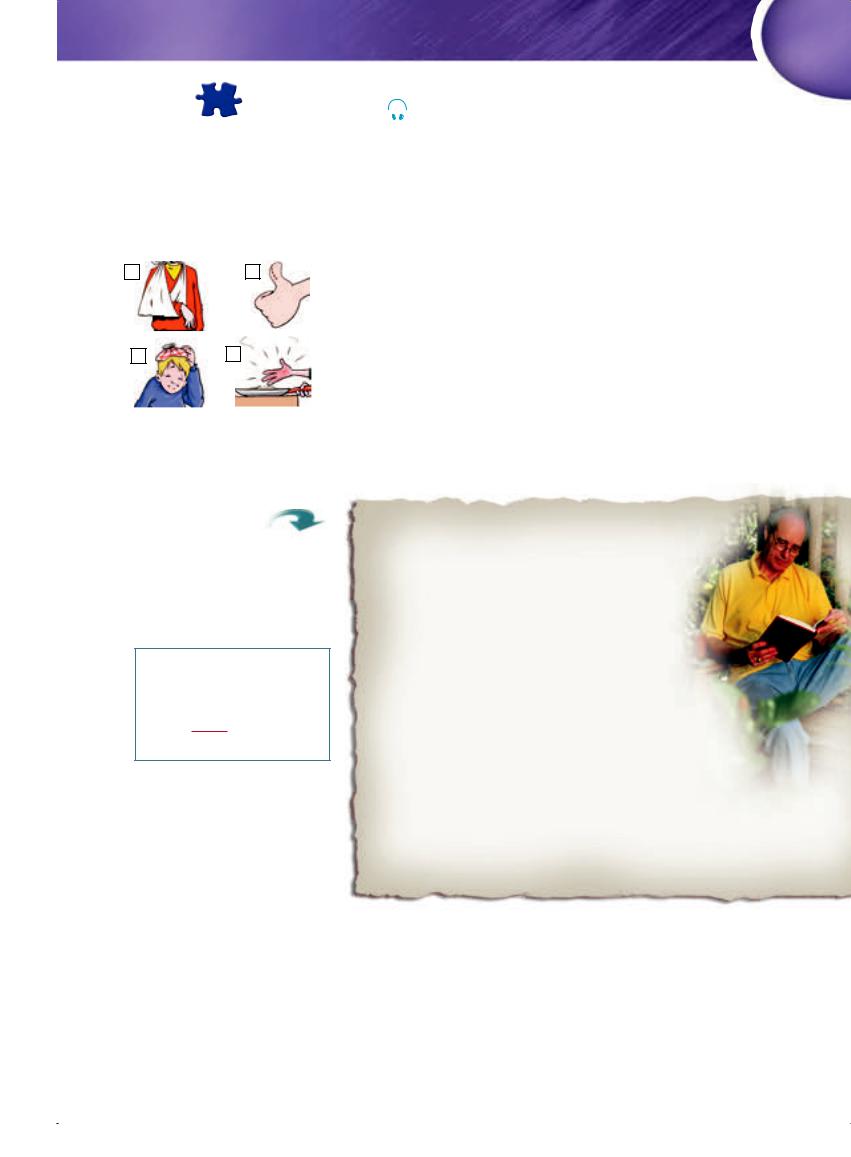
Game
Look at the cartoons, then in teams try to explain what happened to each of the people using past tenses. Each correct sentence gets 1 point. The team with the most points is the winner.
1 2
3 4
He fell off the ladder while he was paintingthewallandbrokehisarm. He had been playing football for an hourwhen...
Used to / Would
Grammar Reference
18 a. Study the examples. In which of the sentences (1-6) can you use would instead of usedto? Tick ( ) accordingly.
Heused to/would gojoggingbefore breakfast.(pastroutine)
Heused to liveinYorkasastudent. (paststate)
NOT: Hewould liveinYorkasa student.
1I used to come here when I was young.
2Jack’s parents used to live in Canada.
3 Louise used to have a motorbike but I think she has a car now.
4Caroline used to play tennis every week when she was a child.
5When they were younger, they
used to go for long walks in the countryside.
6 Grandma used to make porridge for breakfast.
2
 b.
b. Listen to Sam and Sarah and tick ( ) the things that they used to do when they were children and cross ( ) the things that they didn’t use to do. Then make up sentences, as in the example.
|
play with computers |
|
lock their doors |
|
have their own private |
|
do lots of chores |
|
|
||
|
telephone lines |
|
have early nights |
|
|
||
|
|
||
|
play outdoors |
|
wear a uniform to school |
|
|
||
|
play with their friends in the |
|
go to school six days a week |
|
|
||
|
street |
|
visit their grandparents in the |
|
|
||
|
|
||
|
go fishing |
|
school holidays |
|
|
||
|
go swimming in the river |
|
|
|
|
|
SamandSarahdidn’tusetoplaywithcomputers.
c. Talk about what you used to do during your childhood.
19 a. Study the two examples. Which sentence refers to the past?
a. Theymettenyearsago. |
b. Theyhavebeentogethersincethen. |
||
b. Put the verbs in brackets into the pastsimpleor the presentperfect. |
|||
Alex Morton is a talented writer who 1) .......................... |
(lead) a |
||
very interesting life. He was born in 1945 in Manchester, and he |
|||
was the youngest of six children. From the moment he could read, |
|||
he was never without a book in his hands. He was an avid |
|||
reader throughout his schooldays, and he soon 2) ................. |
|
||
(show) his talent for writing, too. In |
fact, his teachers |
||
3) ...................... |
(give) him extra assignments just to be |
||
able to read more of his work. |
|
|
|
After he 4) |
.................... (leave) |
school he went |
to |
Manchester University. By the time he got his BA, he had |
|||
already published a number of short stories, and his first novel |
|||
was almost finished. Over the next few years he 5) ..................... |
|
||
(write) non-stop and each of his books was more successful than the |
|||
last. Despite being so busy with his work, Alex still 6) .................... |
(find) |
||
time for romance. He met Fiona Jones while he was at university and they were married in 1971. They have two children. He 7) .................................
(always/be) a devoted husband and father.
Alex Morton 8) |
.................................. (write) over twenty books so far |
and his name 9) ............................... |
(be) on the best seller list more times |
than he can remember. However, the pinnacle of his career was when he
10) ................................... |
(win) the Booker Prize for Fiction in 1995. Since |
then, Alex 11) ............................................ |
(continue) to write and many of |
his books 12) .................................................. |
(be/made) into films. |
c.Talk about one of your older relatives. You can talk about his/her:
ñchildhood ñ education ñ work ñ family (e.g. marriage/children)
ñachievements ñ later years
My grandfather is called Harry. He was born in Brighton in 1920. When he left school he joined the local fire brigade. He got married when he was twenty-six. He andhiswifeAdahadsevenchildren.Hesaysthathisfamilywashismostimportant achievement in life. My grandfather retired three years ago. Since then, he and my grandmotherhavespenttheirtimetravellingandgardening.
25

Grammar in use
Prepositions
Appendix 1
20 a. Underline the correct preposition, then explain the phrases in bold.
1Julie is capable of/for doing it on her own.
2You can depend to/on Simon.
He’s very reliable.
3He shouldn’t comment on/to
that when he doesn’t know all of the facts.
4It was very unfair that Paul was dismissed from/of his job.
5The criminal has been charged for/with burglary.
6They’re always complaining of/ about something.
7Children are very curious for/ about the world they live in.
8 Julian is very serious and dedicated to/at his work.
9She is finding it difficult to concentrate on/to her studies.
10Sally is amazing. I don’t know how she copes with/at her job, and her kids at the same time.
b.Fill in the correct preposition. Then choose any three phrases and make up sentences using them.
1 ................ |
fact; 2 to be involved |
||
.............. |
sth; |
3 to move ............ |
|
Boston; |
4 to spend time and |
|
|
money .................. |
|
sth; 5 a waste |
|
........... |
time; |
6 an expert ....... |
sth |
Phrasal Verbs
Appendix 2
21 a. Fill in the correct particle and explain the phrasal verbs.
ñout (x2) ñ up with ñ into
ñacross ñ round ñ away ñ on
ñoff ñ down with
1 The fans got completely carried
.............. when their team scored in the last minute.
2Neil was reading the newspaper when he came .............. an article about an old friend of his.
3 |
When Lucy’s uncle died she came .............. |
a lot of money. |
|
4 |
Sue asked Rick and Claire to come ............... |
for dinner tonight. |
|
5 |
Danny carried his speech |
.............. perfectly. |
|
6 |
Jason is going to carry .............. |
the business after his father retires. |
|
7 |
The author has a new novel coming .............. |
next week. |
|
8 |
Liz has come .............. .............. |
an excellent solution to our problem. |
|
9 |
Doctors will carry ............ |
more tests to find out what the problem is. |
|
10 |
John is ill; he has come ............. |
............ |
chickenpox. |
b.Look up other meanings of comeout and come(a)round in your dictionary. Then make up sentences using these meanings.
Word Formation
22 Fill in the correct word derived from the word in bold.
Although the 0) majority of people say that they |
MAJOR |
|||
work, ‘for the money,’ the 1) |
............................. |
reward |
FINANCE |
|
isn’t actually the only thing that they think about. |
|
|||
2) ......................... |
, research |
has shown |
that people |
RECENT |
consider many different factors to be of 3) |
..................... |
IMPORT |
||
when they make their 4) ....................... . |
|
A worldwide |
CHOOSE |
|
survey of students showed that .........................after 5) |
|
GRADUATE |
||
they would |
be looking for jobs that allowed them to |
|
||
balance their 6) .......................... |
lives with their work |
PERSON |
||
lives. |
|
|
|
|
It’s not just the younger generation who think like |
|
|||
this either. There has even been an increase in the |
|
|||
number of middle-aged 7) ................... |
who are moving |
WORK |
||
away from highly-paid executive positions into less |
|
|||
8) ................... |
jobs. They are looking for something |
STRESS |
||
which is more 9) ........................ |
and gives them more |
ENJOY |
||
leisure time. All this has meant ...................that 10) |
are |
EMPLOY |
||
realising that they need to do more than just offer good |
|
|||
wages if they are going to keep their workers happy |
|
|||
and motivated! |
|
|
|
|
26
Open Cloze
23 Read the text and think of the word which best fits each gap. Use only ONE WORD in each gap.
Read the title of the text. It is a summary of
what you are going to read. Read the text once quickly to get the general
meaning. Read the text again. Pay attention to the words before/after each gap. These will help you decide what word is missing. Missing words can be adverbs, articles, modal/auxiliary verbs, conjunctions, prepositions, pronouns, phrasal verbs etc. The word that you choose must be grammatically correct and make sense in context. When you have filled
in the gaps read the text again to see if it makes sense.
2
3We haven’t had a holiday for years.
ages It’s ......................................................
........................................... a holiday.
4 We haven’t been out since last summer.
time |
The .................................................... |
|
............................... was last summer. |
5After hours of discussion, they finally succeeded in reaching an agreement.
managed They ...................................................
................... after hours of discussion.
6 She wasn’t involved in the argument at all. nothing She had .............................................
........................... the argument at all.
|
In Western Europe and the |
|
|
|
|
|
|||||
USA, |
family |
life |
0) has |
changed |
|
|
|
|
|
||
dramatically |
over |
the last |
forty years. |
|
both |
||||||
The number of families that depend 1) |
|
||||||||||
is one |
|||||||||||
parents going out to work, or where 2) ............. |
|||||||||||
parent raising the children alone, is much greater than it |
|||||||||||
3) ............. |
to be. Also, many more people move away |
||||||||||
from their families 4) .............. |
|
ever before. 5) ................. |
|
|
|
|
|
||||
these |
changes, most people |
still think 6) ..................... |
|
|
|
|
of |
||||
their |
family |
as one of the most significant parts |
|
|
|||||||
|
|
|
|||||||||
7) ....................... |
|
lives. |
|
|
|
|
|
|
|
||
|
A recent American survey showed that 8) ................ |
home |
is |
||||||||
people think |
that |
spending |
time 9) |
||||||||
|
|||||||||||
more important 10) ................... |
|
earning a high salary or |
|||||||||
having a challenging job. The majority of young people |
|||||||||||
surveyed said that they 11) ...................... be happy to |
|||||||||||
earn less money if they had more time to 12) ................. |
|
|
that |
||||||||
with their loved ones. Older people also commented |
|||||||||||
|
|
|
|||||||||
they had worked 13) |
|
hard in the past |
when |
||||||||
|
|
|
|
. |
|||||||
they |
should |
have 14) |
|
with their |
|
|
|
|
|||
|
families |
||||||||||
15) |
|
|
if the typical family doesn’t follow |
the |
|||||||
|
|
|
|
||||||||
traditional model today, it is still a vital part of our lives. |
|
|
|||||||||
Key-word Transformations
24 Complete the sentences using the words in bold. You must use between two and five words, including the word given.
1 He started to play golf five years ago.
for |
He ...................................................... |
|
................................... five years now. |
2How long is it since you moved here?
ago How ...................................................
................................................. here?
Idioms & Fixed Phrases
25 Underline the correct word, then try to explain the idioms.
1Let’s put on some music. It’s as silent/quiet as the grave in here.
2He’s got food poisoning and he’s been as sick as a dog/cat all week.
3Don’t worry about Maggie; she’s as tough as old shoes/boots.
4The Martin children are not at all alike. They’re as different as chalk and cheese/milk.
5I’ll look after Jo anytime. Really, she’s as good as silver/gold.
6Ben can’t wait to get started on the project. He’s as keen as ketchup/mustard.
26 Circle the correct word, then explain the expressions in bold.
1Things are going very well at work at the moment, I think a promotion might even be on the ........... .
A books |
B |
cards |
C letters |
D papers |
2 Chris does |
lots of work for charity. He’s always |
|||
doing something for a good ........... . |
|
|||
A aim |
B |
example |
C cause |
D reason |
3You have to make it ........... to her exactly how you feel.
A easy |
B straight C clean |
D clear |
4Helen is a lovely girl, but she always has her head in the ........... . She never notices what’s going on around her.
A sky |
B stars |
C clouds D air |
5It was only a silly argument, but they were both getting very ........... under the collar.
A hot |
B red |
C heated D warm |
27
Listening & Speaking
27  a.
a. You will hear five people talking about the most important thing in their lives. Listen and match the speakers to the statements. There is one statement which does not match any of the speakers.
A |
We have a great relationship. |
Speaker 1 |
B |
Financial security is very important |
Speaker 2 |
|
to me. |
Speaker 3 |
C |
Nothing is as important as your |
Speaker 4 |
|
health. |
Speaker 5 |
D |
They’re like my family. |
|
E |
My family is everything to me. |
|
FMy career is my life.
b.Listen again and write one reason why each person feels this way.
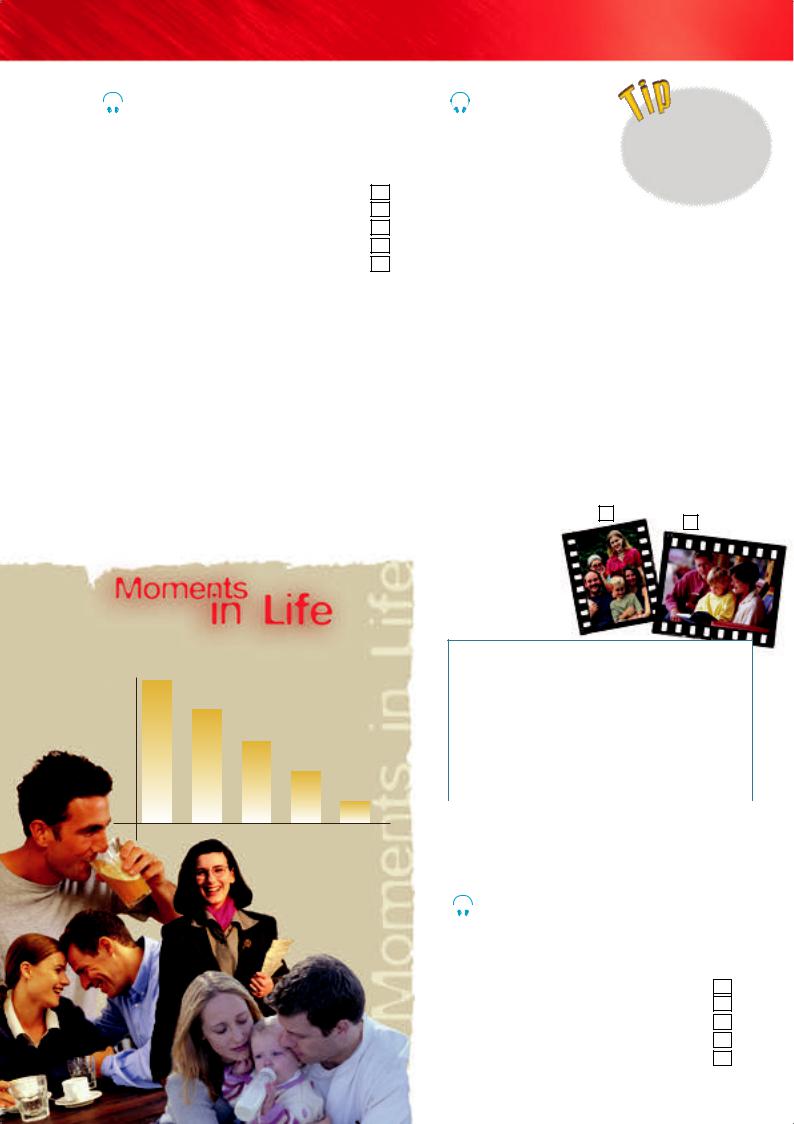
28 Look at the survey results and the visual prompts. Then, in pairs, discuss the following:
ñWhich of these things do you consider to be important in your life? Why/why not?
ñAre some things just as important as other things? Which ones? Give reasons.
A:Ithinkfamilylifeisthemostimportantthinginmylife becausemyfamilyhelpandsupportme.
B:Really,Ithinkfriendshipsarethemostimportantthing becauseIshareeverythingwithmyfriends. etc
100 people were questioned about |
||
28% |
what they thought was the |
|
|
most important thing in |
|
|
|
|
|
24% |
their lives. This is |
|
what they said. |
|
|
|
|
|
|
20% |
|
|
18% |
|
|
10% |
family life |
career |
relationship friendships good health |
28
29 a. |
Listen and mark the |
Read the |
|
|
sentences T (true) |
statements |
|
|
or F (false). |
before you listen and |
|
1 |
Rachel gets plenty of attention |
underline the key words. Try |
|
to match the key words |
|||
|
from her parents. ........ |
||
|
with similar words in |
||
2 |
Her parents spoil her. ......... |
the script. |
3She never feels lonely. .........
4She sometimes wishes she had a brother. .........
5 She doesn’t want to share things with anyone. .........
6She likes having her own room. .........
7She thinks that friends can be as good as sisters. .........
b.In pairs talk about your family.
How big is your family? What does each member of your family look like? Which family member do you admire most? Who is your favourite relative? Why? How often do you see your relatives?
30 Describe the pictures. Then, in pairs, express your opinions about:
ñthe advantages and disadvantages of each type of family
ñ the problems the |
A |
|
|
|
B |
||
children in each |
|
|
|
|
|
|
|
type of family |
|
|
|
might have |
|
|
|
ñhow each family compares to your own
EXPRESSING OPINIONS
Picture A shows ..., whereas ..., I think ..., I believe ..., In
my opinion ..., It seems to me ...
AGREEING |
DISAGREEING |
Youãre right/That’s true/ |
Do you (really) think so? |
I quite agree with you. |
No, I’m afraid I can’t agree |
|
with you. |
|
|
A:Picture A shows a large family. There are the parents and three children; two girls and a boy. They look European or American.Whatdoyouthink?
B:Ithinkyou’reright. Theylookveryhappy. etc
31 
 You’ll hear five people talking about a past experience. Decide which of the statements (A-F) matches what the speaker says. There is one extra statement which you do not need to use.
A |
I simply didn’t want to do it. |
Speaker 1 |
|
B |
It was an unforgettable experience. |
Speaker 2 |
|
C |
I’ve never been so afraid. |
Speaker 3 |
|
D |
It was the best day of my life. |
Speaker 4 |
|
E |
I was really excited. |
||
Speaker 5 |
|||
F |
I didn’t know what was going on. |
||
|