Материал: Uchebnik_dlya_sud_expertov
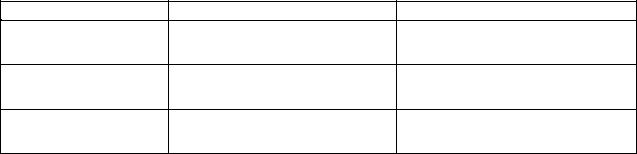
!) New Year Day, St. Valentine’s Day, Easter, Halloween, Thanksgiving Day, Christmas, International Women’s Day, the Victory Day, Independence Day, Boxing Day, National Unity Day, Day of Fatherland Defender
/) October 31st, December 25th, January 1st, 14th of February, 25th of December, the fourth Thursday of November, 26th of December, July 4th, 23rd of February, 8th of March, 9th of May, 4th of November, 12th of June, 7th of January.
country |
holiday |
date |
RUSSIA
GREAT BRITAIN
THE USA
3. .
1.What holidays are celebrated in Russia?
2.What holidays are celebrated in the USA?
3.What holidays are celebrated in Great Britain?
4.What Russian traditions of observing holidays do you know?
5.What customs of New Year's Eve celebration in different countries do you know?
6.What holidays do you observe?
7.Do you prefer to celebrate holidays with your family or with your friends?
8.Do you prefer to celebrate holidays at home or in some public place? How do you usually do it?
9.What is your favorite holiday? Why?
4. , ( ,
# .
(Jerry and Fei are comparing Christmas customs in New York and Beijing).
Jerry: Look, Fei! I got a Christmas card from my sister.
Fei: It's very beautiful. Why are the words "Happy Holidays" written on the card? Christmas is only one holiday. Shouldn't it be "Happy Holiday", without the "s"?
Jerry: We don't just celebrate Christmas during this season. We also celebrate the coming of the New Year.
Fei: Oh, I never thought about that before. There's more than one holiday at the end of the year.
Jerry: Now that I'm in China, I want to celebrate the holidays Chinese-style. What do you and your family do for Christmas?
Fei: Actually, we don't do much at Christmas. It's not really a big family holiday. Young people in China would rather spend Christmas Eve with their boyfriends or girlfriends.
61

Jerry: I see. How about the New Year in China? Is it a bigger holiday than Christmas?
Fei: Not really. We don't celebrate it because the Spring Festival is much more important to us here in China.
Jerry: The Spring Festival is known around the world as "Chinese New Year". It's the beginning of the year according to the traditional lunar calendar, isn't it?
Fei: That's right. The Spring Festival is the biggest family holiday in China, so we don't celebrate the western New Year. How about it in New York? Do people celebrate New Year's Eve more or New Year's Day?
Jerry: There are two kinds of people who celebrate quite differently. Single people, or couples without children, often go out late on New Year's Eve. They drink and party after the clock strikes midnight. There are big parties all over, but the biggest is in Times Square in Manhattan.
Fei: I guess they won't have much energy left over to do anything on New Year's Day, then.
Jerry: Right. But there are families who don't do anything special on New Year's Eve. Instead, they celebrate with their families on New Year's Day.
Fei: What do they do on New Year's Day?
Jerry: They have a big meal to celebrate and often watch parades in the big cities. The parades are quite spectacular.
Fei: It sounds a little bit like our traditional Lion Dance.
Jerry: Yes, it's a lot like the Lion Dance, except there is no lion!
5. ( .
CONGRATULATIONS AND WISHES
(My) Congratulations to you! |
! |
Happy birthday to you! |
&! |
+ New Year! |
C ! |
Merry Christmas! |
2 & ! |
Holly Easter! |
C "! |
I wish you good luck! |
= ! |
Have a nice holiday! |
= ) ! |
I wish you be healthy and wealthy! |
= $ $ ! |
|
|
6. % ! . :
) &;) ) ;) + .
62
7..
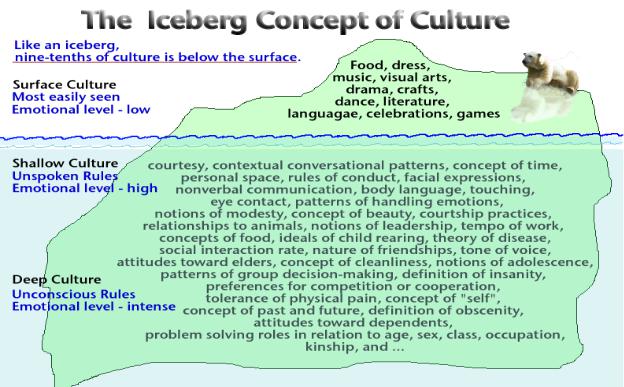
1.What does the notion “culture” comprise?
2.What does the concept of culture consist of?
3.What level of culture is the most noticeable?
4.Can you give examples of food and celebrations in Russia and other foreign countries?
5.What Russian unspoken rules of communication do you know?
6.Do you know any unspoken rules of other nationalities?
7.Have you ever felt that some unconscious rules of behaviour controlled the situation? In what situations did it happen?
8. « », , ( & , & .
Model:
1.Culture is the totality of socially transmitted behaviour patterns, arts, beliefs, institutions, and all other products of human work and thought.
2.Culture is a term that has many different inter-related meanings. However, the word "culture" is most commonly used in three basic senses:
•Excellence of taste in the fine arts and humanities, also known as high culture.
•An integrated pattern of human knowledge, belief, and behaviour that depends upon the capacity for symbolic thought and social learning.
•The set of shared attitudes, values, goals, and practices that characterizes an institution, organization, or group.
63

9. !", ( « ».
.
onsumer culture, corporate culture, political culture, pop culture, youth culture, primitive culture, Western culture.
UNIT 2. WHAT IS CROSS-CULTURAL COMMUNICATION?
1. , , !
. .
Intercultural, international, incorporate, interact, include, underlie, presuppose, over-generalize, overlook.
# ______ & & - ; # ______ & & - ; # ______ ) ; # ______ & $, $;
# ______ & - $.
2. #' -
. .
1. |
$ |
literate, illiteracy, literal, literacy, literalism, literally |
|
|
|
2. |
$ |
compete, competence, competition, competent, in- |
|
|
competent |
3. |
", " |
scholarly, scholarship, scholar, scholastic |
|
|
|
4. |
|
aware, awareness, unawareness, unawares |
|
|
|
5. |
$ ) |
cultural, culture, culturally, uncultured |
|
|
|
6. |
, |
new, news, anew, newish |
|
|
|
3. $ , “have” -
.
They have become critical…, it has become essential…, he has to possess a certain level of competence…, it has profound implications… , every word has to have a French translation, they have in common.
4. .
64

CROSS-CULTURAL COMMUNICATION
Cross-cultural communication (also frequently referred to as intercultural communication) is a field of study that looks at how people from different cultural backgrounds communicate in similar and different ways among themselves.
In the past decade, there has become an increasing pressure for universities across the world to incorporate intercultural and international understanding and knowledge into the education of their students. International literacy and cross-cultural understanding have become critical to a country’s cultural, technological, economic, and political health. It has become essential for universities to educate, or more importantly, “transform”, to function effectively and comfortably in a world characterized by close; multi-faceted relationships. Students must possess a certain level of global competence to understand the world they live in and how they fit into this world.
Cross-cultural communication, as many scholarly fields, is a combination of many other fields. These fields include anthropology, cultural studies, psychology and communication.
The study of languages can not only serve to help us understand what we as human beings have in common, but also assist us in understanding the diversity which underlies not only our languages, but also our ways of constructing and organizing knowledge, and many different realities in which we all live and interact. Such understanding has profound implications with respect to developing a critical awareness of social relationships. Understanding social relationships and the way other cultures work is the groundwork of successful globalization business efforts.
Language socialization can be broadly defined as “an investigation of how language both presupposes and creates anew social relations in cultural context”. It is imperative that the speaker understands the grammar of a language, as well as how elements of language are socially situated in order to reach communicative competence. Human experience is culturally relevant, so elements of language are also culturally relevant. One must carefully consider semiotics and the evaluation of sign systems to compare cross-cultural norms of communication. There are several potential problems that come with language socialization, however. Sometimes people can over-generalize or label cultures with stereotypical and subjective characterizations.
5. ! .
1. to incorporate into the education |
a) ) |
|
2. cross-cultural understanding |
b) $ ) $ - |
|
|
$ |
|
3. multi-faceted relationships |
c) $ & " |
|
4. to possess a certain level of global |
d) |
|
competence |
|
|
5. to fit into this world |
e) &$ |
|
6. a diversity |
f) $ # - |
|
|
" |
|
7. to have profound implications |
g) |
|
|
|
|
8. to develop a critical awareness of |
h) $ |
- |
|
|
|
9. to reach communicative competence |
i) $ $) " |
" |
10. to over-generalize or label cultures |
j) # $ - |
|
6. , # # -
.
Models:
a) I think it is true. The text tells us that ………
65