Материал: Апсе ENVIRONMENTAL PROTECTION 2014
1.Passive nuclear safety thanks to excellent thermophysical properties of sodium coolant and large neutron leakage from the small-sized reactor core.
2.Factory-based manufacturing of the small-sized reactor with the subsequently high fabrication quality, reliability of the reactor operation, the subsequently low financial expenses, possibility of standardization.
3.Relatively short construction time with subsequently low risk of financial investments.
4.Possibility for a step-wise upgrading the NPP power on 170 MWe at each next step.
5.Enhanced proliferation resistance because of the following reasons:
a.Uranium and plutonium co-extraction without any their separa-
tion.
b.Weak purification of uranium and plutonium from fission products and minor actinides. Subsequently, the re-fabricated fuel is characterized by intense radioactivity, residual heat generation and intense emission of spontaneous fission neutrons.
c.No long-distant SNF transportation from the reactor to the SNF reprocessing facility is required here since they are allocated in a single site.
The only drawback of the IFR concept is related with its small power. Evidently, one large-scale power reactor is more economical than a system of small-scale reactors with the same total power.
DUPIC-technology
Name of the DUPIC-technology is an abbreviation from the “Direct Use of spent PWR fuel in CANDU reactors”. The DUPIC -technology is a product of the collaborative efforts undertaken by nuclear specialists from the USA, Canada and South Korea. The DUPIC-technology is a non-aqueous process with enhanced proliferation resistance.
As it follows from its name, main mission of the DUPIC-technology consists in the repeated use of spent fuel discharged from light-water power reactors of PWR-type in heavy-water power reactors of CANDU-type. Reasonability of this approach is based on the fact that spent PWR fuel can contain the amount of fissile isotopes large enough for further use as a fresh fuel composition of CANDU-type reactors. As
146
is known, the standard spent PWR fuel contains partially burnt-up uranium with residual enrichment at the level of 0,9% 235U and 0,6% of
reactor-grade plutonium with about 70%-content of fissile isotopes 239Pu and 241Pu. Thus, in total, the standard spent PWR fuel contains 1,3% of fissile isotopes 235U, 239Pu and 241Pu. Fortunately, heavy-water CANDU-type power reactors are able of functioning even if they are fueled with natural uranium (0,7% 235U). So, spent PWR fuel can provide the twofold amount of fissile isotopes to make CANDU-type reactor operation feasible.
The DUPIC-technology provides spent PWR fuel reprocessing with application of thermal and mechanical procedures only. No components of aqueous, solvent-extraction, Pyrochemical and pyrometallurgical technologies are applied here.
Main stages of the DUPIC-technology:
1.Dismantling of spent fuel assemblies, withdrawal of spent fuel rods.
2.Transversal chopping of fuel rods into small pieces (~20 cm).
3.Longitudinal slitting of fuel claddings to weaken them.
4.Voloxidation, i.e. thermal treatment of fuel pieces in oxygen at
4000С. Uranium dioxide UO2 converts into uranium octa-oxide U3O8. This conversion causes increasing volume of fuel meat on 30%, and
fuel pieces throw their previously weakened cladding. In addition, fuel meat becomes more porous, partially transforms into a powder-like sub-
stance, some gaseous and volatile fission products (nearly all tritium, up to 40% 129I, 70% 85Kr and 90% 106Ru) escape the porous fuel meat.
5.Treatment by the OREOX-process (Oxidation-Reduction of Oxide fuel). The OREOX is an oxidizing-reducing process with multiple interchange of the following reactions:
a.Oxidation by air at 4500С. Uranium dioxide UO2 converts into uranium octa-oxide U3O8, like the voloxidation reaction.
b.Reduction by (Ar - 4% H2) gaseous mixture at 7000С. Uranium octa-oxide U3O8 returns into uranium dioxide UO2.
The multiple alternations of the oxidizing and reducing reactions can produce the dispersed UO2 powder, and result in complete release of all gaseous and volatile fission products. Only solid fission products remain in the powder particles.
6.Manufacturing of UO2 pellets from the dispersed UO2 powder with sintering up to the pellet density about 96% of its theoretical value.
147
7. Manufacturing of fresh fuel rods and fuel bundles for CANDU-type reactors by using the traditional technology but all the manufacturing operations must be performed in hot cells, behind thick enough radiation shielding.
Specific features of the DUPIC-technology:
1.Full absence of any liquid solvents and extractants. Consequently:
a.Small volumes of radioactive wastes (gaseous and volatile FP, metal claddings of spent fuel rods).
b.Compact reprocessing facility and, therefore, a real possibility for co-allocation of NPP and the reprocessing facility in a single site.
2.No uranium – plutonium separation. No complete s eparation of uranium and plutonium from radioactive fission products. Only gaseous and volatile fission products can be released. Solid fission products remain in the reprocessed fuel.
3.Enhanced proliferation resistance of the DUPIC-technology because of the following reasons:
a.Intense radioactivity of fuel materials containing solid fission products.
b.No technological operations with separation of plutonium from uranium.
c.No long-distant transportations of fissile materials as NPP and the reprocessing facility can be co-allocated in a single site.
3.4. Control of NM non-proliferation at SNF reprocessing plants
The spent fuel reprocessing plant (SFRP) is one of the most sensitive NFC part from the viewpoint of nuclear non-proliferation ensuring. Main difficulty here is a plutonium non-proliferation control. In general, plutonium control and accountability at the SFRP encounters the following main challenges:
1. Large plutonium amounts. Throughputs of French SFRP are at the level of 800-900 SNF tons a year, at English SFRP - 1200-1500 SNF tons a year. In average, one SNF-TR ton contains 6-7 kg of plutonium, i.e. 5-10 tons of plutonium can go through the SFRP annually.
2. High required accuracy of the plutonium control. The significant plutonium quantity SQ(Pu) was adopted by the IAEA as 8 kg. The US Nuclear Regulatory Commission (NRC) has adopted even the stricter
148
constraint for the plutonium non-proliferation control, SQ(Pu) = 2 kg. Consequently, the available plutonium quantity must be controlled by the SFRP staff with accuracy about 1 kg of plutonium or below. At av-
erage annual SFRP throughputs of 10 plutonium tons, the accuracy of the control plutonium measurements must be at the level of 0,01%.
Really achievable accuracies of plutonium measurements are at the level of 0,1%.
According to the requirements developed by Russian and American nuclear regulatory bodies, the maximal allowable plutonium disbalance at the SFRP must be equal to 0,1%, i.e. at the utmost achievable level of the measuring capabilities. The problem of so high required accuracy can be solved by using the following two ways:
1.The plutonium balance can be summed up at several time points a year, not once a year, when 5-10 plutonium tons have to be measured. The reasonable chosen number of physical inventory takings can decrease appropriately quantity of the Pu-bearing materials to be assayed. This way can be named as a time sharing.
2.The plutonium balance can be summed up at several material balance areas (MBA) of the SFRP. The reasonable chosen number of MBA can decrease appropriately quantity of the Pu-bearing materials available at each MBA to be measured. This way can be named as a space sharing.
Application of both ways (several physical inventories a year at several MBA separately) opens an opportunity to sum up the plutonium balance at the SFRP as a whole with the accuracy required by the nuclear regulatory guidelines.
3. Different states of the Pu-bearing materials. At the SFRP plutonium can be in various aggregate states (solid fuel and liquid SNF solution), in the aqueous and organic fractions, in solvates with different plutonium valencies. Different Pu-bearing materials can be characterized by different attractiveness for potential nuclear proliferators.
The following factors can be used to evaluate relative attractiveness of the Pu-bearing materials:
1. The density factor f1 depends on the specific volume V of the Pubearing material per one gram of contained plutonium. Metal plutonium is chosen as a reference material with the highest relative attractiveness for potential proliferators of nuclear weapons, i.e. f1(VPu-metal ) = 1. As
149
density of metal plutonium equals 19,8 g/cm3, the specific volume VPu-
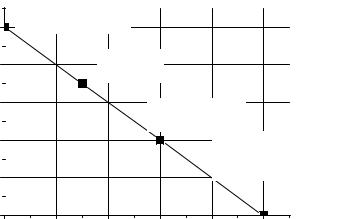
metal ≈ 5·10-5 l/g. Thus, initial point of f1 dependency on V equals unity at V = 5·10-5 l/g. The specific volumes of all other Pu-bearing materials are substantially larger, and their relative attractiveness appropriately diminishes (Fig. 3.3).
|
Pu-металл |
|
|
|
|
1,0 |
Pu-metal |
|
|
|
|
|
|
|
|
|
|
0,8 |
|
|
PuO2 |
|
|
) |
|
|
|
|
|
0,6 |
|
|
|
|
|
( 1(V)уд |
|
|
Pu(NO3)4 |
|
|
f1 |
|
|
|
||
f |
|
|
|
|
|
0,4 |
|
|
|
|
Отвержденные |
|
|
|
|
|
|
|
|
|
|
|
Solidified RAW |
0,2 |
|
|
|
|
ВАО |
|
|
|
|
|
|
0,0 |
|
|
|
|
|
0 |
2 |
4 |
6 |
8 |
10 |
|
УдельныйSpecific volumeобъем плутонияV, l/g Pu , Vуд, л/г |
||||
Fig. 3.3. Dependency of the density factor
on the specific volume of the Pu-bearing materials
2. The time factor f2 depends on duration of the time interval needed to convert the Pu-bearing material into a charge of a nuclear explosive device by well-skilled specialists equipped with the most updated technical tools. Metal plutonium is chosen again as a reference material with the top relative attractiveness. It is assumed that one-week time interval would be required by the specialists to make a nuclear explosive device with metal plutonium as a charge material, i.e. f2 (7 days) = 1. The time intervals needed for the specialists to convert all other Pu-bearing materials into a charge of a nuclear explosive device are substantially longer, and their relative attractiveness appropriately diminishes (Fig. 3.4).
150