Материал: Апсе ENVIRONMENTAL PROTECTION 2014
high temperatures. The warming-up effect complicates substantially the procedures related with the NED assemblage, storage and transportation. Moreover, the implosive NED can fail as chemical high explosives (HE) can be melted down or destroyed by thermal pyrolysis. So, quantitative evaluations must be carried out to determine 238Pu content in plutonium isotope composition that makes plutonium completely unsuitable for any military applications.
The share of 238Pu required for such a thermal plutonium protection has been evaluated in a series of publications where the implosive NED design consisted of central metal plutonium sphere (charge) surrounded by temper, chemical HE and outer casing. Heat from the outer casing was removed by natural air convection. If HE melting-down is chosen as a criterion of plutonium proliferation protection, then 5% 238Pu is a high enough share. If the HE melting-down criterion is supplemented with the HE self-ignition criterion, then minimal 238Pu content must be increased up to 6%.
One common feature of these publications consisted in assumption that plutonium proliferation protection could be evaluated from equilibrium radial temperature field in the NED components. However, the equilibrium temperature profile establishes after the lapse of a sufficiently long time. Indeed, when the implosive NED is assembled and prepared for application, the NED components begin warming, and the warming-up process can be quick or slow depending on internal heat generation rate. The NED gradually reaches the equilibrium temperature distribution, when internal heat generation rate is completely compensated by external heat removal rate. If the equilibrium state can be reached only after a long enough time interval, then a terrorist could explode the NED before it failed. So, it is evident that the NED failure only after a rather long time interval can not be used as a criterion of plutonium proliferation protection. Only the NED failure for relatively short time interval after its assemblage can confirm sufficiently high level of plutonium proliferation resistance.
Consequently, it is necessary to study non-stationary, timedependent process of the NED warming-up and evaluate the time intervals till the NED fails for various plutonium isotope compositions and for various mechanisms which can be used to intensify external heat removal. In addition, there are some possibilities to slow down the NED
201
warming-up process by means, for example, of the following countermeasures:
Preliminary cool-down of the NED components.
Application of additional heat-conducting layers.
Introduction of heat-isolating layers for purposeful re-distribution of radial temperature profile under which the NED could keep its effi-
ciency as long as possible.
These measures can remarkably increase the minimal 238Pu contents for sufficient proliferation protection of the denatured plutonium.
Model of a hypothetical implosive NED
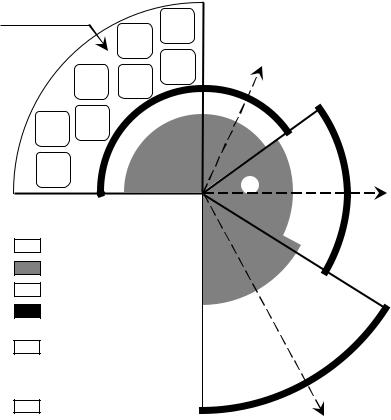
Geometrical model of a hypothetical implosive NED (HNED) is shown in Fig. 6.13.
Central plutonium charge is surrounded by spherical layers of natural uranium, aluminum, chemical HE and outer steel casing. The figure also demonstrates some technology levels (low, medium and high technology) with different thicknesses of spherical layers and with different types of chemical HE. Main relevant properties of effective chemical HE are presented in Table 6.6.
|
|
|
|
|
Table 6.6 |
Thermophysical properties of chemical HE |
|
||||
High |
Density, |
Heat conduc- |
Melting point, |
Self-ignition |
|
explosive |
g/cm3 |
tivity, |
0С |
|
point, 0С |
|
|
W/m·K |
|
|
|
Composition B |
1,74 |
0,219 |
79 |
|
214 |
CYCLOTOL |
1,77 |
0,226 |
79 |
|
208 |
TNT |
1,45 |
0,259 |
81 |
|
288 |
HMX |
1,84 |
0,406 |
256 ÷ 286 |
|
259 |
TATB |
1,89 |
0,544 |
448 |
|
347 |
As is seen, TATB is characterized by the best heat conductivity and the highest acceptable temperatures. So, it seems reasonable to use TATB as a chemical HE in the HNED. This means that the HNED with TATB as a chemical HE can keep its efficiency in the warming-up process up to the longer time intervals than other chemical HE can pro-
202
vide. Therefore, the use of TATB in the HNED represents the largest threat from the standpoint of the HNED long-term efficiency.
Heat-conducting
layer
Plutonium
Natural uranium
Aluminum
Chemical HE
Outer casing
Material with high heat conductivity (aluminum, for instance)
Material with phase transitions (liquid nitrogen, for instance)
High technology
r, cm
|
|
|
Medium |
5,8 |
5 |
5 |
technology |
|
r, cm
10
43
Low
technology
r, cm
Fig. 6.13. Geometrical model of a hypothetical implosive NED
Thus, to provoke the HNED failure, it is necessary to introduce sufficiently intense internal heat source into its charge, i.e. introduce 238Pu into plutonium isotope composition.
Numerical studies were carried out to assess effectiveness of the countermeasures on prolongation of the time interval till the HNED
203
failed. This time interval may be called as the HNED lifetime. Content of 238Pu in plutonium charge that provides only very short lifetime can be adopted as a sufficient value for plutonium proliferation protection.
Radial temperature distribution in the geometrical model of the implosive HNED (Fig. 6.13) can be determined through iterative solution of the following differential equation:
div |
[l(r,T)×grad T(r, t)] + qV (r) = cV (r,T)× |
∂T(r, τ) |
, |
|
|
¶t |
|
where l(r, T), cV (r, T) – heat conductivity and heat capacity, respectively, which depend on temperature T(r, τ) ; qV (r) – intensity of in-
ternal heat source.
Three options for external boundary conditions were used in accordance with different heat removal mechanisms:
1. Ideal heat removal: T(RS, τ) = TS, i.e. temperature at outer surface (r=RS) is a time-independent value.
2. Ideal heat isolation: |
∂T (r,τ ) |
|
|
|
= 0. |
||
|
∂r |
|
r =RS |
|
|
|
|
3. Heat is removed by natural air convection and thermal radiation only.
Criteria for the implosive HNED failure
The most temperature-sensitive component of the implosive HNED is a chemical HE that self-ignites at 3470С. In addition to the melting and self-ignition problems, one else temperature-dependent process can lead to the HNED failure, namely the thermal pyrolysis process. At elevated temperatures the thermal pyrolysis results in intense emission of gaseous products capable to destroy HE. According to some experimental data, chemical HE failed when rather small fraction (0.02%) of the pyrolysis products was accumulated in HE. However, this value can vary within a wide range (from 0.02% to 2%), depending on the HNED design and conditions for HE applications. So, pyrolytic dissociation of 2% HE molecules can be adopted as an upper border of the HE temperature resistance.
204
Rate of the HE pyrolytic dissociation can be evaluated with application of Arrhenius equation:
W (T ) = B × exp[- EACT  (R0 ×T )];
where W(T) – dissociation rate at temperature T; В – pre-exponential factor; EACT – energy of activation; R 0 – universal gas constant (8.31 J/mol×К).
Experimental studies on TATB parameters gave the following results: log10B = 11.6 s-1, EACT = 172.6 kJ/mol. Fraction of the HE molecules destroyed up to the time moment τ can be calculated by integrating the dissociation rate:
e(t) = ∫0τ W[T(t¢)]×dt¢.
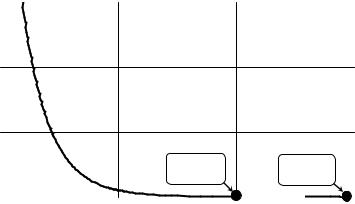
At self-ignition point of TATB, i.e. at 3470С, the upper border of TATB stability (2%) can be reached in eighteen seconds. However, even at the lower temperatures, the upper border can be reached in a rather short time interval (for instance, in five minutes at 3000С).
|
3 |
|
|
|
|
dissociation |
сутday. |
|
|
|
|
2 |
|
|
|
|
|
|
|
|
|
|
|
разложения |
|
|
|
|
|
till |
1 |
|
|
|
|
Время |
|
|
|
|
|
molecules,химическогоof2%(TATB),2%TATBВВ |
|
|
|
|
|
Time |
300 0С |
|
347 0C |
||
5 minutes |
|
1818secondsсек. |
|||
5 |
мин. |
|
|||
|
|
|
|
||
|
0 |
|
|
|
|
|
200 |
250 |
300 |
|
350 |
|
|
|
0 |
0 |
С |
|
|
ТемператураTATBхимическогоtemperature,ВВ (TATB),C |
|
||
Fig. 6.14. Temperature dependency of TATB dissociation
205