Материал: Апсе ENVIRONMENTAL PROTECTION 2014
negative environmental and climatic effects. As to the reactors with long-life cores, these are small and medium-sized power reactors. Besides, during transportation and mounting, they can be very attractive sources of plutonium in amounts large enough for manufacturing of several dozens of nuclear bombs.
6.4.2. Plutonium denaturing as a way for proliferation protection of the closed NFC
Some nuclear properties of 238Pu make this isotope a valuable material for proliferation protection of uranium-plutonium fuel. Firstly, 238Pu is an intense source of thermal energy (T1/2 = 87 years, specific heat generation - 570 W/kg). So, introduction of 238Pu into plutonium creates almost insuperable barrier to manufacturing of even primitive implo- sion-type NED. Plutonium heating up by isotope 238Pu can provoke undesirable phase transitions and thermal pyrolysis of conventional explosives applied for compression of central plutonium charge. Secondly, 238Pu is an intense source of spontaneous fission neutrons, even more intense than 240Pu. As a consequence, probability of premature CFR initiation in NED sharply increases while energy yield of nuclear explosion drastically drops down to the levels comparable with energy yield of conventional explosives. Thus, LWR MOX-fuel cycle with ternary fuel compositions (Np-U-Pu) is characterized by enhanced proliferation resistance.
Like uranium, plutonium can be denatured by the following two ways: either direct introduction of intensely radioactive isotope 238Pu into MOX-fuel composition or introduction of relatively low intense radioactive isotope 237Np into MOX-fuel composition. 237Np is the nearest neutron predecessor of main denaturing isotope 238Pu. So, only short-term pre-irradiation of fresh MOX-fuel assemblies would be sufficient to produce proliferation resistant fuel assemblies, suitable even for export deliveries to any countries.
196
6.4.3. Effects of 237Np and 238Pu introduction into MOX-fuel composition on proliferation resistance of plutonium
The equilibrium isotope vectors were determined for MOX-fuel circulating between LWR, spent fuel reprocessing plants and fuel manu-
facturing facilities. It was presumed the fuel feed consisting of 237Np, 238Pu and 239Pu was produced in blanket regions of Hybrid Thermonu-
clear Installation (HTI). By using the computer code GETERA for cell calculations of fuel burn-up, Pu isotopic compositions of MOX-fueled PWR were determined for moments of the beginning and end of cycle. 238Pu fraction in plutonium was adopted to be an index of Pu protection against uncontrolled proliferation. It means that the impact of the heavier plutonium isotopes on the CFR neutronics in the imploded plutonium charge of NED was not taken into account.
The fuel loaded into PWR core may be considered as material consisting of two parts: the first part includes equilibrium composition of 238U and plutonium isotopes produced by 238U while the second part ("feed part of fuel) includes equilibrium composition of 237Np, 238Pu and other plutonium isotopes produced entirely by the feed. Equilibrium contents of 238Pu in plutonium of PWR fuel depending on 238Pu contents in plutonium of feed (with different 237Np fractions in "feed part of fuel") for equilibrium multi-cycle operation regime are presented in Fig. 6.12.
The plot region situated under the bisectrix B is a region where plutonium protection in feed is higher than plutonium protection in fuel. Respectively, the plot region situated above the bisectrix B is a region where plutonium protection in fuel is higher than that in feed. The curves of this figure characterize the correlation between plutonium protection levels in feed and fuel when the "feed part of fuel" contains 237Np in addition to plutonium. Basing on these data, it is possible to select the appropriate equilibrium regime of NFC. Proper selection of the feed compositions, i.e. fractions of 238Pu and 237Np, makes it possible to attain the same level of fuel plutonium protection for various combinations of 238Pu and 237Np content in feed.
For example, 32%-level of fuel plutonium protection can be attained in case of feed containing (0% 237Np, 52% 238Pu) or (20% 237Np, 43% 238Pu) or (40% 237Np, 32% 238Pu). The latter option corresponds to equal
197
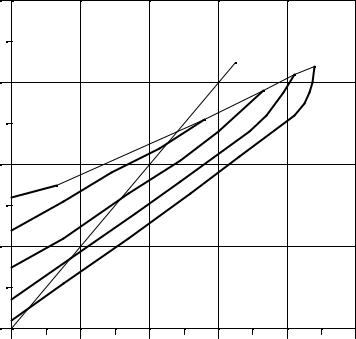
level of plutonium protection both in fuel and in feed. The line "S" that connects the right ends of the curves shown in Fig. 6.12 may be regarded as an "ultimate option" of the (Np-U-Pu) NFC considered here. The points of this line correspond to particular option of the (Np-U-Pu)
NFC where 238U is absent in fuel composition, and its fertile functions passed to 238Pu and 237Np.
|
80.00 |
|
|
|
|
|
|
|
|
|
B |
20% |
|
|
60.00 |
|
|
|
40% |
|
% |
|
|
|
60% |
|
|
fuel, |
|
|
|
|
|
|
|
|
S |
|
0% Np-237 |
|
|
in |
|
|
|
|
||
% |
40.00 |
80% |
|
|
|
|
fuel, |
|
|
|
|
|
|
|
|
|
|
|
|
|
238/Pu)- |
|
|
|
|
|
|
in |
|
|
|
|
|
|
(Pu |
|
|
|
|
|
|
Pu-238/Pu |
20.00 |
|
|
|
|
|
|
|
|
|
|
|
|
|
0.00 |
|
|
|
|
|
|
0.00 |
20.00 |
40.00 |
60.00 |
80.00 |
100.00 |
(Pu-238/PuPu) in feed, %
Puin feed, %
Fig. 6.12. Proliferation protection of plutonium in fuel as function of proliferation protection of plutonium in feed
and 237Np content in "feed" part of fuel.
So, this NFC may be called as a (Np-Pu) NFC. In this NFC the highest fuel Pu protection level (65% 238Pu) can be reached with feed Pu
198
protection of 90% 238Pu. As known, the IAEA safeguards are not applied to plutonium containing 80% 238Pu or more.
Inherent heat generation of plutonium is considered as a significant factor of its protection. The rates of inherent heat generation for various feed compositions are presented in Table 6.5. Here, the rates of specific heat generation for weapons-grade plutonium (WG-Pu) and reactorgrade plutonium (RG-Pu) are presented as well.
Table 6.5
Decay heat generation q(Pu)
and generation of spontaneous fission neutrons nsf(Pu)
in LWR fuel with equal plutonium protection both in fuel and in feed
Plutonium parameters |
|
238Pu/Pu in fuel and in feed |
|||
|
Np/(Np + Pu) in feed |
||||
|
|
|
|||
|
WG- |
RG- |
17% |
33% |
44% |
|
Pu |
Pu |
(7%) |
(15%) |
(19%) |
q(Pu), W/kg Pu |
2.3 |
13. |
97 |
186 |
248 |
nsf,(Pu), 106 n/s·kg Pu |
0.06 |
0.38 |
0.71 |
1.06 |
1.30 |
q (fuel), W/kg fuel |
--- |
--- |
14.9 |
41.2 |
99.5 |
nsf(fuel), |
--- |
--- |
0.11 |
0.24 |
0.53 |
106 n/s·kg fuel |
|||||
Feed composition |
|
|
38/ |
103/ |
176/ |
237Np/238Pu/239Pu, |
--- |
--- |
82/ |
194/ |
318/ |
kg/GWe·year |
|
|
402 |
377 |
421 |
Basing on the results shown above, it can be concluded that denatured fuel plutonium containing more than 25% 238Pu is characterized by the internal heat generation which exceeds that of RG-Pu by more than order of magnitude and, by the larger extent, that of WG-Pu. In addition, denatured fuel plutonium is characterized by the higher neutron background caused by spontaneous fissions. The factors mentioned above enhance plutonium protection against its utilization in NED. The same factors complicate, to certain degree, the handling procedures with such a fuel in nuclear technologies.
199
Values of specific heat generation and neutron emission due to spontaneous fission of the loaded MOX-fuel for the equilibrium cycle options analyzed are shown in Table 6.5 too. For comparison, "dry" technology for handling with spent fuel assemblies may be applied if specific heat generation does not exceed 20-35 W/kg fuel. It may be also concluded that plutonium denaturing with 238Pu is restricted by thermal constraints imposed on permissible specific heat generation of fuel.
The same tendency exists in connection with emission of spontaneous neutrons. These constraints need to be taken into account in fuel fabrication, fuel rods and fuel assemblies manufacturing and transport operations. These complications of fuel management may be considered as certain "payment" for proliferation resistance of MOX-fuel cycle.
Actually speaking, the protection of plutonium in (Np-U-Pu)-fuel cycle is supposed to be enhanced due to addition 237Np and 238Pu into
fuel. The degree of fissile nuclides protection depends mainly on magnitude of 238Pu fraction in plutonium.
Meanwhile, 237Np itself can be also considered as a potential material for NED. For example, critical mass of 237Np (metal sphere, steel reflector) is about 55 kg. It’s ten times more than that of 239Pu. The magnitude of critical mass of 237Np is sensitive with respect of its dilution. For example, minimum critical mass of NpO2 is as much as 315 kg. Besides, in fuel composition 237Np is present together with plutonium which is characterized by essential neutron source strength due to spontaneous fissions. Therefore, in order to apply extracted 237Np in NED it is needed to perform effective 237Np purification from plutonium (plutonium fraction is restricted by value of 10-4 - 10-3.
6.4.4. Proliferation resistance of denatured plutonium
Plutonium can be regarded as a proliferation-proof fissile material only if plutonium is quite unsuitable for manufacturing and military application of even crude and low efficient NED.
As it was already mentioned above, introduction of 238Pu into plutonium isotope composition can provide proliferation protection of the denatured plutonium. Ability of 238Pu to provide a reliable proliferation protection is mainly caused by intense heat generation rate that can warm the plutonium charge in the implosive NED up to unacceptably
200