Материал: Крючков Фундаменталс оф Нуцлеар Материалс Пхысицал Протецтион 2011
Внимание! Если размещение файла нарушает Ваши авторские права, то обязательно сообщите нам

Zoning helps establish a defense-in-depth system to detect the intruder’s attempts to defeat separate barriers (area boundaries) and predict the intruder’s movement path and targets (Fig. 5.1, b).

In addition, zoning makes it possible to differentiate personnel access into some areas and, additionally, be fully aware (with an accuracy up to an area) of where the NI personnel are (Fig. 5.1, c).

Adequacy of the PPS to assumed potential threats and models of potential intruders.

The concept of the PPS adequacy to threats relates to the necessity of having the PPS “tuned” exactly to the threats assum ed. Where the system is designed to deal with a milder potential threat, no protection will be ensured. Where, contrarily, the PPS is redundant (just in case), excessive capital and operating costs may be involved.

The PPS structure, composition and operation so depend on the potential threats and potential intruder models assumed.

We shall introduce some of the terms and definitions used in the field. Threat - a potential of an act of sabotage or an NM theft.

External threat - a threat coming from an external attacker. Internal threat - a threat coming from an insider.

Attacker model - a combination of qualitative and quantitative characteristics of an intruder used to analyze the resistance to sabotage, formulation of requirements to the PPS and appraisal of the PPS efficiency.

External attacker – an attacker out of the number o f persons without the right of access to the protected area.

Insider – an attacker with the right of unescorted access to the protected area.

Examples of major threats to an NI are:

∙a theft of NM or NM-based items;

∙sabotage at a nuclear facility (NF) or within an NM storage facility;

∙a terrorist act;

∙nuclear blackmail.

As an act of nuclear blackmail requires the intruders to seize NM or the NF’s key components, protection against this threat is reduced to ensuring physical protection against the two first types of threats.

Now we shall look at major intruder types as the “b earers” of the above threats.

The classification of intruders is given in Fig. 5.2.

Further we need to build models of potential intruders which can be divided into “macromodels” and “micromodels”.

451


Intruder


Conspiracy


External intruders


Insider


Group of intruders


Auxiliary

personnel


acting by force


with limited

access to


guarded areas


Single intruder with no


Key personnel with the

right of access to the


right of access to

installation


vulnerable points


Guard personnel with


limited access to


guarded areas


Fig. 5.2. Classification of intruders

A macromodel contains the following data:

∙intruder type;

∙anticipated act;

∙target;

∙number of intruders (where there is more than one intruder);

∙awareness;

∙preparedness;

∙equipment, if any;

∙weapons.

A micromodel contains the following data:

∙techniques to defeat physical barriers and detections sensors (DS);

∙speed of movement within the DS detection area;

∙appliances at hand, if any;

∙dedicated facilities intended, e.g., to disable DSs, if any.

Macromodels are used primarily to conceptualize the PPS design in general, while micromodels help formulate requirements, say, to the detection sensors and physical barriers on the perimeter, in local areas, within buildings and rooms, etc.

Practically, an intruder model for a particular NI is formed for the installation after its vulnerability is analyzed by filling in respective questionnaire forms.

452
Of note is that the intruder model should be revised on a regular basis. The reason for this may be a change in the political situation in the country or in the region or an onsite change (redeployment, relocation of NM, a change in the NI infrastructure and so on).

Timely countermeasures.

Timelines of countermeasures is defined by the fact that, whatever is the scenario under consideration, the relation Тi ³ Тrf is to be fulfilled, where Тi is the time required by the intruder to accomplish his objective and Тrf is the time needed by the response force to suppress the said action in response to alarms from respective facilities.

Balanced strength of the PPI protection given the PPI value (attractiveness), potential consequences of unauthorized activities and the potential of any scenarios to be realized by the attacker.

The definition is absolutely clear so no comments on this are needed.

Adaptivity.

This suggests the PPS capability to adapt to changes in:

·threats and intruder models;

·the installation’s layout and the boundaries of the guarded areas;

·locations of physically protected items;

·types and techniques of guarding;

·seasonal and climatic conditions.

Frequency of performance monitoring. Continuous monitoring serves the purpose of detecting any deviations from onsite routine, e.g. supervision as to correctness of the procedure performance by the PPS personnel. Because of large amounts of information that circulates in the PPS, current PPSs cannot do without automation of the monitoring process.

Physical protection is monitored at the agency level and at the level of the NI as such (self-monitoring).

General technical concept of the PPS design suggests ensuring reliability, survivability and unification of the PPS components, mutual compatibility thereof and so on. This is typical of many complex manmachine systems.

References

1. Измайлов А.В. Методы проектирования и анализа эффективности систем физической защиты ядерных материалов и установок. М.: МИФИ, 2002.

453

CHAPTER 6

PPS CREATION (PERFECTION) PROCESS. STAGES AND

PHASES

The lifecycle of the physical protection system for a nuclear installation involves the creation of the PPS and support of its onsite operations. If we deal not with an installation under design but with an active installation where the PPS already exists, it makes more sense to talk about perfection rather than creation of the PPS.

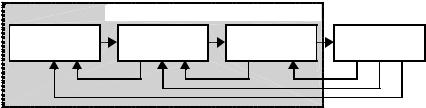
The PPS lifecycle stages are shown in Fig. 6.1. The “feedbacks” between stages reflect the need for the work to be redone given a variety of factors (changes in threats, intruder models, site layout, locations and compositions of physically protected items, constraints on the feasibility of proposed decisions, etc.).

Создание (совершенствование) СФЗ

PPS creation (perfection)

Предпроектная


ВводPPSСФЗ в


Функционирование

Predesign


Проектирование


PPS

стадия


действие


СФЗ


Design


commissioning


operation

Fig. 6.1. Lifecycle of a physical protection system.

The PPS creation (perfection) process comprises the followings stages:

∙predesign;

∙design;

∙PPS commissioning.

The predesign stage includes the following phases:

∙NI vulnerability analysis, including analysis of threats and potential attacker models;

∙categorization of physically protected items (PPI), including nuclear material and critical components of nuclear facilities;

∙performance assessment of the existing PPS;

∙conceptual design of the PPS;

∙feasibility study, including prioritization of investments, crediting, etc.;

454

∙development of technical specifications for the PPS creation (perfection), including individual technical specifications for technical subsystems.

The design stage includes:

∙design of engineered physical protection features (EPPF);

∙development of engineering documentation for EPPFs;

∙development of organizational and technical documentation.

∙The PPS commissioning stage includes:

∙order placement for and supply of equipment (under design documentation);

∙construction and erection;

∙startup;

∙development of operating documentation;

∙run-up;

∙training of the PPS personnel;

∙development of required site-level regulations;

∙initial tests of engineered physical protection features (EPPF);

∙pilot operation of the PPS;

∙acceptance tests of the PPS;

∙acceptance of the PPS.

A note should be made that the design and commissioning stages are fairly standard and typical of many PPS-like complex systems, while predesign takes into account the specific features of the physical protection system.

The work to create (perfect) the PPS for an NI begins with the installation vulnerability analysis. The items to be subject to physical protection1 (PPI) and the potential intruder models for each PPI are identified at this stage.

The PPIs are then categorized and the NI PPS efficiency is assessed (actual physical protection status for active installations) given the PPI categorization results and other factors. Weaknesses in the PPS are identified.

Proposals are further developed on removing the detected weaknesses and raise so the security status of nuclear material. These proposals are concerned with the structure and composition of engineered physical protection features (types and arrangement of detection sensors, situation

1 The NI vulnerability analysis and the PPS efficiency assessment are discussed in more details in the chapters that follow.

455

Источник: https://studfile.net/preview/16708779/
