Материал: part17

Внимание! Если размещение файла нарушает Ваши авторские права, то обязательно сообщите нам

DICOM PS3.17 2020a - Explanatory Information​

Page 331​

JJSurfaceMeshRepresentation(Informative)​

For a general introduction into the underlying principles used in the Section C.27.1 “Surface Mesh Module” in PS3.3 see:​

Foley & van Dam [et al], Computer Graphics: Principles and Practice, Second Edition, Addison-Wesley, 1990.​

JJ.1 Multi-Dimensional Vectors​

The dimensionality of the Vectors Macro (Section C.27.3 in PS3.3) is not restricted to accommodate broader use of this macro in the​ future. Usage beyond 3-dimensional Euclidean geometry is possible The Vectors Macro may be used to represent any multi-dimen-​ sional numerical entity, like a set of parameters that are assigned to a voxel in an image or a primitive in a surface mesh.​

Examples:​

In electroanatomical mapping, one or more tracked catheters are used to sample the electrophysiological parameters of the inner​ surface of the heart. Using magnetic tracking information, a set of vertices is generated according to the positions the catheter was​ moved to during the examination. In addition to its 3D spatial position each vertex is loaded with a 7D-Vector containing the time it​ was measured at, the direction the catheter pointed to, the maximal potential measured in that point, the duration of that potential​ and the point in time (relative to the heart cycle) the potential was measured.​

For biomechanical simulation the mechanical properties of a vertex or voxel can be represented with a n-dimensional vector.​

JJ.2 Encoding Examples​

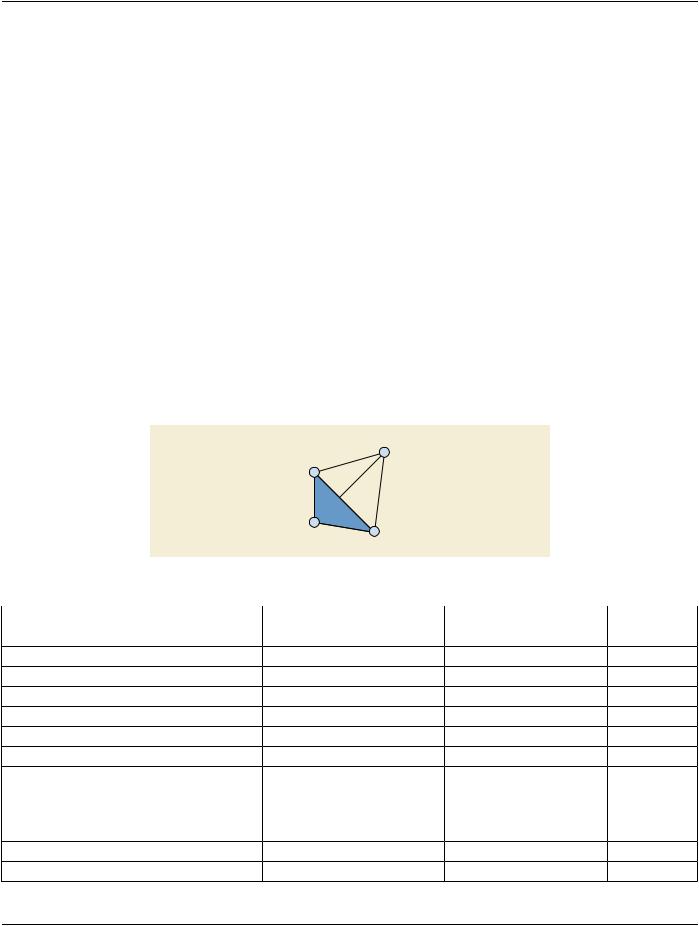
The following example demonstrates the usage of the Surface Mesh Module for a tetrahedron.​

d

a

b

c

Figure JJ.2-1. Surface Mesh Tetrahedron​

Name​

Tag​

Value​

Comment​

Number of Surfaces​

(0066,0001)​

1​


Surface Sequence​

(0066,0002)​


>Surface Number​

(0066,0003)​

1​


>Surface Comments​

(0066,0004)​

Test Surface​


>Surface Processing​

(0066,0009)​

YES​


>Surface Processing Ratio​

(0066,000A)​

1.0​


>Surface Processing Description​

(0066,000B)​

Moved Object​


>Surface Processing Algorithm Identification​

(0066,0035)​


Sequence​


>>Algorithm Family Code Sequence​

(0066,002F)​


>>>Code Value​

(0008,0100)​

123109​


>>>Coding Scheme Designator​

(0008,0102)​

DCM​


>>>Code Meaning​

(0008,0104)​

Manual Processing​


- Standard -​

Page 332​

DICOM PS3.17 2020a - Explanatory Information​

Name​

Tag​

Value​

>>Algorithm Name Code Sequence​

(0066,0030)​


>>>Code Value​

(0008,0100)​

AA01​

>>>Coding Scheme Designator​

(0008,0102)​

ICCAS​

>>>Code Meaning​

(0008,0104)​

Interactive Shift​

>>Algorithm Name​

(0066,0036)​

Interactive Shift​

>>Algorithm Version​

(0066,0031)​

"V1.0"​

>>Algorithm Parameters​

(0066,0032)​

"x = 5 y = 1 z = 0"​

>Recommended Display Grayscale Value​

(0062,000C)​

FFFFH​

>Recommended Display CIELab Value​

(0062,000D)​

FFFF\8080\8080​

>Recommended Presentation Opacity​

(0066,000C)​

1.0​

>Recommended Presentation Type​

(0066,000D)​

SURFACE​

>Finite Volume​

(0066,000E)​

YES​

>Manifold​

(0066,0010)​

YES​

>Surface Points Sequence​

(0066,0011)​


>>Number Of Surface Points​

(0066,0015)​

4​

>>Point Coordinates Data​

(0066,0016)​

-5.\-3.727\-4.757\​


5.\-3.707\-4.757\​


0.\7.454\-4.757\​

Comment​

4 triplets. The​ points are​ marked a,b,c,d​ inFigureJJ.2-1.​


0.\0.\8.315​


>>Point Position Accuracy​

(0066,0017)​

0.001\0.001\0.001​


>>Mean Point Distance​

(0066,0018)​

10.0​


>>Maximum Point Distance​

(0066,0019)​

10.0​


>>Points Bounding Box Coordinates​

(0066,001A)​

-5.\-3.727\-4.757\​

2 triplets​


5.\7.454\8.315​


>>Axis of Rotation​

(0066,001B)​

0.0\0.0\1.0​


>>Center of Rotation​

(0066,001C)​

0.0\0.0\0.0​


>Surface Points Normals Sequence​

(0066,0012)​

<empty>​


>Surface Mesh Primitives Sequence​

(0066,0013)​


>>Vertex Point Index List​

(0066,0025)​

<empty>​


>>Edge Point Index List​

(0066,0024)​

<empty>​


>>Triangle Point Index List​

(0066,0023)​

1\3\2\1\2\4\2\3\4\3\1\4​

The second​


triangle is the​


one marked​


green in​


Figure JJ.2-1.​

>>Triangle Strip Sequence​

(0066,0026)​

<empty>​


>>Triangle Fan Sequence​

(0066,0027)​

<empty>​


>>Line Sequence​

(0066,0028)​

<empty>​


>>Facet Sequence​

(0066,0034)​

<empty>​


Note​

When the actual values are binary a text string is shown.​

- Standard -​

DICOM PS3.17 2020a - Explanatory Information​

Page 333​

KK Use Cases For The Composite Instance​ Root Retrieval Classes (Informative)​

The use cases fall into five broad groups:​

KK.1 Clinical Review​

KK.1.1 Retrieval Based On Report References​

AreferringphysicianreceivesradiologicaldiagnosticreportsonCTorMRIexaminations.Thesereportscontainreferencestospecific​ images. He chooses to review these specific images himself and/or show the patient. The references in the report point to particular​ slices. If the slices are individual images, then they may be obtained individually. If the slices are part of an enhanced multi-frame​ CT/MRobject,thenretrievalofthewholemulti-frameobjectmighttaketoolong.TheCompositeInstanceRootRetrieveServiceallows​ retrieval of only the selected frames.​

The source of the image and frame references in the report could be KOS, CDA, SR, presentation states or other sources.​

Selective retrieval can also be used to retrieve 2 or more arbitrary frames, as may be used for digital subtraction (masking), and may​ be used with any multi-frame objects, including multi-frame ultrasound, XR etc.​

Features of interest in many long "video" examinations (e.g., endoscopy) are commonly referenced as times from the start of the ex-​ amination. The same benefits of reduced WAN bandwidth use could be obtained by shortening the MPEG-2, MPEG-4 AVC/H.264,​ HEVC/H.265 or JPEG 2000 Part 2 Multi-component based stream prior to transmission.​

KK.1.2 Selective Retrieval Without References to Specific Slices​

Retrieval using the Composite Instance Retrieve Without Bulk Data Retrieve Service allows determination and retrieval of a suitable​ subset of frames. This could for instance be used to retrieve only the slices with particular imaging characteristics (e.g., T2 weighting​ from an enhanced MR object).​

KK.2 Local Use - "Relevant Priors"​

KK.2.1 Anatomic Sub-region​

A multi-frame CT or MR may cover a larger area of anatomy than is required for use as a relevant prior. How the SCU determines​ which frames are relevant is outside the scope of the Standard.​

KK.2.2 Worklists​

Relevant priors may be specified by instance and frame references in a worklist and benefit from the same facilities.​

KK.3 Attribute Based Retrieval​

There are times when it would be useful to retrieve from a Multi-frame Image only those frames satisfying certain dimensionality cri-​ teria, such as those CT slices fitting within a chosen volume. Initial retrieval of the image using the Composite Instance Retrieve​ Without Bulk Data Retrieve Service allows determination and retrieval of a suitable sub-set of frames.​

KK.4 CAD & Data Mining Applications​

Given the massively enhanced amount of dimensional information in the new CT/MR objects, applications could be developed that​ would use this for statistical purposes without needing to fetch the whole (correspondingly large) pixel data. The Composite Instance​ Retrieve Without Bulk Data Retrieve Service permits this.​

- Standard -​

Page 334​

DICOM PS3.17 2020a - Explanatory Information​

KK.5 Independent WADO Server​

A hospital has a large PACS (that supports multi-frame objects) that does not support WADO. The hospital installs a separate WADO​ server that obtains images from the PACS using DICOM. WADO has the means to request individual frames, supporting many of the​ above use cases.​

- Standard -​

DICOM PS3.17 2020a - Explanatory Information​

Page 335​

LL Example SCU Use of The Composite​

InstanceRootRetrievalClasses(Informative)​

LL.1 Retrieval of Entire Composite Instances​

There are many modules in DICOM that use the Image SOP Instance Reference Macro (Table 10-3 “Image SOP Instance Reference​ Macro Attributes” in PS3.3), which includes the SOP Instance UID and SOP class UID, but not the Series Instance UID and Study​ InstanceUID.UsingtheCompositeInstanceRootRetrievalClasseshowever,retrievalofsuchinstancesissimple,asadirectretrieval​ may be requested, including only the SOP Instance UID in the Identifier of the C-GET request.​

LL.2RetrievalofSelectedFrameCompositeInstancesFromMulti-frameObjects​

Where the frames to be retrieved and viewed are known in advance, - e.g., when they are referenced by an Image Reference Macro​ in a structured report, then they may be retrieved directly using either of the Composite Instance Root Retrieval Classes.​

LL.3 Retrieval of Selected Frame Composite Instances From MPEG-2, MPEG-4​ AVC/H.264 or HEVC/H.265 Video​

If the image has been stored in MPEG-2, MPEG-4 AVC/H.264 or HEVC/H.265 format, and if the SCU has knowledge independent​ of DICOM as to which section of a "video" is required for viewing (e.g., perhaps notes from an endoscopy) then the SCU can perform​ the following steps:​

1.​Use known configuration information to identify the available transfer syntaxes.​

2.​If MPEG-2, MPEG-4 AVC/H.264, HEVC/H.265 or JPEG 2000 Part 2 Multi-component transfer syntaxes are available, then issue​ a request to retrieve the required section.​

The data received may be slightly longer than that requested, depending on the position of key frames in the data.​

3.​If only other transfer syntaxes are available, then the SCU may need to retrieve most of the object using Composite Instance​ RetrieveWithoutBulkDataRetrieveServicetofindtheframerateorframetimevector,andthencalculatealistofframestoretrieve​ as in the previous sections.​

- Standard -​

Источник: https://studfile.net/preview/14585770/