Материал: 2434

Science creates knowledge using two processes: by making observations, and by explaining the reason for those observations. Both processes are carried out by the same person; often, however, the observations have occurred long before a satisfactory explanation for them is thought up.
Hypotheses follow directly from research questions (from narrowing down the RQ into something that can be empirically tested). A hypothesis is a statement about the expected relationship between two or more variables, and the expected outcomes of the results. This statement predicts a priori what will be the answer to the RQ, based on theory developed by related previous findings.
A hypothesis is a tentative (as opposed to a theory which is well tested) explanation for observed events. A hypothesis must allow you to make predictions which can be tested by experiment. When the results of those experiments are as predicted, it lends support to the hypothesis as a good explanation, and its eventual acceptance as a theory. If the results are not as predicted, the hypothesis must be modified, or replaced with a better explanation. No statement is a hypothesis unless it suggests a cause for an effect, and unless it has the possibility of being wrong.
Hypotheses are rarely (if ever) "eternal". In other words, even a hypothesis that is proven true may be displaced by the next set of research on a similar topic, whether that research appears a month or a hundred years later.
B. Which of the following statements about hypothesis are true/false?
1.It lets us make predictions that can be experimentally tested.
2.Like a theory, it may be revised.
3.When it is well established it will become a scientific law.
4.It suggests a cause-effect relationship to explain why some event occurs.

 Identify the hypothesis: match each statement (A, B, C) and research steps (1 3).
1. Study background information
A. How does the spacО ОЧЯТrШЧЦОЧt КППОМt ПruТt ПХТОs’ immune systems? Since immune suppression leads to increased bacterial infections, fruit flies exposed to the space environment will be more susceptible to bacterial infections than fruit flies not exposed to the space environment.
78

2. State the re- |
B. If I wanted to keep astronauts safe on long trips in |
search problem |
spКМО, I аШuХН rОЯТОа tСО rОsОКrМС tСКt NASA’s ХТПО |
|
scientists have already done. I would find that the |
|
immune system is affected in astronauts and that it is |
|
often studied in smaller animals like fruit flies. |
3. Make a hy- |
C. HШа НШОs tСО spКМО ОЧЯТrШЧЦОЧt КППОМt ПruТt ПХТОs’ |
pothesis |
immune systems? |

 Here are examples of hypotheses. Pick out the variables related in these statements and expected outcomes. First, read the information from the box.
Formalized hypotheses contain two variables. One is "independent" and the other is "dependent." The independent variable is the one you control and the dependent variable is the one that you observe and/or measure the results.
e.g. If skin cancer (dependent variable) is related to ultraviolet light (independent variable), then people with a high exposure to UV light will have a higher frequency of skin cancer (outcome).
1.If the size of the molecules is related to the rate of diffusion as they pass through a membrane, then smaller molecules will flow through at a higher rate.
2.If there is a relation between the wave length of light and the photosynthesis rate, then light of different colors will cause the plant to make different amounts of oxygen.
3.There is a positive correlation between the availability of hours for work and the productivity of employees.
4.If leaf color change is related to temperature, then exposing plants to low temperatures will result in changes in leaf color.
5.The higher the industry competitiveness, the higher the internal R&D investments of companies in that respective industry.

 Summarize the passage about hypotheses in one statement.
One of the cool things about science is that other scientists can learn things from what has already been established. They don't have to go out
and test everything again and again. That's what makes science special: it builds on what has been learned before. АСКt вШu “tСТЧФ” аТХХ СКppОЧ, ШП
79

course, should be based on your preliminary research and your understand-
ing of the science and scientific principles involved in your proposed experТЦОЧt Шr stuНв. IЧ ШtСОr аШrНs, вШu НШЧ't sТЦpХв “РuОss”. ВШu'rО ЧШt
taking a shot in the dark. You're not pulling your statement out of thin air. Instead, you make КЧ “ОНuМКtОН РuОss” based on what you already know and what you have already learned from your research.
|
Look at the requirements a good hypothesis should satisfy and |
|
explain: a) what they mean; b) why experts consider the state- |
|
ments in the table to be good or poor hypotheses. |
|
A good hypothesis is: |
simple; |
|
|
describing a general, not a particular occurrence; |
|
verifiable/verifiable; |
|
empirically testable; |
|
clearly stating the relationship between the defined variables. |
Good Hypothesis |
Poor Hypothesis |
1. When there is less oxygen in the |
1. Our universe is surrounded by |
water, rainbow trout suffer more |
another, larger universe, with |
lice. |
which we can have absolutely no |
|
contact. |
2. Aphid-infected plants that are |
2. Ladybugs are a good natural |
exposed to ladybugs will have few- |
pesticide for treating aphid infected |
er aphids after a week than aphid- |
plants. |
infected plants which are left un- |
|
treated. |
|

 Develop hypotheses out of these predictions by formalizing them (include variables and outcomes).
1.Salt in soil may affect plant growth.
2.Temperature may cause leaves to change color.
3.Trees will change color when it gets cold.

 Say if the statements below are: a) empirically testable; b) verifyable / falsifiable. Can you make a conclusion if they can be scientific hypotheses?
80
1.There are other inhabited planets in the universe.
2.Any two objects dropped from the same height above the surface of the earth will hit the ground at the same time, as long as air resistance is not a factor.


 First, write down the hypothesis related to your research. Then discuss it with your group. Try to consider the questions below.
Is your hypothesis testable, falsifiable? What variables does it include?
Is it related to the research problem?


 Say, what is a scientific experiment, why scientists perform expОrimОnts. CompКrО вour iНОКs аitС tСosО ЛОloа. WСКt СКvОn’t
An experiment is a planned way to test a hypothesis and find out the an-swer to the problem statement.
An experiment is a way to collect data and determine the value of thedependent variable.
An experiment compares the independent variable to the dependent vari-able.
Typically, an experiment is constructed to explain some kind of causation. The basic principle of causality is determining whether the results and trends seen in an experiment are actually caused by the manipulation orwhether some other factor may underlie the process.
An experiment is a study in which the researcher manipulates the level of some independent variable and then measures the outcome. Experiments are powerful techniques for evaluating cause-and-effect relationships. Many researchers consider experiments the "gold standard" against which all other research designs should be judged.


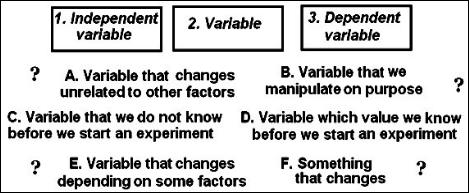
 A. Match the words related to the experiment (1 3) and their descriptions (A F).
81
B. Case study: scan the abstracts of PhD theses and pick out variables under investigation.
Sample 1
Social Entrepreneurship and Innovation:
A Case Study on International Awards
The objective of this dissertation is to explore the relationship between innovation and social entrepreneurship, to investigate the ways in which social entrepreneurship can be innovative, and to understand how such innovativeness can be evaluated. In order to complete the research objectives, six international awards of social entrepreneurship have been investigated. A representative of each organization has been interviewed and organizational documents have been researched. The findings show a strong connection between innovation and social entrepreneurship, a relationship that can be considered inherent to the concept of social entrepreneurship. The most common types of innovations among social entrepreneurs are found to be (1) the use and reuse of existing assets of marginalized groups, (2) the provision of tailor made service packages to the ones in need, (3) business model innovation, (4) incremental technological innovation and (5) the opening of new markets. Social entrepreneurs can be labeled as creative imitators and constant innovators. The most widespread system of assessment among the investigated organizations regarding the evaluation of the relative innovativeness of social entrepreneurship is the utilization of experts. These findings shed light on the topic of social entrepreneurship which, in spite of the interest demonstrated by scholars in the topic, is still in its infancy where research is concerned.
82