Материал: Oxford American Handbook of Urology ( PDFDrive )
512 CHAPTER 13 Neuropathic bladder
Sacral neuromodulation
Sacral and nonsacral neuromodulation using the InterStim can be attempted in cases of detrusor hyperactivity (see p. 528).
Bladder augmentation
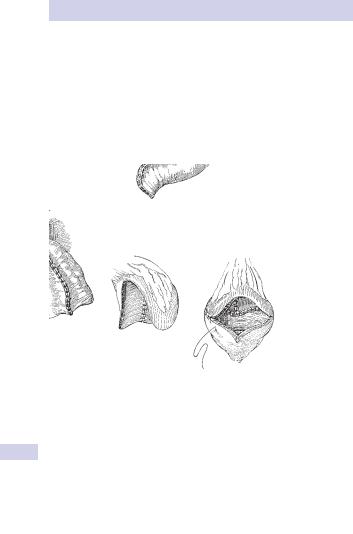
This technique involves increasing bladder volume to lower pressure by implanting detubularized small bowel into the bivalved bladder (“clam” ileocystoplasty) (Fig. 13.2) or by removing a disc of muscle from the dome of the bladder (autoaugmentation or detrusor myectomy) and allowing the mucosa to balloon outward.
25–30 cm
A
B
Figure 13.2 A “clam” ileocystoplasty. This figure was published in McAninch JW,
Traumatic and Reconstructive Urology, p. 2287. Copyright Elsevier 1996.
BLADDER MANAGEMENT TECHNIQUES 513
An autologous tissue-engineered bladder substitute for autoaugmentation is under study.4
Indications include refractory incontinence and hydronephrosis.
Urinary diversion
In the most extreme cases, permanent urinary diversion may be necessary.
•Cystectomy with continent urinary reservoir
•Ileal or colon pouch; continent catheterizable stoma (appendix or tapered ileum) on abdomen
•Cystectomy with ileal conduit
Deafferentation
This involves division of dorsal spinal nerve roots of S2–4 (sacral rhizotomy) to convert the hyperreflexic, high-pressure bladder into an areflexic, low-pressure one. Deafferentation can be used when the hyperreflexic bladder is the cause of incontinence or hydronephrosis.
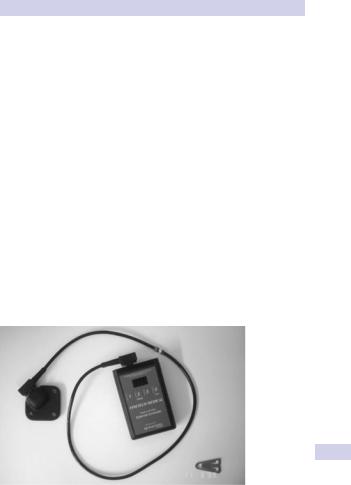
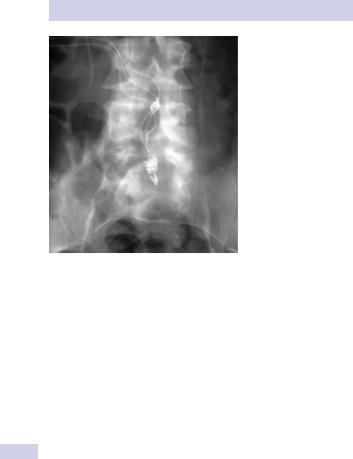
Bladder emptying can subsequently be achieved by ISC or implantation of a nerve stimulator placed on ventral roots (efferent nerves) of S2–4 to drive micturition when the patient wants to void (a pager-sized externally applied radio transmitter activates micturition) (Figs. 13.3 and 13.4).
This technique is also useful for DSD/incomplete bladder emptying causing recurrent UTIs and retention.
Figure 13.3 A sacral anterior root stimulator, used to drive micturition following a deafferentation (external components).
4 Atala A, Bauer SB, Soker S, Yoo JJ, Retik AB (2006). Tissue-engineered autologous bladders for patients needing cystoplasty. Lancet 367(9518):1241–1246.
514 CHAPTER 13 Neuropathic bladder
Figure 13.4 KUB X-ray showing the sacral electrodes positioned on the ventral roots of S2, 3, and 4.
This page intentionally left blank

516 CHAPTER 13 Neuropathic bladder
Catheters and sheaths and the neuropathic patient
Many patients manage their bladders by intermittent catheterization (IC) done by themselves (intermittent self-catheterization, ISC) or by a caregiver if their hand function is inadequate, as is the case with most tetraplegics. Many others manage their bladders with an indwelling catheter (urethral or suprapubic). Both methods can be effective for managing incontinence, recurrent UTIs, and bladder outlet obstruction causing hydronephrosis.
Intermittent catheterization
IC requires adequate hand function. The technique is a clean one (simple handwashing prior to catheterization) rather than a sterile one.
Gel-coated catheters become slippery when in contact with water, thus providing lubrication. IC is usually done every 3–4 hours.
Problems
•Recurrent UTIs
•Recurrent incontinence: check technique (adequate drainage of last few drops of urine). Suggest increasing frequency of ISC to minimize volume of urine in the bladder (reduces bacterial colonization and minimizes bladder pressure). If incontinence persists, consider intravesical botulinum toxin.
Long-term catheterization
Some patients and clinicians prefer the convenience of a long-term catheter. Others regard it properly as a last resort when other methods of bladder drainage have failed.
The suprapubic route (suprapubic catheter [SPC]) is preferred over the urethral because of pressure necrosis of the ventral surface of the distal penile urethra in men (acquired hypospadias—“kippering” of the penis) and pressure necrosis of the bladder neck in women, which becomes so wide that urine leaks around the catheter (“patulous” urethra) or frequent expulsion of the catheter occurs with the balloon inflated.
Problems and complications of long-term catheters
Recurrent UTIs: colonization with bacteria provides a potential source of recurrent infection.
Catheter blockages are common due to encrustation of the lumen of the catheter with bacterial biofilm. Proteus mirabilis, Morganella, and Providencia species secrete a polysaccharide matrix. Within this, ureaseproducing bacteria generate ammonia from nitrogen in urine, raising the urine pH and precipitating magnesium and calcium phosphate crystals. The matrix–crystal complex blocks the catheter.