Материал: Oxford American Handbook of Urology ( PDFDrive )

CATHETERS AND SHEATHS AND THE NEUROPATHIC PATIENT 517
Bladder distension can cause autonomic dysreflexia. Regular bladder washouts and increased catheter size sometimes help. Impregnation of catheters with silver alloy particles can reduce the incidence of infection.1
Bladder stones develop in 1 in 4 patients over 5 years.
Chronic inflammation (from bladder stones, recurrent UTIs, long-term catheterization) may increase the risk of squamous cell carcinoma in SCI patients. Some studies report a higher incidence of bladder cancer (whether chronically catheterized or not); others do not.2
Condom catheter sheaths
These are an externally worn urine collection device consisting of a tubular sheath applied over the glans and shaft of the penis (just like a contraceptive condom only without the lubrication to prevent it from slipping off). Sheaths are usually made of silicone rubber with a tube attached to the distal end to allow urine drainage into a leg bag.
They are used as a convenient way of preventing leakage of urine, but are obviously only suitable for men. Detachment of the condom sheath from the penis is prevented by use of adhesive gels and tapes.
They are used for patients with reflex voiding (where the hyperreflexic bladder spontaneously empties, and where bladder pressure between voids never reaches a high enough level to compromise kidney function).
They are also used as a urine collection device for patients after external sphincterotomy (for combined detrusor hyperreflexia and sphincter dyssynergia where incomplete bladder emptying leads to recurrent UTIs and/or hydronephrosis).
Problems
The principal problem experienced by some patients is sheath detachment. This can be a major problem and, in some cases, requires a complete change of bladder management.
Skin reactions sometimes occur.
1 Seymour C (2006). Audit of catheter-associated UTI using silver alloy-coated Foley catheters. Br J Nurs 15(11):598–603.
2 Subramonian K, et al. (2004) Bladder cancer in patients with spinal cord injuries. Br J Urol Int 93:739–43.

518 CHAPTER 13 Neuropathic bladder
Management of incontinence in the neuropathic patient
Causes
These include high-pressure bladder (detrusor hyperreflexia, reduced bladder compliance); sphincter weakness; UTI; bladder stones; and rarely, bladder cancer (ask about UTI symptoms and hematuria).
Hyperreflexic peripheral reflexes suggest that the bladder may be hyperreflexic (increased ankle jerk reflexes, S1–2 and a positive bulbocavernosus reflex indicating an intact sacral reflex arc—i.e., S2–4 intact).
Absent peripheral reflexes suggest that the bladder and sphincter may be areflexic (i.e., sphincter is unable to generate pressures adequate for maintaining continence).
Initial investigations
These include urine culture (for infection); KUB X-ray for bladder stones; bladder and renal ultrasound for residual urine volume and to detect hydronephrosis; cytology and cystoscopy if bladder cancer is suspected.
Empirical treatment
Start with simple treatments. If the bladder residual volume is large, regular ISC may lower bladder pressure and achieve continence. Try an anticholinergic drug (see p. 511).
Many SCI patients are already doing ISC and simply increasing ISC frequency to every 3–4 hours may achieve continence. ISC more frequently than every 3 hours is usually impractical, particularly for paraplegic women who usually have to transfer from their wheelchair onto a toilet and then back onto their wheelchair. See Table 13.1.
Management of failed empirical treatment
This is determined by cystometrogram, sphincter EMG, and VCUG to assess bladder and sphincter behavior.
Detrusor hyperreflexia or poor compliance
High-pressure sphincter (i.e., DSD)
Treating the high-pressure bladder is usually enough to achieve continence.
•Bladder treatments—intravesical botulinum toxin, detrusor myectomy (autoaugmentation), bladder augmentation (ileocystoplasty). All of these will usually require ISC for bladder emptying.
•Long-term suprapubic catheter
•Sacral deafferentation + ISC or Brindley implant (SARS—sacral anterior root stimulator)
Low-pressure sphincter
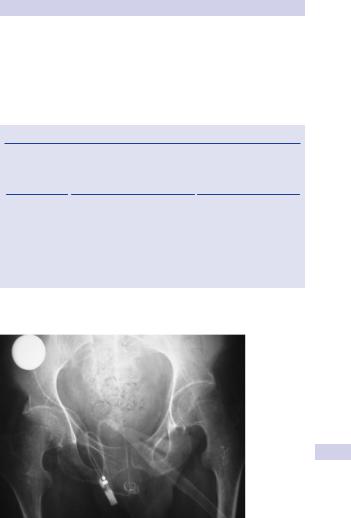
Treat the bladder first (as above). If bladder treatment alone fails, consider a urethral bulking agent, urethral sling procedure, or bladder neck closure in women (last resort) or an artificial urinary sphincter in either sex (Fig. 13.5).
MANAGEMENT OF INCONTINENCE 519
Detrusor areflexia + low pressure sphincter
•Urethral bulking agents
•URETHRAL SLING PROCEDURE
•Bladder neck closure in women
•Artificial urinary sphincter
Table 13.1 Summary of treatment for incontinence
|
High bladder pressure |
Low bladder pressure |
High sphincter |
Lower bladder pressure by |
ISC* |
pressure |
anticholinergics +/– ISC or |
|
|
botulinum toxin or augmentation |
|
Low sphincter |
Lower bladder pressure by |
Urethral bulking agent |
pressure |
(anticholinergics +/– or botulinum |
Urethral sling procedure |
|
toxin or augmentation) + |
Bladder neck closure |
|
urethral bulking agent, urethral |
(women only) |
|
sling procedure or bladder |
Artificial urinary |
|
neck closure or artificial urinary |
sphincter |
|
sphincter |
|
|
|
|
* High sphincter pressure is usually enough to keep the patient dry.
Figure 13.5 Artificial urinary sphincter implanted around the bulbar urethra.

520 CHAPTER 13 Neuropathic bladder
Management of recurrent urinary tract infections (UTIs) in the neuropathic patient
Causes of recurrent UTIs
•Incomplete bladder emptying
•Kidney stones including staghorn calculi
•Bladder stones
•Vesicourethral reflux
•Presence of an indwelling catheter (urethral or suprapubic)
History
What the spinal cord–injured patient interprets as a UTI may be different from the UTI in a noninjured patient. The neuropathic bladder is frequently colonized with bacteria and the urine often contains white blood cells (pyuria). From time to time, it becomes cloudy from precipitation of calcium, magnesium, and phosphate salts in the absence of active infection.
The presence of bacteria, pus cells, or cloudy urine in the presence of nonspecific symptoms (abdominal pain, tiredness, headaches, feeling under the weather) is often suggestive of a UTI.
Indications for treatment of UTI in the neuropathic patient
It is impossible to eradicate bacteria or pus cells from the urine in the presence of a foreign body (e.g., a catheter). In the absence of fever and cloudy, foul-smelling urine, we do not prescribe antibiotics; the indiscriminate use of these encourages growth of antibiotic-resistant organisms.
We prescribe antibiotics to the chronically catheterized patient when there is a combination of fever, cloudy, and foul-smelling urine, and when the patient feels unwell. Culture urine and immediately start empirical antibiotic therapy with a quinolone (such as ciprofloxacin based on local sensitivity patterns), changing to a more specific antibiotic if the organism is resistant to the prescribed one.
Investigations
For recurrent UTIs, such as frequent episodes of fever, cloudy, smelly urine, and feeling unwell, the following are helpful:
•KUB X-ray for kidney and bladder stones. Some consider this to be standard annual screening in patients with chronically indwelling catheters.
•Renal and bladder ultrasound to determine the presence or absence of hydronephrosis and to measure pre-void bladder volume and postvoid residual urine volume and to localize any stones.
Treatment
In the presence of fever and cloudy, foul-smelling urine, culture the urine and start antibiotics empirically (e.g., trimethoprim, amoxicillin, ciprofloxacin), changing the antibiotic if the culture result suggests resistance to

MANAGEMENT OF RECURRENT URINARY TRACT INFECTIONS 521
your empirical choice. Response to treatment is suggested by the patient feeling better and the urine clearing and becoming nonoffensive to smell.
Persistent fever, with constitutional symptoms (malaise, rigors) despite treatment with a specific oral antibiotic in an adequate dose is an indication for admission for treatment with intravenous antibiotics.
If the patient appears to have pyelonephritis or is manifesting signs of sepsis, hospitalization and empiric IV antibiotics (such as ampicillin and gentamicin or third-generation cephalosporin) is indicated with change to oral antibiotics when the patient is afebrile for 24 hours.
Management of recurrent UTIs (see Table 13.2)
If there is residual urine present, optimize bladder emptying by intermittent catheterization (males, females) or external sphincterotomy for DSD (males). Intermittent catheterization can be done by the patient (intermittent self-catheterization, ISC) if hand function is good (paraplegic), or by a caregiver if tetraplegic.
An indwelling catheter (IDC) is an option, but the presence of a foreign body in the bladder may itself cause recurrent UTIs (though in some it seems to reduce UTI frequency).
Table 13.2 Summary of treatment for recurrent UTI’s
Low bladder pressure |
High bladder pressure + DSD |
ISC |
ISC |
IDC |
IDC |
|
External sphincterotomy—surgical, botulinum |
|
toxin, sphincter stent |
|
Deafferentation/SARS |
|
|
Remove stones if present—cystolitholapaxy for bladder stones, PCNL for staghorn stones.