Материал: Oxford American Handbook of Urology ( PDFDrive )


598 CHAPTER 16 Urological surgery and equipment
Lasers in urological surgery
Lasers involve light amplification by stimulated emission of radiation. Photons are emitted when an atom is stimulated by an external energy
source, and its electrons having been so excited revert to their steady state. In a laser the light is coherent (all the photons are in phase with one another), collimated (the photons travel parallel to each other), and of the same wavelength (monochromatic). The light energy is thus concentrated, allowing delivery of high energy at a desired target.
The holmium:YAG (yttrium aluminum garnet) laser is currently the principal urological laser. It has a wavelength of 2140 nm and is highly absorbed by water and thus by tissues, which are composed mainly of water. The majority of the holmium laser energy is absorbed superficially, resulting in a superficial cutting or ablation effect. The depth of the thermal effect is no greater than 1 mm.
The holmium:YAG laser produces a cavitation bubble that generates only a weak shock wave as it expands and collapses. Holmium laser lithotripsy occurs primarily through a photothermal mechanism that causes stone vaporization.
Lasers used in BPH treatments are summarized in Chapter 3 in the section entitled “Invasive Surgical Alternatives to TURP” (p. 86).
Uses
•Laser lithotripsy (ureteric stones, small intrarenal stones, bladder stones)
•Resection of the prostate (holmium laser prostatectomy)
•Division of urethral strictures
•Division of ureteric strictures, including PUJO
•Ablation of small bladder, ureteric, and intrarenal TCCs
Advantages
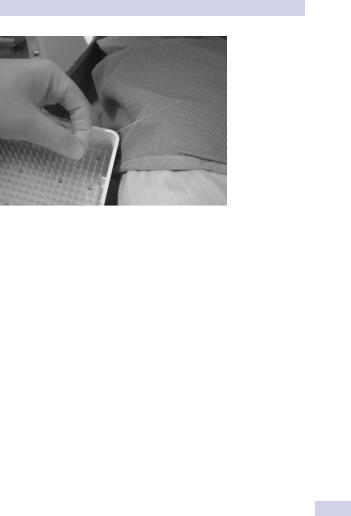
The holmium laser energy is delivered via a laser fiber (Fig. 16.12) that is thin enough to allow its use down a flexible instrument, without affecting the deflection of that instrument, and can therefore gain access to otherwise inaccessible parts of the kidney.
The zone of thermal injury adjacent to the tip of the laser fiber is limited to no more than 1 mm; the laser can safely be fired at a distance of 1 mm from the wall of the ureter.
A laser can be used for all stone types.
There is minimal stone migration effect because of minimal shock wave generation.
Disadvantages
•High cost
•Produces a dust cloud during stone fragmentation that temporarily obscures the view
•Can irreparably damage endoscopes if inadvertently fired near or within the scope
•Relatively slow stone fragmentation—the laser fiber must be “painted” over the surface of the stone to vaporize it.
LASERS IN UROLOGICAL SURGERY 599
Figure 16.12 Holmium laser fiber.


DIATHERMY 601
Diathermy burns
If current returns to earth through a small contact rather than the broad area of the earth pad, then the tissues through which the current passes will be heated just like those under the cutting loop. If the pad is making good contact, the current will find it easier to run to earth through the pad and no harm will arise, even when there is accidental contact with some metal object.
The real danger arises when the diathermy pad is not making good contact with the patient. It may not be plugged in, or its wire may be broken. Under these circumstances the current must find its way to earth somehow, and any contact may then become the site of a dangerous rise in temperature.
Pacemakers and diathermy
See Box 16.3 for diathermy problems and their prevention.