Материал: Oxford American Handbook of Urology ( PDFDrive )
588 CHAPTER 16 Urological surgery and equipment
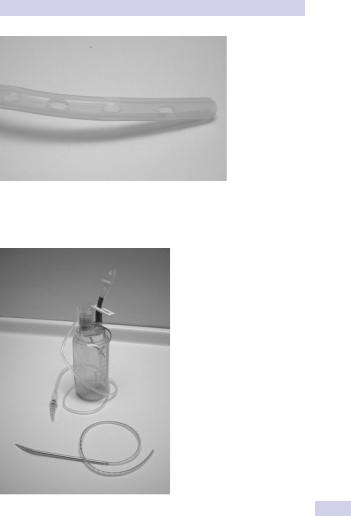
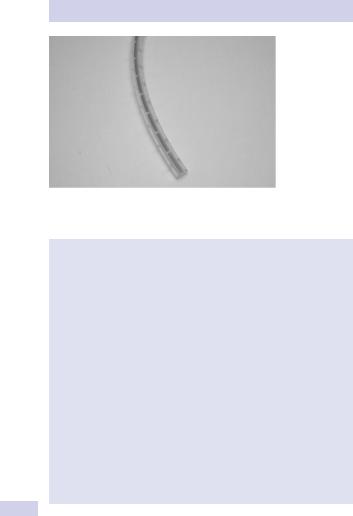
Figure 16.6 The eyeholes at the tip of the suction drain.
Box 16.2 Failure to deflate catheter balloon for removal of a urethral catheter
From time to time an inflated catheter balloon will not deflate when the time comes for removal of the catheter.
•Try inflating the balloon with air or water—this can dislodge an obstruction.
•Leave a 10 mL syringe firmly inserted in the balloon channel and come back an hour or so later.
•Try bursting the balloon by overinflation.
•Cut the end of the catheter off, proximal to the inflation valve—the valve may be stuck and the water may drain out of the balloon.
•In the female patient, introduce a needle alongside your finger into the vagina and burst the balloon by advancing the needle through the anterior vaginal and bladder wall.
•In male patients, balloon deflation with a needle can also be done under ultrasound guidance. Fill the bladder with saline using a bladder syringe so that the needle can be introduced percutaneously and directed toward the balloon of the catheter under ultrasound control.
•Pass a ureteroscope alongside the catheter and deflate the balloon with the rigid end of a guide wire or with a laser fiber (the end of which is sharp).
This page intentionally left blank

590 CHAPTER 16 Urological surgery and equipment
Guide wires
Guide wires are an essential tool for endourological procedures.
Uses
They are used as a track over which catheters or instruments can be passed into the ureter, collecting system of the kidney (retrograde or antegrade), or the bladder.
Types
Many different types of guide wire are available. They are classified according to their size, tip design, rigidity, and surface coating. These specific properties determine their use. All are radio-opaque so X-ray screening can be used to determine their position.
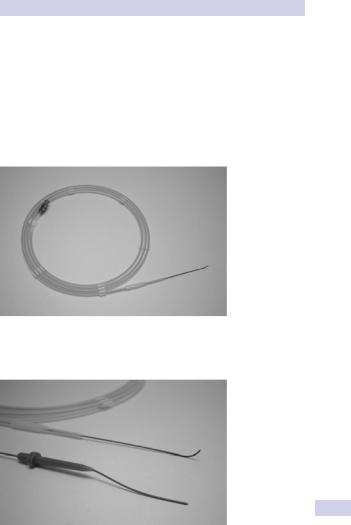
They come prepackaged in a coiled sheath to allow ease of handling and storage (Fig. 16.7).
Size
Size refers to diameter measured in inches (length is usually around 150 cm). The most common sizes are 0.035 inches and 0.038 inches. They are also available in 0.032 inches.
Tip design
The shape of the tip is either straight or angle (Fig. 16.8). A straight tip is usually adequate for most uses. Occasionally, an angle tip is useful for negotiating an impacted stone or for placing the guide wire in a specific position.
Similarly, a J-shaped tip can negotiate an impacted stone—the curved leading edge of this guide wire type can sometimes suddenly flick past the stone (in this situation, a straight guide wire can inadvertently perforate the ureter, thereby creating a false passage).
Surface coating
Most standard guide wires are coated with polytetrafluoroethylene (PTFE), which has a low coefficient of friction, thus allowing easy passage of the guide wire through the ureter and of instruments over them.
Some guide wires are coated with a polymer that when wet is very slippery (hydrophilic coating). In some cases, the entire length of the guide wire is so coated (e.g., Terumo Glidewire) and in others, just the tip (e.g., Sensor guide wire). The virtually friction-free surface of Glidewires makes them liable to slip out of the ureter, and they therefore make unreliable safety wires (they can be exchanged for a wire with greater friction via a ureteric catheter).
If allowed to become dry, these wires have a high coefficient of friction, which makes them difficult to manipulate.
Tip rigidity
The tip of all guide wires, over at least 3 cm, is soft and therefore flexible. This reduces—though does not completely remove—the risk of ureteric perforation.