Материал: Oxford American Handbook of Urology ( PDFDrive )

212 CHAPTER 6 Urological neoplasia
Prostate cancer grading
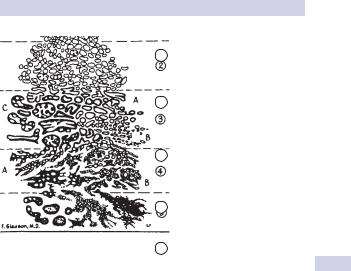
Adenocarcinoma of the prostate is graded using the Gleason system (see Fig. 6.4). Microscopically, adenocarcinoma is graded as a pattern 1 to 5 according to its gland-forming differentiation at relatively low magnification. Cytological features play no part in this grading system.
Since most are multifocal, an allowance is made by adding the two dominant grades to give a sum score between 2 and 10. If only one pattern is observed, the grade is simply doubled. The system is used with needle biopsies, TURP, and radical prostatectomy specimens.
Tertiary Gleason score is sometimes reported on radical prostatectomy specimens and represents the third-most prevalent grade present on the entire surgical specimen and may have prognostic significance if high grade.
Gleason scores 2–4 are considered well differentiated; 5–7 are moderately differentiated; and 8–10 are poorly differentiated. In practice, over 80% of PCs are graded 6 or 7, and, fortunately, only 15% are graded 8–10. Gleason score of less than 6 are uncommon in modern series.
Among expert pathologists, there is good interobserver reproducibility with Gleason scoring. However, scores assigned to needle biopsies are lower than those assigned to the subsequent radical prostatectomy specimen in 30% of cases, while overgrading on needle biopsy is less commonly seen.
The importance of the Gleason score is that it correlates well with prognosis, stage for stage, however the patient is managed. For example, a Gleason 4+4 = 8 adenocarcinoma carries a worse prognosis than a 3+3 = 6 cancer of equivalent stage. Moreover, cancers of the same Gleason score have a worse prognosis if the predominant grade is higher (for example, 4+3 = 7 is worse than 3+4 = 7).
Some men with low-grade tumors develop high-grade tumors after several years. This is most likely due to clonal expansion of high-grade cells rather than to dedifferentiation of low-grade tumor cells. In general, largevolume tumors are more likely to be high-grade than low-volume tumors, but occasionally exceptions are seen.
Finally, caution must be taken when Gleason-scoring prostate tissue that has been subjected to certain interventions, such a hormonal or radiation therapy. It is well recognized that prostate cancer treated with androgen ablation exhibits changes very similar to those seen in Gleason scores 8–10.
It is possible that even treatment of BPH with 5A-reductase inhibitors could adversely affect the Gleason score of cancer present in the gland. Pathologists should be informed of these important aspects of the patient history to provide the most accurate Gleason scores.
PROSTATE CANCER GRADING 213
|
1 |
|
2 |
C |
A |
|
|
|
3 |
|
B |
A |
4 |
|
B |
A |
5 |
|
|
|
B |
Figure 6.4 A diagrammatic representation of the Gleason grading system for prostate cancer. The grade depends on the structure of the prostatic glands and their relationship to the stromal smooth muscle.

214 CHAPTER 6 Urological neoplasia
Risk stratification in management of prostate cancer
Prostate cancer treatment options have varying levels of success. A challenge is to choose the most appropriate therapy based on the risk of disease progression with a given treatment and based on an individual’s cancer characteristics. It is often useful to assign a relative risk to an individual.
The risk groups were established from literature and are based on known prognostic factors: PSA biopsy Gleason score, and AJCC TNM stage. One typical system described by D’Amico1 is described below.
This is risk of PSA progression post-therapy and not overall or disease specific-survival.
•Low risk: stages T1c and T2a, PSA level of 10 ng/mL or less, and biopsy Gleason score of 6 or less (<25% PSA progression at 5 years posttherapy)
•Intermediate risk: PSA levels 10–20 ng/mL or lower, biopsy Gleason score of 7, or clinical stage T2b (25–50% PSA progression at 5 years post-therapy)
•High risk: T2c disease or a PSA level >20 ng/mL or a biopsy Gleason score of 8 or more (>50% PSA progression at 5 years post-therapy)
1 D’Amico, et al. (1998). Biochemical outcome after radical prostatectomy, external beam radiation therapy, or interstitial radiation therapy for clinically localized prostate cancer. JAMA. 280 (11): 969–974.

MANAGEMENT OF LOCALIZED PROSTATE CANCER 215
General principles of management of localized prostate cancer
When considering treatment options for the man with localized prostate cancer, the following factors should be considered in the discussion:
•Patient’s life expectancy and overall health status
•Tumor characteristics, including Gleason score, tumor stage, PSA levels, PSA velocity and PSA doubling times
•Risk stratification
•Outcome tools such as nomograms1 and Partin tables (p. 208) that give specific likelihood of final pathological stage or specific
outcomes based on tumor characteristics and individual treatments (e.g., brachytherapy, radical prostatectomy, etc.)
1 http://www.mskcc.org/mskcc/html/10088.cfm

216 CHAPTER 6 Urological neoplasia
Management of localized prostate cancer: watchful waiting and active surveillance
More men die with prostate cancer than because of it, as most prostate cancers are slow growing and the majority of men diagnosed are often older with limited life expectancies, often with competing morbidities. This scenario forms the basis for less aggressive approaches to prostate cancer; some men diagnosed with nonmetastatic prostate cancer are offered no initial treatment.
Watchful waiting is based on the premise that some patients will not benefit from definitive treatment of the primary prostate cancer. The decision is made at the time of diagnosis to forgo definitive treatment and to instead provide palliative treatment for local or metastatic progression if and when it occurs.
The risks of developing metastatic disease and of death due to prostate cancer after 10–15 years of watchful waiting can be considered using published data, according to biopsy grade. Table 6.4 summarizes these data.
In contrast, active surveillance is based on the concept that some, but not all, patients may derive benefit from treatment of their primary prostate cancer. There are several international trials attempting to answer this question, which will take many years to complete.
The goals of active surveillance are to provide definitive treatment for men with localized cancers that are likely to progress and to reduce the risk of treatment-related complications for men with cancers that are not likely to progress.
Advantages of active surveillance include avoidance of possible side effects and costs of definitive therapy that may be unnecessary, and maintaining quality of life.
Disadvantages include possibly missing an opportunity for cure, the risk of progression and/or metastases, increased anxiety, increased physician visits and tests, and causing subsequent treatment to be more aggressive.
Selection of patients for active surveillance and suggested protocols
There are many different opinions on the best approach to active surveillance. The following represents guidelines from the National Comprehensive Cancer Network (NCCN).1
Characteristics of the patient and disease state for whom active surveillance may be considered are the following:
•Low risk prostate cancer (T1–T2a and Gleason 2–6 and PSA <10 ng/ mL) regardless of life expectancy
•Intermediate risk prostate cancer T2b–T2c or Gleason 7 or PSA 10–20 ng/mL with <10 year life expectancy
1 National Comprehensive Cancer Network (NCCN) Clinical Practice Guidelines in Oncology: Prostate Cancer V.2.2009. Available at: www.nccn.org (registration required).