Материал: The_Future_of_Hydrogen-IEA-2020

The Future of Hydrogen |
Chapter 2: Producing hydrogen and hydrogen-based products |
For electricity-based pathways, the largest cost component for hydrogen-based products is typically electricity, accounting for about 40–70% of the production cost of different hydrogen-based products.15 An electricity price of USD 20/MWh alone is equivalent to USD 60–70/bbl when used for liquid hydrocarbon production and USD 10–12/MBtu of methane.16 These prices are already close to the price range of fossil fuel options even without adding CAPEX and OPEX, CO2 feedstock cost and other costs. Reducing the cost of electricity is therefore an important goal, together with increasing the overall efficiency of the conversion chain (Figure 20).
CO2 feedstock costs are an important further cost component in the case of synthetic hydrocarbon fuels. They can vary significantly, depending on the availability of suitable CO2 sources. Costs may be low if pure CO2 is readily available as a by-product of a production process such as the manufacture of bioethanol, but can be much higher. CO2 feedstock costs of USD 30/tCO2 translate for synthetic diesel into a cost of USD 13/bbl; and CO2 feedstock costs of USD 100/tCO2 into a cost of USD 42/bbl. However, whether a producer of CO2 would be willing to sell it to a synthetic fuel manufacturer at close to the cost of capture would depend on the prevailing CO2 emissions price or the level of any competing financial benefit for sending the CO2 to long-term geological storage, if available.
When the production costs of different electricity-based pathways are compared, the costs for ammonia come out as lower than those for synthetic hydrocarbons (Figure 22). Synthetic hydrocarbons benefit, however, from the existing fossil fuel-based infrastructure for transmission and distribution, which means that it is cheaper to transport them to end users. They also have a greater number of established end uses. The use of ammonia is so far limited to its application as a feedstock in the chemical industry, and value chains for using ammonia as a fuel in the energy sector are virtually non-existent today.
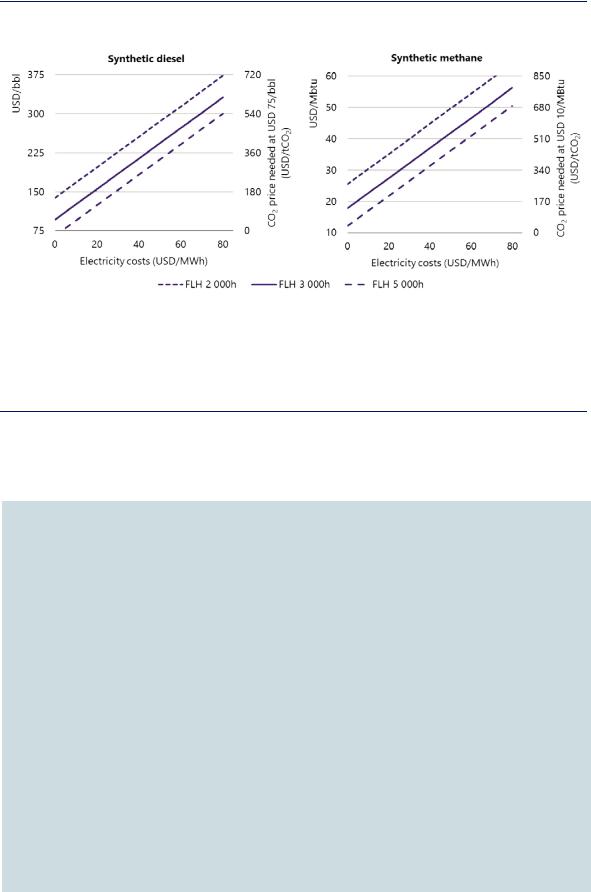
High CO2 prices (or equivalent policies discouraging fossil fuel use) would be needed for synthetic hydrocarbon fuels to become competitive with fossil fuel alternatives. If, for example, synthetic diesel can be produced at a cost of USD 150/bbl, a CO2 price of USD 180/tCO2, or equivalent policy measure, would be needed for synthetic diesel to become competitive with fossil diesel at USD 75/bbl (Figure 23). The high level of equivalent CO2 prices that would be needed for synthetic hydrocarbon fuels from electricity to compete with fossil fuels suggests that the use of synthetic hydrocarbon fuels at a larger scale is unlikely to happen in the near term. The economics of hydrogen-based fuels and feedstocks does, however, depend on the specific local conditions and the configuration of the different process components, as illustrated in Box 6 for the case of ammonia production at different locations in China.
15In case of low CO2 feedstock costs in Figure 22.
16Ranges reflect different electrolyser efficiencies.
PAGE | 61
IEA. All rights reserved.
The Future of Hydrogen |
Chapter 2: Producing hydrogen and hydrogen-based products |
Figure 23. Synthetic diesel and methane production costs and CO2 price penalty needed for competitiveness with fossil diesel and natural gas in the long term
Notes: FLH: full load hours. Left axes show the production cost for synthetic diesel and methane, while the right axes show the CO2 price needed to reach competitiveness with fossil diesel at USD 75/bbl and with natural gas at USD 10/MBtu. More information on the underlying assumptions is available at www.iea.org/hydrogen2019.
Source: IEA 2019. All rights reserved.
A combination of low electricity costs and high CO2 prices is needed to make synthetic diesel and methane competitive with fossil crude oil and natural gas.
Box 6. Production of hydrogen and ammonia from solar and wind in China
Developing cost-effective hydrogen supply chains requires location-specific aspects of the different technology options to be taken into account. This applies to the production of both hydrogen and hydrogen-based products. China provides an example: it has abundant renewable energy resources that are often located in vast sparsely populated regions far away from large industrial clusters. In some places, renewable energy has been deployed so rapidly that electricity networks have had difficulty adapting in real time. This has provided an opportunity for producers of hydrogen and hydrogen-rich chemicals to tap into renewable resources. Ammonia production is one opportunity given that China is the world’s largest user of nitrogen fertilisers, consuming 46 Mt per year.
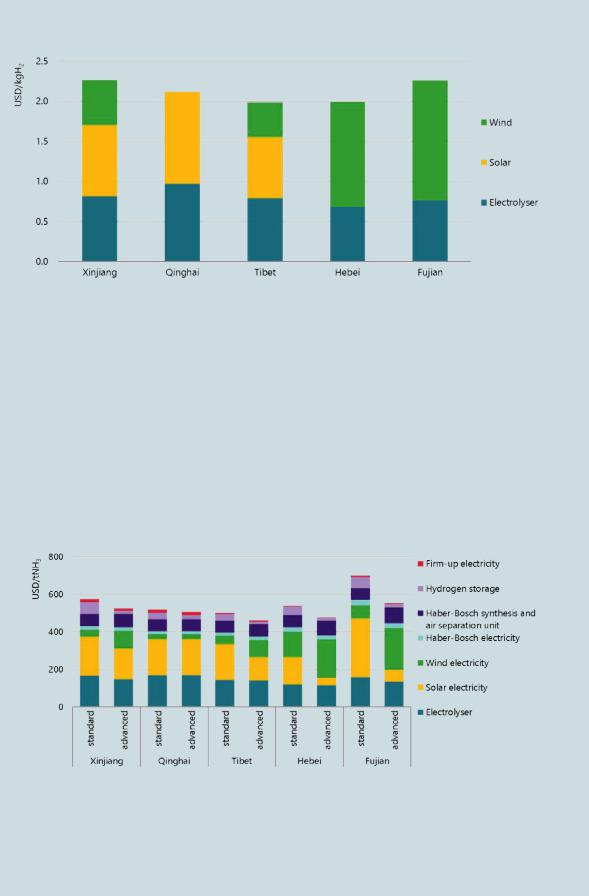
A detailed economic assessment by the IEA, based on hourly solar and wind data over a year in five locations across different provinces, suggests hydrogen can be produced at a cost of USD 2– 2.3/kgH2. In some provinces the lowest production costs are reached by using only solar (Qinghai) or wind (Hebei and Fujian), while in Xinjiang and Tibet performance is best with a combination of the two.
PAGE | 62
IEA. All rights reserved.
The Future of Hydrogen |
Chapter 2: Producing hydrogen and hydrogen-based products |
|
|
|
|
Estimated hydrogen production costs from solar and wind in China, 2020
Source: IEA 2019. All rights reserved.
The search for the optimal format for ammonia production based on variable renewables is more complex. Calculating the appropriate size of solar and wind capacity involves taking account of the size of the electrolysers, the hydrogen buffer storage and of the Haber-Bosch loop, as well as the use of more costly “firm-up” electricity to run the Haber-Bosch loop continuously.
In all provinces a mix of solar and wind is needed for best performance, despite cost differences between both resources. Mixing reduces the size of the hydrogen buffer storage and reduces the need for more costly firm-up electricity; it only marginally increases the capacity factor of the Haber-Bosch loop and the electrolysers
Estimated ammonia production costs from solar and wind in China, 2020
Notes: tNH3 = tonne of ammonia. Left-hand bars correspond to “standard” flexibility of the Haber-Bosch operations with a 40% downward flexibility of the Haber-Bosch synthesis; right-hand bars correspond to the “advanced” flexibility case, allowing 80% downward flexibility and the possibility of shutting down the synthesis process completely. From bottom to top, the bars show the following costs: electrolyser, electricity from solar and wind for hydrogen production, renewable electricity for running the HaberBosch synthesis, Haber-Bosch synthesis and air separation unit for nitrogen production, hydrogen buffer storage and firm-up electricity to run the Haber-Bosch process when there is not enough wind at night.
Source: IEA 2019. All rights reserved.
PAGE | 63
IEA. All rights reserved.
The Future of Hydrogen |
Chapter 2: Producing hydrogen and hydrogen-based products |
References
Agora Verkehrswende, Agora Energiewende and Frontier Economics (2018), The Future Cost of ElectricityBased Synthetic Fuels, Study, www.agoraenergiewende.de/fileadmin2/Projekte/2017/SynKost_2050/Agora_SynKost_Study_EN_WEB.pdf.
Albrecht, F. G. et al. (2017), “A standardized methodology for the techno-economic evaluation of alternative fuels – A case study”, Fuel, Vol. 194, pp. 511–26.
Ammonia Industry (2018), “ThyssenKrupp’s ‘green hydrogen and renewable ammonia value chain’”, 26 July 2018, https://ammoniaindustry.com/thyssenkrupps-green-hydrogen-and-renewable- ammonia-value-chain/.
Asian Renewable Energy Hub (2019), “About the Asian Renewable Energy Hub”, https://asianrehub.com/about/.
Bazzanella, A. M. and F. Ausfelder (2017), “Low carbon energy and feedstock for the European chemical industry”, DECHEMA Technology Study, https://dechema.de/dechema_media/Downloads/Positionspapiere/Technology_study_Low_carbo n_energy_and_feedstock_for_the_European_chemical_industry-p-20002750.pdf
Bennett, S.J., Schroeder, D.J. and S. T. McCoy (2014), “Towards a framework for discussing and assessing CO2 utilisation in a climate context”, Energy Procedia, Vol. 63, pp. 7976–7992.
Buttler, A. and H. Spliethoff (2018), “Current status of water electrolysis for energy storage, grid balancing and sector coupling via power-to-gas and power-to-liquids: a review”, Renewable and Sustainable Energy Reviews, Vol. 82, pp. 2440–54.
Caldera, U. et al. (2018), “Role of seawater desalination in the management of an integrated water and 100% renewable energy based power sector in Saudi Arabia”, Water, Vol. 10,
DOI: 10.3390/w10010003.
Chehade, Z. et al. (2019), “Review and analysis of demonstration projects on Power-to-X pathways in the world”, International Journal of Hydrogen Energy, in press.
Dagle, R. et al. (2017), “An overview of natural gas conversion technologies for co-production of hydrogen and value-added solid carbon products”, ANL-17/11; PNNL-26726, US Department of Energy.
Ericsson, K. (2017), “Biogenic carbon dioxide as feedstock for production of chemicals and fuels: A technoeconomic assessment with a European perspective”, Environmental and Energy System Studies, Lund University.
Element Energy (2018), “Hydrogen supply chain evidence base”, prepared for the UK Department for Business, Energy & Industrial Strategy, https://assets.publishing.service.gov.uk/government/uploads/system/uploads/attachment_data/fil e/760479/H2_supply_chain_evidence_-_publication_version.pdf.
Fasihi, M. and C. Breyer (2017), “Synthetic methanol and dimethyl ether production based on hybrid PVwind power plants”, paper presented at 11th International Renewable Energy Storage Conference, Düsseldorf, 14–16 March.
Fasihi, M., O. Efimova and C. Breyer (2019), “Techno-economic assessment of CO2 direct air capture plants”, Journal of Cleaner Production, doi: https://doi.org/10.1016/j.jclepro.2019.03.086.
FCH JU (Fuel Cells and Hydrogen Joint Undertaking) (2014), Development of Water Electrolysis in the European Union: Final Report, www.fch.europa.eu/sites/default/files/study%20electrolyser_0Logos_0_0.pdf.
PAGE | 64
IEA. All rights reserved.
The Future of Hydrogen |
Chapter 2: Producing hydrogen and hydrogen-based products |
Fulcheri, L. (2018), “Direct decarbonization of methane by thermal plasma for the co-production of hydrogen and carbon nanostructures”, 15th International High-Tech Plasma Processes Conference, Toulouse, 2–6 July 2018.
H21 (2018), H21 North of England, H21 NoE Report/2018, https://northerngasnetworks.co.uk/h21- noe/H21-NoE-23Nov18-v1.0.pdf.
Hannula, I. (2016), “Hydrogen enhancement potential of synthetic biofuels manufacture in the European context: A techno-economic assessment”, Energy, Vol. 104, pp. 199–212.
IEA (International Energy Agency) (2018), World Energy Investment, IEA, Paris, www.iea.org/wei2018/. IEA (2017), Renewable Energy for Industry, from Green Energy to Green Materials and Fuels, IEA, Paris. IEA (2016), World Energy Outlook 2016, IEA, Paris.
IEAGHG (IEA Greenhouse Gas R&D Programme) (2017a), “Reference data and supporting literature reviews for SMR based hydrogen production with CCS”, 2017-TR03, March 2017, https://ieaghg.org/exco_docs/2017-TR3.pdf.
IEAGHG (2017b), “Techno-economic evaluation of SMR based standalone (merchant) hydrogen plant with CCS”, 2017/02, February 2017.
Irlam, L. (2017), “Global costs of carbon capture and storage: 2017 update”, Global CCS Institute, June 2017, https://hub.globalccsinstitute.com/sites/default/files/publications/201688/global-ccs-cost- updatev4.pdf.
JEPX (Japan Electric Power Exchange) (2019), Intraday Market Trading Results 2018, www.jepx.org/english/market/index.html.
Keith, D. et al. (2018), “A process for capturing CO2 from the atmosphere”, Joule, Vol. 2, pp. 1573–94.
Mignard, D. and C. Pritchard (2008), “On the use of electrolytic hydrogen from variable renewable energies for the enhanced conversion of biomass to fuels”, Chemical Engineering Research and Design, Vol. 86, Issue 5, pp.473–87.
Muradov, N. (2017), “Low to near-zero CO2 production of hydrogen from fossil fuels: Status and perspectives”, International Journal of Hydrogen Energy, Vol. 42, Issue 20, pp. 14058–88.
NOW (Nationale Organisation Wasserstoffund Brennstoffzellentechnologie) (2018), Studie IndWEDe Industrialisierung der Wasserelektrolyse in Deutschland: Chancen und Herausforderungen für nachhaltigen Wasserstoff für Verkehr, Strom und Wärme[Industrialization of water electrolysis in Germany: Opportunities and challenges for sustainable hydrogen for transport, electricity and heat], www.now-gmbh.de/content/service/3-publikationen/1-nip-wasserstoff-und- brennstoffzellentechnologie/indwede-studie_v04.1.pdf.
Proost, J. (2018), “State-of-the art CAPEX data for water electrolysers, and their impact on renewable hydrogen price settings”, International Journal of Hydrogen Energy, Vol. 44, Issue 9, pp. 4406– 13.renewables.ninja (2019), www.renewables.ninja.
Rife, D. L. et al. (2014), NCAR Global Climate Four-Dimensional Data Assimilation (CFDDA) Hourly 40 km Reanalysis, Research Data Archive at the National Center for Atmospheric Research, Computational and Information Systems Laboratory, http://dx.doJ.org/10.5065/D6M32STK.
Ruth, M.F., P. Jadun and B. Pivovar (2017), “H2@Scale: Technical and economic potential of hydrogen as an energy intermediate”, presentation at the Fuel Cell Seminar and Energy Exposition, Long Beach, CA, 9 November, http://dx.doi.org/10.5065/D6M32STK.
Schmidt, O. et al. (2017), “Future cost and performance of water electrolysis: An expert elicitation study”,
International Journal of Hydrogen Energy, Vol. 42, pp. 30470–92.
PAGE | 65
IEA. All rights reserved.