Материал: The_Future_of_Hydrogen-IEA-2020
The Future of Hydrogen |
Chapter 2: Producing hydrogen and hydrogen-based products |
Technology options
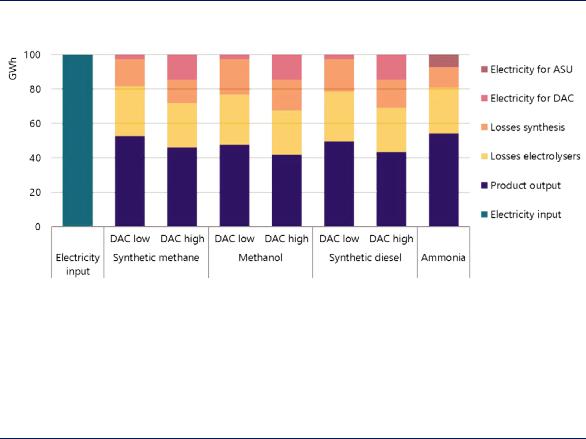
Various pathways exist to convert hydrogen into fuels and feedstocks that can be more easily handled, transported and used. Ammonia can be produced by combining hydrogen and nitrogen, and synthetic hydrocarbons, such as methane, methanol, diesel or jet fuel, can be produced by combining hydrogen with carbon in the form of CO2. However, for pathways based on electrolytic hydrogen, much of the electricity used to convert hydrogen into fuels and feedstocks is lost during the process of conversion (Figure 20).
Figure 20. Outputs and losses of different pathways for hydrogen-based fuels and feedstocks from electrolytic hydrogen
Notes: ASU = air separation unit (for nitrogen production); DAC = direct air capture; GWh = gigawatt hour. The energy contents of the outputs (methane, methanol, diesel and ammonia) are based on their LHVs. For methane, methanol and diesel, DAC has been assumed here as the source of CO2 feedstocks, with electricity needs of 250 kWh per tCO2 for low-temperature DAC (DAC low) and 1 750 kWh per tCO2 for high-temperature DAC (DAC high). Low-temperature DAC also requires heat of 1 535 kWh per tCO2, which could be covered in large part by the shown synthesis heat losses.
Source: IEA 2019. All rights reserved.
Around 45–60% of the electricity used for the production of synthetic hydrocarbons or ammonia is lost during the process.
Ammonia
Ammonia is a compound of nitrogen and hydrogen and therefore does not generate CO2 emissions when combusted. It is a gas at normal temperature and pressure, but can be liquefied at -33°C, a temperature that is not too difficult to reach. Liquid ammonia has a 50% higher volumetric energy density than liquid hydrogen. Ammonia has been used as a refrigerant for 170 years, and as a chemical feedstock for nitrogen fertilisers and explosives for a century. Industry is used to storing and transporting it, including in oceangoing tankers. Ammonia can, in principle, be used as a fuel in various energy applications (e.g. for co-firing in coal power plants), but none of these applications is being commercially used today. The toxicity of ammonia means that its handling requires care and would likely be limited to professionally trained operators, potentially restricting its techno-economic potential.
Ammonia has been made with hydrogen from electrolysers running on hydropower and nitrogen from ASUs since the 1920s, with a few plants in Norway feeding the entire European demand for nitrogen fertilisers (IEA, 2017). New projects are, however, now underway to
PAGE | 56
IEA. All rights reserved.
The Future of Hydrogen |
Chapter 2: Producing hydrogen and hydrogen-based products |
produce ammonia from renewable electricity. For example, a commercial-scale ammonia plant with a production capacity of 50 tonnes ammonia per day and an electrolyser capacity of 30 MWe is being built in Port Lincoln in South Australia, and will be powered by wind and solar electricity (Ammonia Industry, 2018).
Synthetic hydrocarbons
Hydrogen can be combined with CO2 to produce synthetic hydrocarbons such as methane, or synthetic liquid fuels such as methanol, diesel, gasoline and jet fuel. Some of these products have higher energy densities than hydrogen or ammonia:
Synthetic methane: This can be directly produced from CO2 and hydrogen in a methanation process. Applications of the methanation process today rely mostly on catalytic (thermochemical) methanation. Biological methanation is also possible, in which
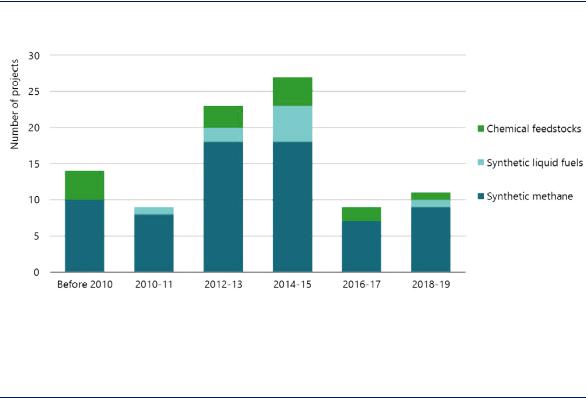
microorganisms in an anaerobic environment convert hydrogen and CO2 into methane, but this is at an earlier stage of development. The majority of the projects for hydrogen-based fuels and feedstocks have so far been aimed at producing synthetic methane, with almost 70 demonstration plants (Figure 21). Most of these are located in Germany and other European countries.
Figure 21. Number of new projects for making various hydrogen-based fuels and feedstocks from electrolytic hydrogen
Sources: IEA analysis based on Chehade et al. (2019), “Review and analysis of demonstration projects on Power-to-X pathways in the world”, IEA (2018), World Energy Investment, and the World Energy Council (2018), “Hydrogen an enabler of the Grand Transition” and data provided by IEA Hydrogen Technology Collaboration Programme.
The majority of the pilot and demonstration projects for hydrogen-based fuels and feedstocks produce synthetic methane.
Synthetic diesel or kerosene: The production of synthetic diesel or kerosene requires hydrogen and carbon monoxide as inputs. Since carbon monoxide is generally not easily
available, CO2 can be used instead. This CO2 is first converted into carbon monoxide, and the resulting synthesis gas of carbon monoxide and hydrogen is then converted (via
PAGE | 57
IEA. All rights reserved.

The Future of Hydrogen |
Chapter 2: Producing hydrogen and hydrogen-based products |
Fischer-Tropsch [FT] synthesis)13 to raw liquid fuels and, with further upgrading, into synthetic diesel or kerosene. FT synthesis is relatively slow and requires costly investment.
Synthetic methanol: Methanol is the simplest alcohol. It has an energy content equal to 19.9 megajoules per kilogram (LHV) and a 80% higher energy density than liquid hydrogen. As a liquid it is easily transportable, like other common petroleum fuels. It is as toxic as common liquid petroleum fuels, but unlike them it is not carcinogenic or mutagenic. Methanol is soluble in water and is biodegradable, and its production from synthesis gas is fully commercial. Around 40% of global methanol production today is used for energy purposes, but methanol can also be used as the building block for synthesising a range of chemicals, e.g. for the production of plastics.
Significant amounts of electricity and generation capacity are required for the production of synthetic hydrocarbons because of the low overall efficiency of production processes. Around 1 000 TWh and 700 TWh of electricity would be needed as input for synthetic hydrocarbons to provide just 1% of current global oil and global gas production respectively, representing around 4% and 3% of global electricity generation in 2018. This would require 600 GW and 400 GW of solar PV capacity at a capacity factor of 20%, or 340 GW and 230 GW of onshore wind capacity at a capacity factor of 35%.
The production of synthetic hydrocarbon from hydrogen uses CO2 as input, which can be derived through various means (Box 6). In Werlte in Germany, for example, a plant with an electrolyser capacity of 6 MWe has been producing 300 m3 per hour of synthetic methane since 2013, with CO2 being provided by a biogas plant. A synthetic liquids plant for methanol production has been operating in Iceland since 2012 with an electrolyser capacity of 6 MWe and a methanol output of 4 000 tonnes per year. The required CO2 is captured from a geothermal power plant.
Box 5. CO2 sources for synthetic hydrocarbons
The production of methane or liquid hydrocarbon fuels and feedstocks from hydrogen often uses CO2 as input. For example, replacing today’s global fossil kerosene demand of 2 600 million barrels per year completely with synthetic kerosene would require 1 gigatonne of carbon dioxide (GtCO2) per year. If the synthetic hydrocarbon fuel is combusted, this CO2 is again released to the atmosphere (assuming the combustion process is not equipped with CCUS). From a climate perspective, the source of CO2 is therefore vitally important.
One option is to acquire CO2 produced from the combustion of fossil fuels, or from various industry plants offering more concentrated CO2 streams such as in cement production. Although the CO2 is based on fossil fuels, its utilisation can contribute to CO2 reduction as, in principle, each carbon molecule is being used twice: the carbon contained in a fossil fuel is used to produce energy or in an
13 FT synthesis is a fully commercial process. Several large-scale plants converting coal or natural gas via FT synthesis into liquid fuels are in operation. The largest coal-to-liquid plant has operated since the 1980s in Secunda, South Africa, with a capacity of 160 000 barrels per day (bbl/d). The largest gas-to-liquid plant has operated in Qatar since 2011 at 140 000 bbl/d.
PAGE | 58
IEA. All rights reserved.

The Future of Hydrogen |
Chapter 2: Producing hydrogen and hydrogen-based products |
|
|
|
|
industrial production process; and then the resulting CO2 is used in combination with hydrogen to
produce a synthetic hydrocarbon fuel. However, such a system would still involve emissions of CO2 from fossil fuels and would have a theoretical upper limit of 50% emissions reduction (Bennett, Schroeder and McCoy, 2014).
For very low CO2 pathways, non-fossil CO2 sources would be needed. One option is to use CO2 formed at high purity during the production of biogas and bioethanol. Capturing CO2 from these processes requires only moderate additional investment and energy, and has CO2 capture costs as low as USD 20–30/tCO2 (Irlam, 2017). If the production of the hydrogen-based fuel is at the same site as the production of the upgraded biogas or biofuel, then the two product streams can be blended to take advantage of the same infrastructure for onward distribution. There is also an efficiency from maximising the use of the carbon contained in the original biomass input. If biomass gasification were to reach commercial scale, it could also become a potential CO2 source owing to relatively low CO2 capture costs and compatibility with most biomass feedstocks (Ericsson, 2017). To raise efficiency, it may not be necessary to separate the CO2 if the externallysourced hydrogen can be introduced directly into the gasification products (containing CO2, and also hydrogen and carbon monoxide) so that they can be converted to synthetic fuels in one combined reaction process (Hannula, 2016). However, it remains uncertain whether sufficient biogenic CO2 could be available in the future at the scale needed for widespread production of hydrogen-based synthetic hydrocarbon fuels.
CO2 can also be captured directly from the atmosphere, where there a no constraints on the availability of CO2. However, due to the low atmospheric concentrations of CO2, DAC is more energy-intensive than CO2 capture from gases formed at power plants or industrial facilities. Today’s units require both electricity and heat for CO2 capture, with the two main types of system being high-temperature or low-temperature DAC. High-temperature DAC operates at around 900°C and uses an aqueous solution to absorb CO2, while low-temperature DAC operates at around 100°C with a solid sorbent. Estimates for the energy requirements of DAC are in the order of 250–400 kWh of heat and 1 500–1 750 kWh of electricity per tonne of CO2. The heat requirement can, however, be reduced by integrating DAC with the production of synthetic hydrocarbon fuels (Fasihi and Breyer, 2017). DAC plants operate today at a scale of 900 tCO2 per year or less in Canada, Iceland, Italy and Switzerland, but practical experience remains limited. Cost estimates for DAC remain uncertain, but studies estimate that in the long term costs for DAC may fall to a range of USD 94–232/tCO2 for high-temperature DAC (Keith et al., 2018) and USD 130–170t CO2 for lowtemperature DAC (Fasihi, Efimova and Breyer, 2019).
The environmental impact of hydrogen-based synthetic hydrocarbon fuels depends on the CO2 intensity of both the hydrogen and the CO2. Policy must therefore consider the CO2 intensity of the whole value chain, including the source of the CO2, to avoid outcomes that do not lead to CO2 reduction overall. Policies that incentivise hydrogen production and hydrogen-based fuel production separately could inadvertently encourage the separation of CO2 from hydrogen in fossil methane and its recombination with hydrogen to produce methane again, with an investment of energy in the process. A low-carbon hydrogen-based fuel is one with net emissions after combustion that are zero, or nearly zero, after subtracting emissions of CO2 originating from a biogenic or atmospheric carbon source. It is important to manage this accounting challenge effectively. The simplest approach, if feasible, may be to certify and track carbon through the
PAGE | 59
IEA. All rights reserved.
The Future of Hydrogen |
Chapter 2: Producing hydrogen and hydrogen-based products |
|
|
|
|
supply chain as “fossil” or “non-fossil”. The operator of the CO2 capture facility would be credited
with lower emissions for their process compared with the same process without CO2 capture.
Sources: Bennett, Schroeder and McCoy (2014), “Towards a framework for discussing and assessing CO2 utilisation in a climate context”, Irlam (2017), “Global costs of carbon capture and storage: 2017 update”; Ericsson (2017), “Biogenic carbon dioxide as feedstock for production of chemicals and fuels: A Techno-economic assessment with a European perspective”; Hannula (2016), “Hydrogen enhancement potential of synthetic biofuels manufacture in the European context: A techno-economic assessment”; Keith et al. (2018), “A process for capturing CO2 from the atmosphere”; Fasihi and Breyer (2017), “Synthetic methanol and dimethyl ether production based on hybrid PV-wind power plants”; Fasihi, Efimova and Breyer (2019), “Techno-economic assessment of CO2 direct air capture plants”.
Production costs
The main cost components for the production of ammonia and synthetic hydrocarbons are the CAPEX and the hydrogen costs, together with the electricity costs if the hydrogen is produced through electrolysis and, for synthetic hydrocarbons, the CO2 feedstock costs.
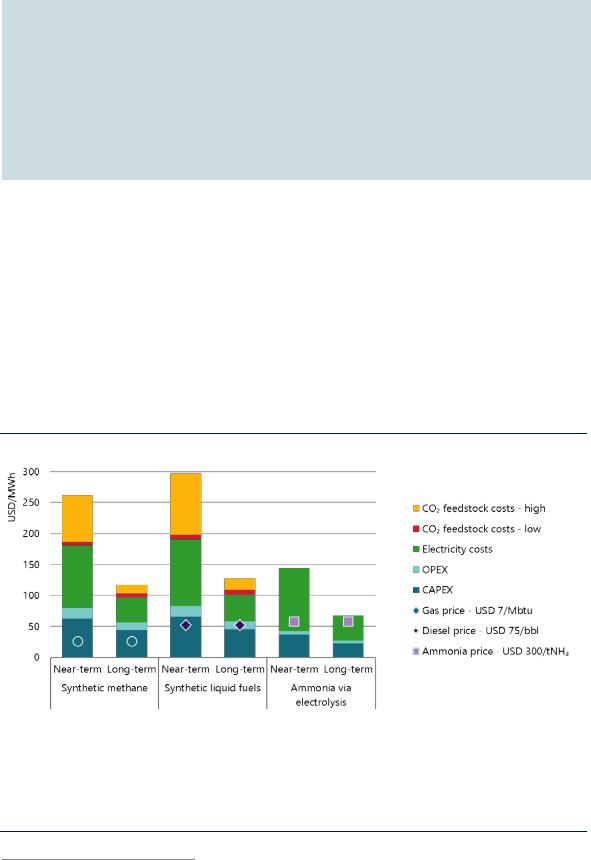
Capital costs constitute around 30–40% of the total production costs for ammonia and synthetic hydrocarbons if the hydrogen is produced from electricity. CAPEX costs are dominated by the costs of the electrolyser, while the synthesis process and other equipment components have a smaller impact.14 Learning effects could roughly halve the CAPEX costs of the different production pathways in the long term, thereby bringing down the cost of production (Figure 22).
Figure 22. Indicative production costs of electricity-based pathways in the near and long term
Notes: NH3 = ammonia.; renewable electricity price = USD 50/MWh at 3 000 full load hours in near term and USD 25/MWh in long term; CO2 feedstock costs lower range based on CO2 from bioethanol production at USD 30/tCO2 in the near and long term; CO2 feedstock costs upper range based on DAC = USD 400/tCO2 in the near term and USD 100/tCO2 in the long term; discount rate = 8%. More information on the underlying assumptions is available at www.iea.org/hydrogen2019.
Source: IEA 2019. All rights reserved.
Future cost reductions for hydrogen-based products from electricity will depend on lowering the cost of electricity, with cost reductions for CO2 feedstocks also being critical for synthetic hydrocarbons.
14 For example, for ammonia production from electrolytic hydrogen, the synthesis process and the air separation unit account for less than 5% of the total CAPEX.
PAGE | 60