Материал: The_Future_of_Hydrogen-IEA-2020

The Future of Hydrogen Chapter 5: Opportunities for hydrogen in transport, buildings and power
Table 9. |
Role of hydrogen and hydrogen-based products in power generation |
|||||||||||||
|
|
|
|
|
|
|
|
|
|
|
|
|
|
|
|
|
|
|
Current role |
|
|
Demand |
|
|
Future deployment |
|
|
|
|
|
|
|
|
|
|
|
|
|
|
|
|
|
||
|
|
|
|
|
|
perspectives |
|
|
|
|
|
|
|
|
|
|
|
|
|
|
|
|
Opportunities |
|
|
Challenges |
|
||
|
|
|
|
|
|
|
|
|
|
|
|
|||
|
|
|
|
|
|
|
|
|
|
|
|
|
||
|
|
|
|
|
|
|
|
|
|
|
|
|
|
|
|
|
|
|
|
|
|
|
|
|
|
|
|
|
|
|
|
|
|
|
|
|
|
|
|
|
|
|
CO2 mitigation costs |
|
|
|
|
|
No |
|
|
20% co-firing share in |
|
|
|
|
|
can be low, but rely on |
|
|
|
|
|
|
|
global coal power |
|
|
|
|
|
low-cost ammonia |
|
|
|
|
|
|
deployment so |
|
|
|
|
|
|
|
|
||
|
|
|
|
|
|
plant fleet could by |
|
|
|
|
|
supply. |
|
|
|
Co-firing |
|
|
far; co-firing |
|
|
|
|
Reducing the carbon |
|
|
|
||
|
|
|
|
|
2030 lead to an |
|
|
|
|
Attention has to be paid |
|
|||
|
ammonia |
|
|
has been |
|
|
|
|
impact of existing |
|
|
|
||
|
|
|
|
|
ammonia demand of |
|
|
|
|
to NOx emissions; |
|
|||
|
in coal |
|
|
demonstrated |
|
|
|
|
coal-fired power |
|
|
|
||
|
|
|
|
|
up to 670 Mt |
|
|
|
|
further NOx treatment |
|
|||
|
power |
|
|
in a |
|
|
|
|
plants in the near |
|
|
|
||
|
|
|
|
|
ammonia or a |
|
|
|
|
may be needed. |
|
|||
|
plants |
|
|
commercial |
|
|
|
|
term |
|
|
|
||
|
|
|
|
|
corresponding |
|
|
|
|
Only a transitional |
|
|||
|
|
|
|
coal power |
|
|
|
|
|
|
|
|
||
|
|
|
|
|
|
hydrogen demand of |
|
|
|
|
|
measure – still |
|
|
|
|
|
|
plant in Japan |
|
|
|
|
|
|
|
|
||
|
|
|
|
|
|
120 MtH2 |
|
|
|
|
|
significant remaining |
|
|
|
|
|
|
|
|
|
|
|
|
|
|
|
||
|
|
|
|
|
|
|
|
|
|
|
|
|
CO2 emissions |
|
|
|
|
|
Few |
|
Assuming 1% of |
|
|
|
|
Availability of low-cost |
|||
|
|
|
|
commercial |
|
global gas-fired |
|
Supporting the |
|
and low-carbon |
||||
|
|
|
|
gas turbines |
|
power capacity would |
|
|
hydrogen and |
|||||
|
|
|
|
|
|
integration of VRE in |
|
|||||||
|
|
|
|
using |
|
run on hydrogen by |
|
|
ammonia. |
|||||
|
Flexible |
|
|
|
the power system. |
|
||||||||
|
|
hydrogen-rich |
|
2030, this would |
|
|
Competition with other |
|||||||
|
power |
|
|
|
Some gas turbine |
|
||||||||
|
|
gases. |
|
result in a capacity of |
|
|
flexible generation |
|||||||
|
generation |
|
|
|
designs already able |
|
||||||||
|
|
363 000 fuel |
|
25 GW, generating |
|
|
options as well as other |
|||||||
|
|
|
|
|
|
to run on high |
|
|||||||
|
|
|
|
cell units |
|
90 TWh of electricity |
|
|
flexibility options (e.g. |
|||||
|
|
|
|
|
|
hydrogen shares |
|
|||||||
|
|
|
|
(1 600 MW) |
|
and consuming |
|
|
demand response, |
|||||
|
|
|
|
|
|
|
|
|
||||||
|
|
|
|
installed |
|
4.5 MtH2 |
|
|
|
|
storage) |
|||
|
|
|
|
|
|
|
|
|
|
|
|
|
||
|
|
|
|
Demonstration |
|
|
|
|
|
Fuel cell systems in |
|
|
|
|
|
Back-up |
|
|
projects for |
|
|
With increasing |
|
|
combination with |
|
|
|
|
|
|
|
electrification |
|
|
|
|
storage as a cost- |
|
|
Often higher initial |
|
||
|
and off- |
|
|
|
|
growth of |
|
|
|
|
|
|||
|
|
|
of villages. |
|
|
|
|
effective and less |
|
|
investment needs |
|
||
|
grid |
|
|
|
|
telecommunications, |
|
|
|
|
|
|||
|
|
|
Fuel cell |
|
|
|
|
polluting alternative |
|
|
compared with diesel |
|
||
|
power |
|
|
|
|
also growing need for |
|
|
|
|
|
|||
|
|
|
systems in |
|
|
|
|
to diesel generators. |
|
|
generators |
|
||
|
supply |
|
|
|
|
reliable power supply |
|
|
|
|
|
|||
|
|
|
combination |
|
|
|
|
More robust than |
|
|
|
|
||
|
|
|
|
|
|
|
|
|
|
|
|
|
||
|
|
|
|
with storage |
|
|
|
|
|
battery systems |
|
|
|
|
|
|
|
|
|
|
|
In the long term, with |
|
Due to high energy |
|
|
|
||
|
|
|
|
|
|
|
very high VRE shares, |
|
content of hydrogen, |
|
High conversion losses. |
|||
|
|
|
|
|
|
|
need for large-scale |
|
relatively low CAPEX |
|
||||
|
|
|
Three salt |
|
|
|
Geological availability of |
|||||||
|
|
|
|
and long-term |
|
cost for storage itself. |
|
|||||||
|
|
|
cavern storage |
|
|
|
salt caverns for |
|||||||
|
|
|
|
storage for seasonal |
|
Few alternative |
|
|||||||
|
Long-term |
sites for |
|
|
|
hydrogen storage |
||||||||
|
|
imbalances or longer |
|
technologies for |
|
|||||||||
and large- |
hydrogen in |
|
|
|
region-specific. |
|||||||||
|
periods with no VRE |
|
long-term and large- |
|
||||||||||
scale |
the United |
|
|
|
Little experience with |
|||||||||
|
generation. |
scale storage. |
|
|||||||||||
energy |
States; another |
|
|
depleted oil and gas |
||||||||||
|
In combination with |
|
Conversion losses |
|
||||||||||
storage |
three in the |
|
|
|
fields or water aquifers |
|||||||||
|
long-distance trade, |
|
can be reduced if |
|
||||||||||
|
|
|
United |
|
|
|
for hydrogen storage |
|||||||
|
|
|
|
scope to take |
|
stored hydrogen or |
|
|||||||
|
|
|
Kingdom |
|
|
|
(e.g. contamination |
|||||||
|
|
|
|
advantage of |
|
ammonia can be |
|
|||||||
|
|
|
|
|
|
|
|
|
issues) |
|||||
|
|
|
|
|
|
|
seasonal differences |
|
directly used in end- |
|
||||
|
|
|
|
|
|
|
|
|
|
|
||||
|
|
|
|
|
|
|
in global VRE supply |
|
use applications |
|
|
|
||
Note: VRE = variable renewable energy.
PAGE | 151
IEA. All rights reserved.

The Future of Hydrogen |
Chapter 5: Opportunities for hydrogen in transport, buildings and power |
How does the power sector use hydrogen today?
Although pure hydrogen does not generally feature as a fuel in power generation today, there are small-scale exceptions. For example, a 12 MW hydrogen-fired combined-cycle gas turbine in Italy uses hydrogen from a nearby petrochemical complex, while in Kobe, Japan, a hydrogenfired gas turbine is providing heat (2.8 watts thermal) and electricity (1.1 MWe) to a local community. Somewhat more common is the use of hydrogen-rich gases from steel mills, petrochemical plants and refineries. Reciprocating gas engines today can handle gases with a hydrogen content of up to 70% (on a volumetric basis),53 while in the future gas engines should be able to operate on even 100% hydrogen (Goldmeer, 2018). Gas turbines also have the capability to run on hydrogen-rich gases. In Korea a 40 MW gas turbine at a refinery has run on gases with a hydrogen content of up to 95% for 20 years.
Fuel cells are a further option to convert hydrogen into electricity and heat, producing water and no direct emissions. They can achieve high electric efficiencies of over 60% and reveal a higher efficiency in part load than full load, which makes them particularly attractive for flexible operations such as load balancing (Box 15).
Box 15. Fuel cell technologies for stationary power applications
Various fuel cell technologies exist for stationary power applications:
•Polymer electrolyte membrane fuel cells (PEMFCs) operate at relatively low temperatures (below 100°C) and have a quick start-up time. They require, however, a pure hydrogen stream, or an external reformer if natural gas is used as fuel. PEMFCs are used today as micro co-generation units, operating with natural gas or LPG in residential buildings.
•Phosphoric acid fuel cells (PAFCs), based on phosphoric acid as electrolyte, are used today as stationary power generators with outputs in the 100–400 kW range. In addition to electricity, they also produce heat at around 180°C, with potential uses for space and water heating.
•Molten carbonate fuel cells (MCFCs) and solid oxide fuel cells (SOFCs) operate at higher temperatures, 600°C and 800–1 000°C respectively, which allow them to run on different hydrocarbon fuels without the need for an external reformer to produce hydrogen first. MCFCs are used in the MW scale for power generation (due their low power density, resulting in a relatively large size). The produced heat can be used for heating or cooling purposes in buildings and industrial applications. SOFCs have similar application areas, often at smaller scale in the kW range, such as micro co-generation units or for off-grid power supply.
53 Hydrogen has a more than one third lower energy content per cubic metre (m3) of 10 MJ/m3 compared to natural gas with 35 MJ/m3. Therefore, a volumetric blending share of 70% of hydrogen into natural gas corresponds to a 20% blending share in energy terms. If not noted otherwise, the hydrogen shares in this section refer to volumetric shares.
PAGE | 152
IEA. All rights reserved.
The Future of Hydrogen |
Chapter 5: Opportunities for hydrogen in transport, buildings and power |
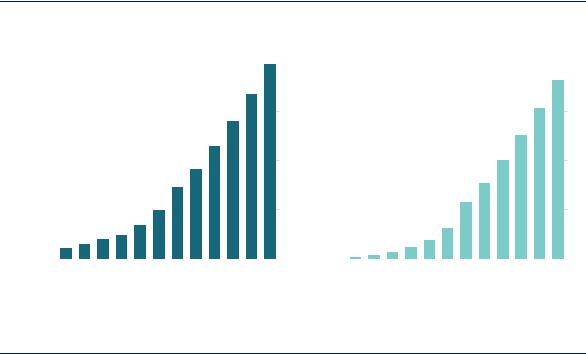
Global installed stationary fuel cell capacity has been rapidly growing over the last ten years, reaching almost 1.6 GW in 2018 (Figure 61), although only around 70 MW uses hydrogen as fuel; most of the existing fuel cells today run on natural gas. The number of globally installed fuel cell units is around 363 000, largely dominated by micro co-generation systems. The Japanese ENEFARM initiative (Box 14) accounts for the majority, with around 276 000 micro co-generation systems, but represents only 12% of the installed capacity at 193 MW (IPHE, 2018a). Outside Japan, the residential fuel cell market is also growing in Germany, driven by the KfW433 support programme with around 1 900 funding approvals by November 2018 (IPHE, 2018b). Larger fuel cell systems above 100 kW to 2.4 MW are still almost exclusively deployed in Korea and the United States, with installed capacities of 300 MW and 150 MW, respectively. A further growing market for fuel cells is the provision of back-up power and off-grid electricity (Box 16).
Figure 61. Development of global stationary fuel cell capacity, 2007–18
MW |
1 600 |
|
Installed capacity |
|
|
|
|
|
|
|
|
|
units |
400 |
|
|
|
Installed number of units |
|
|
|
|
|
|||||||||||
|
|
|
|
|
|
|
|
|
|
|
|
|
|
|
|
|
|
|
|
|
|
|
|
|
|
|
|
|
|
|
||||
|
|
|
|
|
|
|
|
|
|
|
|
|
|
|
|
|
|
|
|
|
|
|
|
|
|
|
|
|
|
|
|
|
||
|
1 200 |
|
|
|
|
|
|
|
|
|
|
|
|
|
|
|
Thousand |
300 |
|
|
|
|
|
|
|
|
|
|
|
|
|
|
|
|
|
|
|
|
|
|
|
|
|
|
|
|
|
|
|
|
|
|
|
|
|
|
|
|
|
|
|
|
|
|
|
|
|
||
|
800 |
|
|
|
|
|
|
|
|
|
|
|
|
|
|
|
|
200 |
|
|
|
|
|
|
|
|
|
|
|
|
|
|
|
|
|
|
|
|
|
|
|
|
|
|
|
|
|
|
|
|
|
|
|
|
|
|
|
|
|
|
|
|
|
|
|
|
|
||
|
400 |
|
|
|
|
|
|
|
|
|
|
|
|
|
|
|
|
100 |
|
|
|
|
|
|
|
|
|
|
|
|
|
|
|
|
|
|
|
|
|
|
|
|
|
|
|
|
|
|
|
|
|
|
|
|
|
|
|
|
|
|
|
|
|
|
|
|
|
||
|
0 |
|
|
|
|
|
|
|
|
|
|
|
|
|
|
|
|
0 |
|
|
|
|
|
|
|
|
|
|
|
|
|
|
|
|
|
|
|
|
|
|
|
|
|
|
|
|
|
|
|
|
|
|
|
|
|
|
|
|
|
|
|
|
|
|
|
|
|
||
|
2007 |
2010 |
|
|
|
|
2015 |
|
|
2018 |
|
2007 |
2010 |
2015 |
|
2018 |
||||||||||||||||||
Sources: E4tech (various years), The Fuel Cell Industry Review; S&P Global Platts (2018), World Electric Power Plants Database.
Stationary fuel cells have experienced strong growth over the last decade in terms of installed capacity and number of units, but still represent only 0.02% of global power generation capacity.
Very few countries have stated explicit targets for the use of hydrogen or hydrogen-based fuels in the power sector. Japan is one of the few exceptions: it aims to reach 1 GW of power capacity based on hydrogen by 2030, corresponding to an annual hydrogen consumption of 0.3 MtH2, rising to 15–30 GW in the longer term, corresponding to annual hydrogen use of 15– 30 MtH2 (METI, 2017). Korea is another exception: its hydrogen roadmap sets a target of 1.5 GW installed fuel cell capacity in the power sector by 2022, and 15 GW by 2040. A number of countries have, however, recognised the potential of hydrogen as a low-carbon option for power and heat generation.
Research and pilot projects to introduce hydrogen and ammonia as fuel for gas turbines and coal power plants are being pursued in Japan. An existing 440 MW combined-cycle gas turbine (CCGT) plant is being converted from natural gas to hydrogen in the Netherlands, and ammonia is being considered for long-term storage there; it would be reconverted into hydrogen and nitrogen before combustion of the hydrogen in the gas turbine (Northern Netherlands Innovation Board, 2017). The Port Lincoln Green Hydrogen Project under construction in Australia includes a 30 MW electrolyser plant and an ammonia production facility, as well as a 10 MW hydrogen-fired gas turbine and a 5 MW hydrogen fuel cell, which
PAGE | 153
IEA. All rights reserved.

The Future of Hydrogen |
Chapter 5: Opportunities for hydrogen in transport, buildings and power |
will supply balancing services to the grid and the ammonia plant. The facility will also support to two new solar farms, as well as a nearby micro-grid which will be utilised by local aqua agriculturists who have been affected by ageing back-up power generation (Bruce et al., 2018).
Box 16. Using fuel cells to provide back-up power and access to electricity
The provision of back-up power and off-grid electricity is today often still dominated by diesel generators. Fuel cells represent a possible alternative, in many cases reducing local air pollution as well as the need for imported diesel. An estimated 2 500 to 3 000 such systems were deployed in 2018 (E4Tech, 2018).
The mobile telecommunication industry is an example of a sector that needs back-up and offgrid power. It relies on an estimated 7 million base stations worldwide, and this number is increasing by over 100 000 each year, mostly in developing and emerging economies. To ensure reliable electricity supply for these base stations in parts of the world where the electricity infrastructure is weak or no grid connection is available, these base stations require their own electricity supply, which is often provided by diesel generators or diesel-battery hybrid systems, with each base station consuming around 10 000 to 12 000 litres of diesel per year. To take one example, India has around 650 000 telecom towers today, around 20% of which rely on diesel generators, resulting in an annual diesel consumption of 5 billion litres and CO2 emissions of 5 MtCO2/yr (Lele, 2019).
Fuel cell systems, relying on bottled hydrogen, methanol or ammonia as fuel, offer an alternative to diesel generators or battery systems. Compared to battery systems, fuel cells can operate in environments from -40°C to 50°C without the need for any cooling. (It has been also reported that compared to diesel generators, PV systems and batteries, fuel cells and their fuel appear less attractive to thieves.) In Kenya 800 base stations are switching from diesel generators to 4 kW ammonia-based alkaline fuel cell systems, including a cracker to convert the ammonia into hydrogen. A single 12-tonne tank of ammonia can provide enough fuel to operate a base station for a year (Ammonia Energy, 2018). In South Africa, over 300 stationary fuel cell systems have been rolled out by Vodacom to provide back-up power for telecom base stations, with a further 250 planned for 2019.
Fuel cells can also help to provide back-up for power outages and access to electricity for offgrid villages, schools and clinics. In South Africa, a small rural village of 34 households was electrified in 2014 in a trial project through a mini grid, relying for electricity supply on three 5 kW methanol fuel cells in combination with a 14 m3 methanol tank and a 73 kWh battery bank. Improvements to stationary fuel cell systems have led to larger field trials, with more recent deployments in Kwa Zulu Natal province involving energy provision for over 500 households in two rural villages as well as water distribution in the area. In 2015 a fuel cell system was installed at a clinic in Gauteng province to provide back-up power for refrigeration of critical medicines and vaccines during power outages. In the same year, in the Eastern Cape province of South Africa, hydrogen fuel cells were installed at schools to support basic electricity requirements such as charging stations for tablets, fax machines and computers.
A wider market for stationary power installations up to around 5 MW for uninterruptible and
PAGE | 154
IEA. All rights reserved.

The Future of Hydrogen |
Chapter 5: Opportunities for hydrogen in transport, buildings and power |
back-up power is also growing, for example in California, reflecting the importance of uninterrupted power for data centres, banks, hospitals and similar organisations. This provides another potential route for fuel cells to scale up, in particular SOFCs. They can be manufactured with electronics industry techniques, and installed quickly and on a modular basis in densely populated areas. They run quietly without NOx emissions and provide resilience against power grid outages by using the natural gas grid, thus avoiding the need for on-site fuel storage. The modular nature of fuel cells means that they lend themselves to real-time monitoring and servicing of components without downtime, which fits well with the trend towards more digitalisation in operations and branding. To reduce emissions they could switch to be run on hydrogen in the future or fitted with CO2 capture if a system for collecting the CO2 were available, for example for geological storage.
Sources: E4Tech (2018), The Fuel Cell Industry Review; Lele (2019), “Hydrogen and fuel cells at Reliance Industries Limited”; Ammonia Energy (2018), “GenCell launches commercial alkaline fuel cell using cracked ammonia fuel”.
Potential for future hydrogen demand in the power sector
Hydrogen and hydrogen-based fuels such as ammonia and synthetic natural gas can be fuels for power generation. Ammonia can be co-fired in coal-fired power plants to reduce coal usage and reduce the carbon footprint of these plants; if low carbon, it would also reduce overall emissions. Hydrogen and ammonia can also be used as fuels in gas turbines, CCGTs or fuel cells, thus providing a flexible and potentially low-carbon generation option. Hydrogenbased fuels are also options for large-scale and long-term energy storage to balance seasonal variations in electricity demand or variable renewable power generation.
Co-firing of ammonia in coal power plants
In 2017 the Japanese Chugoku Electric Power Corporation successfully demonstrated the cofiring of ammonia and coal, with a 1% share of ammonia (in terms of total energy content) at one of their commercial coal power stations (120 MW) (Muraki, 2018). Using ammonia as fuel raises concerns about an increase in NOx emissions, but the demonstration managed to keep them within the usual limits and to avoid any ammonia slip into exhaust gas. Higher blending shares of up to 20% ammonia in energy terms might be feasible with only minor adjustments to a coal power plant. In smaller furnaces with a capacity of 10 MW thermal, blending shares of 20% ammonia have been achieved without problems, and in particular without any slippage of ammonia into exhaust gas.
The economics of substituting coal with ammonia depend on the availability of low-cost ammonia (Chapter 2), but ammonia could help to reduce emissions if produced from lowcarbon hydrogen. By 2030 around 1 250 GW of coal power plants worldwide that are currently in operation or under construction could not only still be in service, but could also still have a remaining lifetime of at least 20 years. Co-firing with a 20% share of ammonia could reduce the 6 GtCO2/yr annual emissions of these coal plants by 1.2 GtCO2, provided that the ammonia was produced from low-carbon hydrogen. Reaching a 20% blending share would result in an annual ammonia demand of 670 Mt, more than three times today’s global ammonia production, which in turn would require 120 MtH2.
PAGE | 155
IEA. All rights reserved.