Материал: UPSTREAM

Внимание! Если размещение файла нарушает Ваши авторские права, то обязательно сообщите нам

c.In pairs, think of other appropriate headings.

d.Explain the words in bold, then answer these questions, according to what the text says.

1 How can surveillance increase public safety?

2In what ways can ID technologies offer greater convenience?

3 What is the disadvantage of increased surveillance?

Follow-up

4Read the article again and list all the surveillance technologies mentioned, making notes on what each does. Then talk about the two technologies that you think are the most useful in your society. Justify your answers.

6

Read the list

of headings quickly. Read the text once and try

to understand the main point of each paragraph. Look at the headings again and underline the key words. Read the text again, paragraph by paragraph, and try to find words/phrases that match the headings. The information might be phrased in different words. Each time

you choose a heading, cross it out.

0

D


Did you know that somebody somewhere knows everything about you – what you buy at the supermarket, who you call on the phone, which videos you rent and even what you like on your pizza? Most of us are aware of the fact that every time we use a credit card, phone card, cash card or supermarket card, our personal information is being recorded somewhere. This is the price we pay for the convenience of using cards instead of cash. We have even accepted the fact that nothing we do on our computer is ever completely private.

1

You might think that you have never been on TV, but you are wrong. CCTV (closed circuit TV) cameras are everywhere! They are in shopping centres, at ATMs, outside buildings and even on our roads and motorways. They are operated by the police and private security companies, and they are there to discourage crimes such as muggings, shoplifting, and carjackings. They also watch the roads for people speeding, and more. In some buildings there are even cameras in smoke detectors, clocks and exit signs. They keep track of where you are and what you are doing all day, every day.

2

In the very near future you will no longer have to worry about forgetting your computer password, your cash card number or even your keys, because your body will be your ID. Finger scanning, which is similar to fingerprinting, is already being used by large companies to identify employees. Face recognition is another growing area of ID technology, as are voice and eye recognition. Something quite new on the market is footstep identification. Using special floor tiles, computers are able to identify people from the way they walk. This technology will let your employer or your teacher know exactly where you are and what you are doing while you are at work or at school.

3

Locating you when you are not at work or at school is also becoming easier. GPS (Global Positioning Systems) technology already exists, and in less than a minute it can

find out, via satellite, exactly where you are. Some car rental companies are already using this technology to keep track of their vehicles. Mobile phone companies are even planning to use this technology in all their phones. This means that when someone makes a call on their mobile phone, or even if they simply have their phone turned on, they can easily be located.

4

Identity cards are also getting ‘smarter’. Many countries already have a system which requires their citizens to carry identification cards. These cards usually include personal information such as name, address and birth date as well as a personal identification number. However, in the near future, these cards will also contain a microchip, which will be able to store a lot more information. Using this technology, one card will be able to replace your driving licence, student card, medical card, library card, credit card, birth certificate and most of the other pieces of ID that we have to carry around with us.

5

The benefits of all these new ID systems are obvious. Imagine walking into your office at work. The floor will know you have arrived and your computer will recognise your voice and automatically log you on. You will be able to walk up to your ATM, smile sweetly and say hello, and it will give you your money. Your family will know exactly where you are, and you will always know where your car is. Criminals are going to find it a lot more difficult to commit crimes, and the police will find it a lot easier to catch them.

6

The question that we have to ask ourselves now is how the rights of the individual will be preserved. We must ask ourselves whether increased public safety and convenience will come at the cost of our privacy, and whether or not this is a price we are willing to pay. Is convenience worth the loss of privacy as all our personal data from bank records to health information and employment history is on file and more readily available every day? Are we really ready to live in a world where our every move is being watched?

85

Vocabulary Practice

Technology at Home

8 Add words to each of the


spidergrams, then make up

5a. Are you a technophile or a technophobe? Choose A, B or C to complete each sentence in the way that best describes you.


A


B


C

I


never


always


use a mobile phone


only in an emergency


C


I


seldom


often


use an answering machine


only if I have no choice


I


don’t


love to


play computer games


when I’m in the mood


I


can’t


usually


send e-mails


whenever I need to


I


won’t


frequently


use the Internet


now and again


sentences using the words.

satellite dish


remote control

digital

TV

closed

circuit


...........................


...........................

floppy disk


keyboard

Iuseamobilephoneonlyinanemergency.

Mostly A’s: You are definitely technophobic. There is nothing to be scared of. Try it – you might like it!

Mostly B’s: You are without doubt a technophile. Be careful you don’t forget how to use pen and paper!

hard software computer drive

........................... ...........................

Mostly C’s: You seem to have the technical world under control. Well done! It’s

withdraw


transaction


important to be able to use technology to help you, but not let it run your life.

deposit

ATM

PIN


b. Now, use the words and phrases to talk about how often you:

ñwatch DVDs ñ listen to MP3s ñ buy something online

ñwatch satellite TV ñ cook with a microwave oven

ñwithdraw money from an ATM

IneverwatchDVDs,becausewehaven’tgotaDVDplayer.

6 a. Which of these have you got at home?

...........................

...........................

signal


call direct

menu

mobile

ring

phone

tones


........................... ...........................

1 fax machine 2 iron

3 camcorder

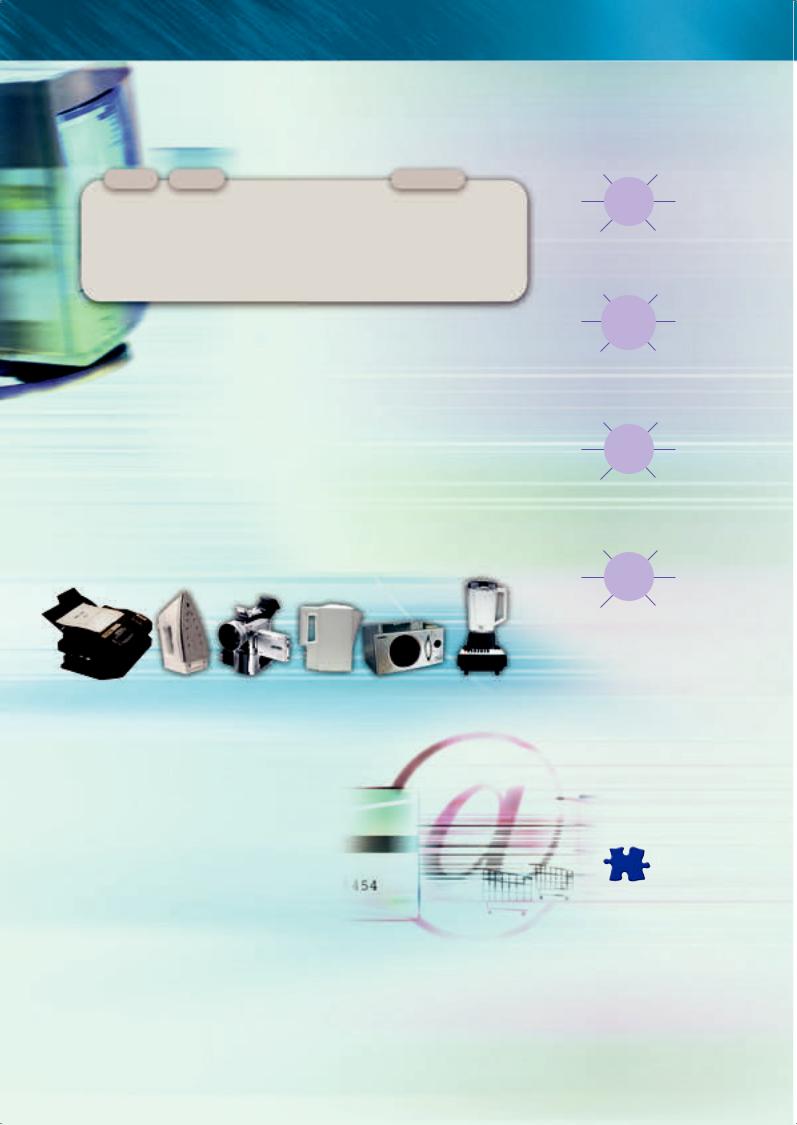
4 kettle 5 microwave oven 6 blender

b.Match the appliances above to their uses listed below, then make up sentences, as in the example.

ñ video events

ñ cook food ñ liquidise food

ñ boil water

ñ iron clothes ñ send faxes

Afaxmachineisusedforsendingfaxes.

7a. Fill in: turnon, plugin, logoff, create, send, install.

1The battery in my laptop is running out.


I need to ....................

it

............. and recharge it.


2

I’m going to ....................


an e-mail to my mother, because it’s


cheaper than calling her on the phone.


3

Can you help me ....................


this new computer game on my PC?

4

I’m going to ....................


a “birthday” file to store my friends’ birthdays.

5

Your printer isn’t broken – you just forgot to ....................

it ............ .

6

Don’t forget to ....................


when you have finished using the


Internet, or your phone bill will be huge.


b. Find the opposites of the verbs above.

86

WritingProject

Collect information about various inventors (e.g. date of birth/death, nationality, etc) and their

inventions (e.g. year, reason/use, etc). Find or draw pictures and prepare a poster of famous inventors and their inventions.

Game

Divide into two teams. One team says a word related to technology. The other team makes up a sentence using the word. Each correct sentence gets a point. The team with the most points is the winner.

TeamAS1: ATM

TeamBS1: AnATMisusedtoallowustoget

moneyoutofthebank.

Crime

9a. Match the criminals 1-8 to the definitions a-h, then make sentences, as in the example.

1

c

burglar

5


kidnapper


smuggler

6


hijacker

2


shoplifter

7


thief

3


arsonist

8


forger

4


asets fire to buildings/ forests/etc on purpose

btakes someone by force and doesn’t release them

until a ransom is paid

c breaks into a building in order to steal things

dcopies works of art/ documents/signatures/ etc to deceive people

e takes things into or out of a country illegally

f steals things from a shop while pretending to be a customer

gillegally takes control of a plane or other vehicle using force

hsteals another person’s property

Aburglarbreaksintoabuildinginordertostealthings.

b.Give the name of the crime and the verb related to each of the criminals above.

burglar–burglary–toburgle

10 a. Underline the correct word or phrase, then use your dictionary to help you explain the meaning.

24-year-old Sam Thorn of Leeds was 1) charged with/sentenced to 5 years in prison yesterday for car theft.

After Thorn was stopped for 2) speeding/skidding last July, the police discovered that the car which he was driving was stolen.

Although Thorn pleaded not guilty at his 3) court/ trial, there were three 4) statements/witnesses who saw him smash the window of the car and drive it away.

Thorn told the 5) judge/trial that it was his car but he had lost his keys. Unfortunately, he could not produce 6) defence/proof that the car was his and it was discovered that the real owner had reported it 7) stolen/ robbed the same day.

“I’m innocent” is all Thorn would say to the reporters outside the 8) courtroom/courtyard.

b. Match the columns to make correct sentences.

He was charged

for murder.

He was robbed

out of his money.

He was accused

of assault.

He was sentenced

with burglary.

He was cheated

to two years’ imprisonment.

He was tried

of a family heirloom.

6

Writing

Read the headline below, then write a news report.

Write: ñ where/when it happened

ñwhat happened in detail

ñwhat the criminal said

You can use words from Ex. 10.

11 Study the table, then rewrite the descriptions below, putting the adjectives in the correct order.

When two or more adjectives are used together to the same noun, they usually follow this order:


Opinion

expensive

elegant

pretty


Size

miniature

large

small


Age

brand-new

antique

old


Shape

rectangular

round

square


Colour

silver

brown

grey


Origin

Japanese

American

Irish


Material

plastic

wooden

stone


Use

mobile

dining

holiday


NOUN

phone

table

cottage

a a(n) oval/jewellery/blue/enamel box b a prehistoric/clay/cooking/brown pot c a striped/new/small/canvas bag

d a pair of triangular/ugly/plastic/orange earrings e a(n) antique/enormous/Chinese/beautiful vase

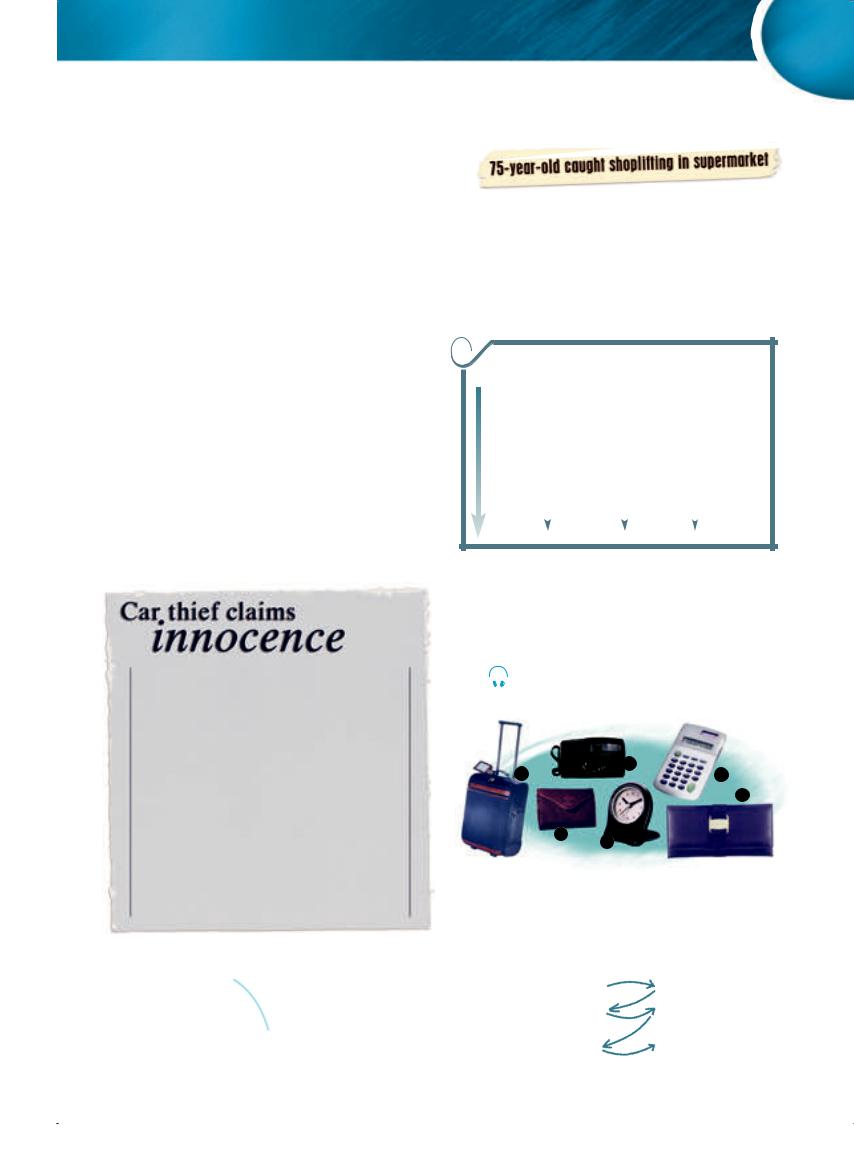
12 a. You will hear someone describing his stolen bag and what it contained. Listen and tick ( ) which of the objects below he describes.

B

A

C

F

D

E

b.Describe each of the objects shown above.

c.Take roles and act out a dialogue between a police officer (A) and a person (B) who is reporting the theft of their travel bag.

A

B

ask B’s name/address

give name/address

ask when/where/how

say when/where/how

the theft occurred

the theft occurred

ask B for description

describe stolen bag

of bag and contents

and contents in detail

87

Grammar in use

The Passive

Grammar Reference

13 Read the sentences a-h and underline the passive forms, then answer questions 1-6.

aCustomers are requested to refrain from smoking

inside the store.

b The motorist was fined í80 for illegal parking.

c Breakfast is now being served in the Garden Room. d “Guernica” was painted by Picasso.

e The theft was committed with high-tech equipment.

fRentals should be returned to the main garage.

gThe telephone was invented by Alexander Graham Bell.

hThis is clearly a case of arson, because the fire was started with rags soaked in petrol.

1Where might you see/read the sentences above?

Are they formal or informal in style?

2How do we form the passive?

3Which sentence(s) contain(s) the agent? Why? How is the agent introduced?

4 Why is there no agent in the other sentences? 5 How do we form the passive of modal verbs?

6When do we use withto introduce the agent?

14 Use the prompts to make complete passive sentences, as in the example.

1A: my office / break into / last night

Myofficewasbrokenintolastnight.

B:Oh no! Did they take anything?

2A: you / invite / to Bill’s birthday party?

B:No, I wasn’t.

3A: Can I have my bill, please?

B:Of course, sir. Your bill / prepare / now.

4A: the new CCTV camera / install / yet?

B:No, not yet.

5A: Is their website information up to date?

B:Maybe ... but I visited the website last week, and / it / not / update / for months.

6A: Why is everyone lined up?

B:Our ID cards / check / the security guards.

15 Study the examples. How do the two passive sentences differ?


Active

ñ Peoplesay that he escaped toBrazil.


Passive

ñ He is said to have escaped toBrazil.


ñ It is said that he escaped toBrazil.


16 Use the patterns in Ex. 15 to make sentences, as in the example.

1People believe he has stolen í1m.

Itisbelievedthathehasstolení1m. Heisbelievedtohavestolení1m.

2 They say he is working on a new software package.

3We expect the company will set up a computer network this year.

4The police think he was involved in the theft.

5Everyone thinks she is the creator of the robot-pet.

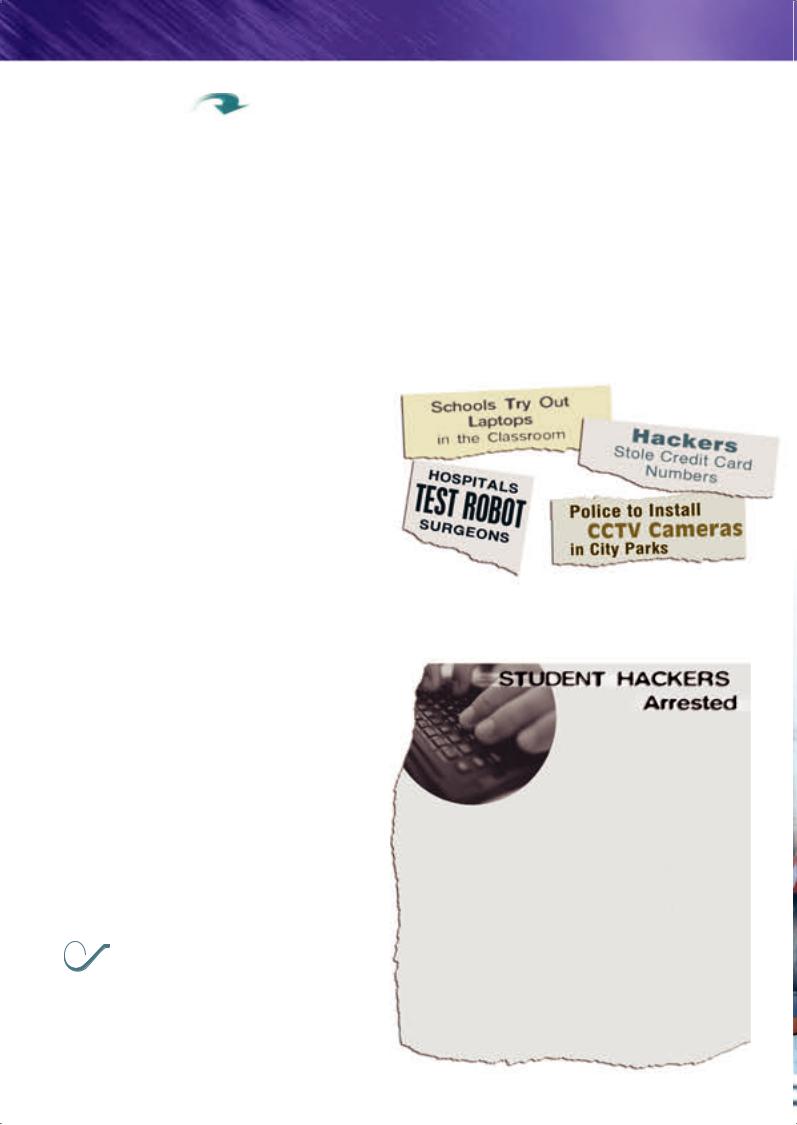
17 Expand the newspaper headlines into full sentences using the passive, as in the example.

Laptopsarebeingtriedoutintheclassroombyschools.

18 Complete the text by putting the verbs into the correct tense/form of the active or passive voice.

Four high school computer hackers 0) were arrested (arrest) yesterday and face charges of theft and fraud. It 1) .......................

.......................

(believe) the four boys,

aged between 16 and 18, 2) .......................

(use) a complex

Internet scheme to steal computer equipment. The boys,

whose names 3)

............................................. (not/release)

yet, 4) ...............................

(say) to 5) .................................

(break) into a local Internet server and 6) .............................

(steal) credit card numbers, which they used to go on a

giant online shopping trip. Altogether, they 7) .....................

(order) í20,000 worth of computer equipment before they

8) ..................................

(catch). The equipment 9) ............


..........................

(deliver) to vacant homes in the area,

where it

could 10) ...............................

(pick up)

after

school. When the boys 11) .........................................


(ask)

why they carried out such an elaborate scheme, they said they 12) ................................. (surprise) at how easy it was.
88

Relative Pronouns in Defining/Non-Defining

Relative Clauses

Grammar Reference

19 a. Use appropriate relative pronouns to match the main clauses to the relative clauses. When do we use who, which/that or whose?


Relative


Relative

clause


Main clause


pronoun


.


are useful


.


people

who

aren’t

arrogant


Lucy likes

she can talk to.


which

/ that


things

.


Lucy likes


whose

family

you have met

.


That’s

Lucy,


she can make

something

with


.


bicycle

was stolen

yesterday


b.Study the rule below. Can we leave out the relative pronoun in any of the sentences above? Which sentences, and why?

We can leave out the relative pronouns who, which and that if they are used as the object of a defining relative clause.

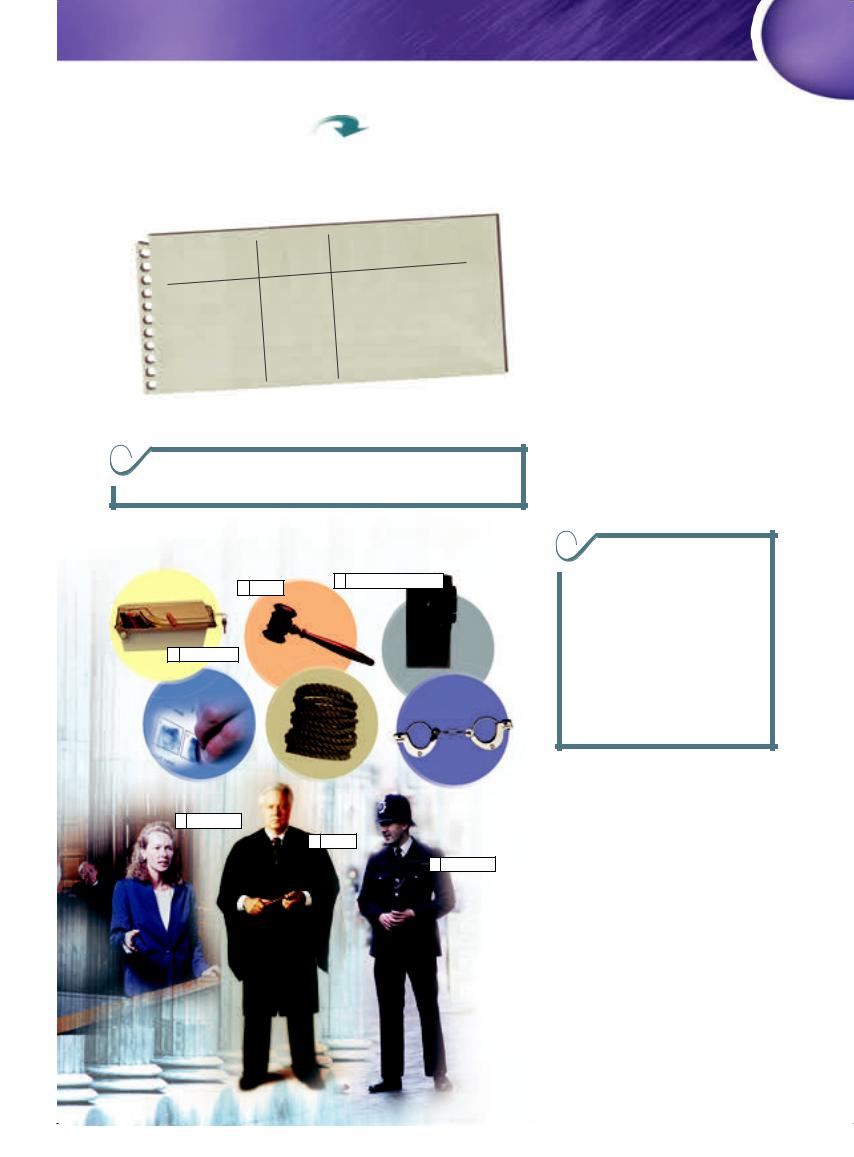
20 Make sentences with who/which about the people/things in the pictures, as in the example.

3 personaldictaphone

2 gavel

1 storagebox

6

21 Fill in who, whose or which. In which sentences could you leave out the relative pronoun? Why?

1 The man .................... she was talking to used to live here.

2He’s got a new job, ..................

is much better than his last one.

3That’s the man .....................

wife works with Steve.

4The police arrested the burglar

............ broke into their house.

5Sarah, ............. dog I’m looking after, is on holiday in Spain.

6We’re looking for a restaurant


................. serves Italian food.

7

Is that the girl

.............. bought


your car?


8

The train ....................

we were

going to take has just left.

9My video recorder, ..................

I bought last week, cost í200.

10I gave Joan, ................... car had broken down, a lift to the office.

... of whom / ... of which

Whom (for people) and which (for things) can be used with none of ... , allof...,mostof...,anyof...,manyof..., someof...,bothof...,eachof...,neither of...,eitherof...,oneof...etc.

He bought three jackets, all of which wereexactlythesamecolour.

He’s got two brothers, both of whom liveinEngland.

4

fingerprints


6

handcuffs

5

rope


7 lawyer

8 judge

9 policeman

1 Astorageboxis something whichweuseto storedisks.

22 Join the sentences using whichor whom, as in the example.

1Mary has three sisters. One of them is married.

Maryhasthreesisters,oneofwhom ismarried.

2He has three cars. One of them

is a Jaguar.

3Louise invited fifty people to the

party. Most of them said that they would come.

4The police arrested six men. Two of them are suspected of organising the crime.

5Two prisoners escaped. They were both later recaptured by the police.

89

Источник: https://studfile.net/preview/16430601/