Материал: Uchebnik_dlya_sud_expertov
intonation and stress. Any one of these areas communicates significant information nonverbally in any given culture.
One of the most apparent differences is the interpretation of dress. The message given by polished shoes, for instance, could easily be lost in a culture in which sandals are the standard footwear. Similarly, a woman's decision to wear her best suit would be lost in a culture in which no women wear business suits.
Just as importantly, people often bring to a crosscultural meeting ethnocentric prejudices regarding what they believe to be properly dressed. Thus, a European or an American may condemn as somehow less than civilized a Saudi or an Iranian in traditional garb. Conversely, a Saudi or an Iranian may well consider as immoral the bare face, arms, and legs of a European or an American woman in business attire.
Non-verbal behavioural differences in kinesics may be less obvious than dress differences. How people walk, gesture, bow, stand, or sit are all, to a large part, culturally determined. In many cases, a kinesic sign well understood in one culture is totally unknown in another culture. In Indonesia and in much of the Arab world, for example, it is offensive to show the soles of one's feet to another. This often clashes with behaviour in the United States where foot-crossing is common with no attention to where one's sole points. In Japan, a relatively elaborate system of bowing is common but has no counterpart in the United States.
Some kinesic behaviour may carry distinctly different meanings in more than one culture. In such cases, all parties recognize the gesture, but interpret it differently. During George Bush's visit to Australia while he was the President of the USA, he held up two fingers in a V sign. In both countries the symbol is widely understood, but in the United States the "V" emblem is a sign of good will, victory, and solidarity , while in Australia it carries a lewd, sexual meaning.
Haptics or touching behaviour also reflects cultural values. In a generally nonhaptic society such as Japan, touching another person in a business setting even with a handshake is traditionally considered foreign. While those Japanese familiar with U.S. handshaking may adapt to its use, one can expect that such cultural compromise would not easily extend to so haptic a response as a pat on the back.
The use of eye contact also varies significantly depending on the culture involved. In several cultures, for example, it is considered disrespectful to prolong eye contact with those who are older or of higher status. In many cultures, it is considered improper for women to look men in the eye. By contrast, in the United States, studies have shown that eye contact has less to do with age or rank than with a person's credibility or sense of belonging.
Finally, how far apart people stand when speaking or how far apart they sit in meetings carries significant information to people who share the same culture. Personal space is culturally determined. In the United States, for instance, people tend to feel most comfortable in business settings when speaking at approximately arm's length apart from each other.
In many Latin American, southern European, central African and Middle Eastern cultures, however, a comfortable conversational distance would be much closer. Indeed, in many parts of the world, friendly or serious conversations are conducted close enough to feel the breath of the speaker on one's face. The U.S. or northern European communicator unaware of this may face a very discomforting situation, with the speaker literally backing his or her U.S. or northern European counterpart into a comer as the speaker continues to move closer to the retreating listener. The result in a business situation could be disastrous. The speaker with the closer personal space conception would likely feel distrustful. Conversely, the person with larger personal space conception might feel the encroaching speaker to be pushy, overly aggressive, or rude.
Notes:
* kinesics - ( , , & , ) ** haptics - ( )
5. .
76

1.Non-verbal behaviour is a very important part of any communication.
2.Non-verbal behaviour may be broken down into five areas.
3.Kinesics includes emotions and speaking style of the speaker.
4.Haptics implies the use of body space.
5.The most apparent difference in cross-cultural communication is the interpretation of dress.
6.The bare face, arms, and legs of a woman in business attire is considered immoral in many Latin American cultures.
7.It is offensive to show the soles of one's feet to another in much of the Arab world.
8.All cultures have the same gestures and the same interpretation of them.
9.Prolonged eye contact with men is common for women in many cultures.
10.A relatively elaborate system of bowing is common for Middle Eastern cultures.
11.How far apart people sit in meetings carries significant information to those who share the same culture.
12.Those Japanese familiar with U.S. handshaking may adapt to its use and even extend such haptic response to patting on the back.
6.!$ $ .
Non-verbal pattern(s) of |
is (are) allowed in … |
is (are) forbidden in … |
behaviour |
(what country?) |
(what country?) |
1.a prolong eye contact with those who are older
2.a handshake
3.foot-crossing
4.two fingers in a V sign
5.patting on the back
6.bowing
7.to feel the breath of the speaker on your face
8.to speak at arm's length apart from each other
7. , & . ( $ $ & ! !' #' -
.
1.A Saudi, the Irtysh, an Iranian, a Japanese, the British, an Australian; ___________
2.a suit, a business attire, a garb, a suite, a dress, trousers; __________
77

3.handshake, hugging, touching, smile, kiss, patting; __________
4.shoes, sandals, boots, snickers, soles; __________
5.eyes, ears, a mouth, lips, a back, a nose, a forehead; __________
6.a mime, a gesture, a finger sign, thumb up, sadness. __________
8.. ..
1. kinesics 2. haptics 3. rhythm 4. intonation 5. stress 6. counterpart
a.The patterned, recurring alternations of contrasting elements of sound or speech.
b.The emphasis placed on the sound or syllable spoken most forcefully in a word or phrase.
c.The study of nonlinguistic bodily movements, such as gestures and facial expressions, as a systematic mode of communication.
d.One that closely resembles another.
e.A manner of producing or uttering tones, especially with regard to accuracy of pitch.
f.The study of nonlinguistic bodily movements, such as touch.
9. , #' !' %. / -
( !' & .
1.When greeting or leaving Russians always a) kiss each other
b) shake hands
c) pat on the shoulder
2.Russian belief holds that _____________ will lead to an argument. a) a handshake over a threshold
b) a handshake with a woman c) a handshake without smiling
3.Russians stand ________ when talking.
a)far from each other
b)close
c)holding hands
4. The ___________ can be an acceptable gesture of approval.
a)V sign
b)“thumb-up” sign
c)“thumb-down” sign
5.Speaking or laughing loudly in public is _________. a) discouraged
b) common c) desirable
6.Any public physical contact: hugs, backslapping, kisses on the cheeks are _________ among friends or acquaintances and between members of the same sex.
a) forbidden b) rare
78
c) common
10. ! #' # -
# .
A popular American politician (to travel) to a Latin American country several years ago. When he (to arrive) at the airport of the host country, he (to emerge) from the aircraft waving to the assembled crowd which included dignitaries and reporters from the local press. Someone (to ask) the American politician how his flight (to be). In response, he (to use) his thumb and forefinger to flash the common "O.K.!" gesture as the news cameras busily (to click away).
Leaving the airport, the American politician (to go) for a short visit with local government officials. Next, he (to go) to the major university in the area to deliver an address. He (to be) accompanied to the university by his official U.S. government translator who (to happen) to be a military man in full uniform. The American politician's speech (to deal) with the United States' desire to help their Latin American neighbours by way of economic aid.
The entire trip (to be) a disaster. Why? Because, though the American politician's verbal communication (to be) satisfactory, non-verbally he (to communicate) an entirely different message. When asked how his flight (to be), the American (to flash) what to him was a common "O.K." hand gesture. This act (to photograph) by the news media and (to print) on the front page of the local newspapers. While that hand gesture (to mean) "O.K." in North America, it (to be) a very obscene gesture in that part of Latin America. The university where the American politician (to choose) to deliver his policy address (to be) just the site of violent anti-government demonstrations. The students (to interpret) the presence of a military translator as meaning that the American politician (to support) the policies of the local government. The American politician (to communicate) two radically different sets of messages: one verbally and one nonverbally.
(by David Hesselgrave)
11. $ ! ' $ . , & - ! & -10-12 . / ! #, -
!' %.
$ . 2 & - # . + & $ & ,&, & .
$ , , " ! - *. > & $ - " $ -.
$ & ). @ & $ -. ( ) , ".
" " - )$ , ,) ", % . &$ -&.
&$, -
. " $) " |
, |
" . + , " |
: $- |
$ . - ; -" , 3; ) # # "" .
& $ , " : -
) " , ) &$, . + $ $ |
- |
. 1-" !, !# |
- |
" " ". - , & " " .
79
"$ $ $ & , & `V` ( ).$ , , .
12. % ! . ( ! #-! $ -
!' , ! $ ! ( $ .
UNIT 5. WRITTEN COMMUNICATION
1..
1.What does written communication include?
2.What does the effectiveness of written communication depend on?
3.What communication forms are described in the text?
4.What are the aims of writing memos?
5.What should you do before writing a memo?
6.What does effective use of emails require?
7.What is the best advice for writing emails?
Written communication includes traditional pen and paper letters and documents, typed electronic documents, e-mails, text chats, SMS and anything else conveyed through written symbols such as language. This type of communication is indispensable for formal business communications and issuing legal instructions. Communication forms that predominantly use written communication include handbooks, brochures, contracts, memos, press releases, formal business proposals, and the like. The effectiveness of written communication depends on the writing style, grammar, vocabulary, and clarity.
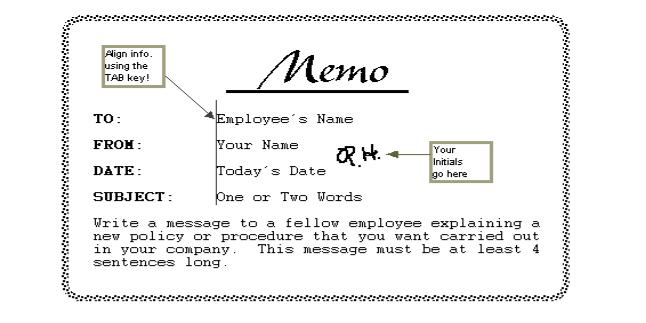
A memo is a document typically used for communication within a company. Memos can be as formal as a business letter and used to present a report. Usually you write memos to inform readers of specific information. You might also write a memo to persuade others to take action, give feedback on an issue, or react to a situation. However, most memos communicate basic information, such as meeting times or due dates. Before writing a memo, outline what your purpose is for doing so, and decide if the memo is the best communication channel.
80