Материал: Uchebnik_dlya_sud_expertov

Внимание! Если размещение файла нарушает Ваши авторские права, то обязательно сообщите нам

MODULE 11

FORENSIC DOCUMENT EXAMINATION

UNIT 1. INTRODUCTION

The discipline is known by many names including forensic document examination, questioned document examination, handwriting examination, or sometimes handwriting analysis, although the latter term is not often used as it may be confused with graphology.

1. , (

.

301

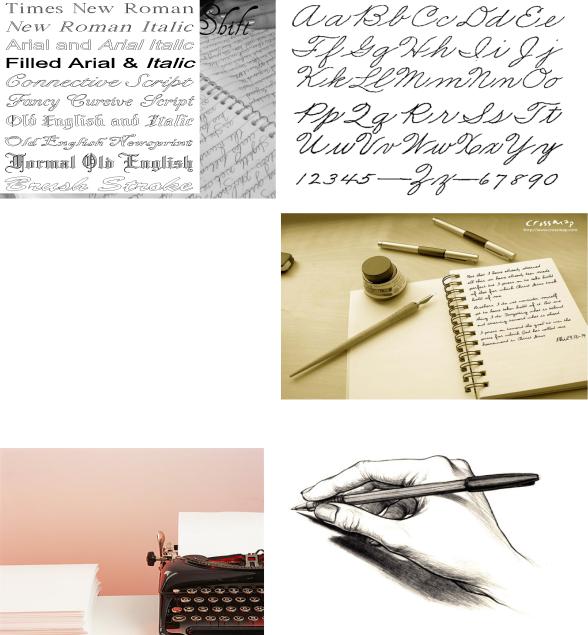
Writing, pen, pencil, ballpoint pen, paper, type-writer, alphabet, penmanship, style of handwriting, ink, letters, rubber stamp, font style, lines, cursive writing,

2. & ,

.

1. Writing is a system of human visual communication using signs or symbols associated by convention with units of language meanings or sounds recorded on materials such as paper, stone, or clay.

2.A ballpoint pen is a writing instrument which features a tip that is automatically refreshed with ink.

3.Penmanship is the technique of writing with the hand using a writing instrument.

4.Rubber stamp is a piece of rubber affixed to a handle and bearing raised characters used to make ink impressions, as of names or dates.

5.Font style is a typeface variation (normal, bold, italic, bold italic).

6.Line is a horizontal row of printed or written words or symbols.

7.Cursive is any style of handwriting that is designed for writing notes and letters quickly by hand. In the Arabic, Latin, and Cyrillic writing systems, the letters in a word are connected, making a word one single complex stroke. In fact, the word comes from the Latin cursivus, meaning "flowing".

3. ! . -

.

1.The advent of the (& ' &) in 1873 reduced the need for handwriting.

2.Today the influence of the early ( ) is seen throughout Europe and the Americas.

3.( ) evolved because people had a desire to communicate their thoughts with oth-

ers.

4.A forensic document examiner deals with items such as ( , &, !).

5.(< ) became extinct early in the 20th century as the typewriters replaced

handwriting in modern business.

6. For typing, the document examiner observes characteristics of the typeface, ( -&), spacing between letters and ( ).

4., .

1.What is the origin of the word “alphabet”?

2.What contribution did Romans do in the development of alphabet?

3.What does the word “italic” mean?

4.What alphabet is used in Russia and Eastern European countries?

a)Our present cursive handwriting is called italic, the word which comes from Italy. Today italic means script that slants to the right.

b)The word stems from the first two letters of Greek alphabet, alpha and beta. Their alphabet consists of 24 letters.

c)The Cyrillic alphabet derived from the Greek is used in Russia and Eastern European countries. This alphabet was introduced by St. Cyril and Methodis who proselytized* the Slavic tribes of East Europe in the ninth century.

d)The Romans borrowed the alphabet from the Greek and gave letters their names. For several centuries their writing consisted of disconnected capital letters then they invented the lower-

302

case letters that were patterned from the capital letters. These letters simplified the forms and made it easier to copy manuscripts.

*to proselytize –

5..

1.What will you do as a forensic document examiner?

2.How does a forensic document examiner work?

3.What problems does a forensic document examiner resolve?

4.What kind of documents does a forensic document examiner study?

5.What is the role of a forensic document examiner as a witness?

6.What qualifications should a forensic document examiner satisfy?

7.What educational qualifications are required?

TEXT

If you become a document examiner, you will not conduct crime scene searches, street investigations, interviews, or interrogations. Document examiners are laboratory investigators — not field investigators — most of the time. But know this, as a document examiner you will not be bored. Be assured, you will not find your work routine or mechanical.

You will usually work your cases solo — just you and the documents. You will use your eyes, your intellect, your experience, and optical tools such as the stereo-binocular microscope and camera. Examining questioned documents is a personal and mostly subjective decision-making business. When the examiner’s name on the report is yours, you alone will be responsible for the findings and conclusions. And you will be expected to show judges and jurors why you believe you are right. And you will do it alone.

So as a forensic document examiner you will usually have two basic problems to resolve:

(1) solving the evidence puzzle itself and (2) convincing judges and jurors that your opinions (conclusions) are correct.

A forensic document examiner studies all aspects of a document to determine its authenticity and origin, including handwriting, typewriting, printing, photocopies, inks and papers. Examiners look for clues that point to forgery. Having found they also try to determine where the forgery originated. Some of the most frequently examined documents are wills, medical records, loan agreements, contracts, checks, and letters that have no identified authors.

Forensic document examiners also testify as expert witnesses in court. A Forensic Document Examiner (also known as Questioned Document Examiner) discovers and develops evidence from a document or signature that can be used in a Court of Law. Forensic document examiners may cross and examine all forms of documents without losing any credibility in their testimony.

A Forensic Document Examiner must be a person of good moral character, high integrity, and good repute and must possess high ethical and professional standing.

A Forensic Document Examiner must have a sound basic education through the Bachelor degree. The typical training period is two years of study and practical experience in an established questioned documents laboratory where the examiner trainee studies the basic literature, completes study projects, becomes familiar with the role of forensic sciences in general and questioned documents in particular as they relate to the legal system.

303

6., !" ! .

. ( ! #! & -

$ .

Handwriting (cursive / printing) and signatures

Typewriters, photocopiers, laser printers, ink jet printers, fax machines

Rubber stamps, Price markers, Label markers

Printing processes

Ink, pencil, paper

Alterations, additions, erasures, obliterations

7.% ! . ! , -

. ! , -

! .

Case Study: Insurance Fraud

Background

A life insurance agent was “selling” insurance policies to people without their knowledge and consent. The people were elderly immigrants from Eastern Europe. The agent falsified the medical information and changed the age of the insured. He was caught because the handwriting did not match the insured’s normal writing.

Question

What alphabet would immigrants of Eastern Europe use?

Answer.

The Cyrillic alphabet.

Outcome

The document examiner determined that the handwriting of the immigrants was based on the Cyrillic alphabet, whereas the signatures in question were not. The insurance company sued the agent and recouped its losses.

UNIT 2. BASIC PRINCIPLES OF HANDWRITING

1. .

TEXT

BASIC PRINCIPLES OF HANDWRITING

No two people write exactly alike. The principles of handwriting identification are based on basic scientific truths about handwriting. The first and foremost of these scientific truths is that no two people write exactly alike in an extended handwriting sample. The use of a signature in legal and financial transactions is possible because unique characteristics in an individual's handwriting distinguish it from every other handwriting. This principle enables document examiners to differentiate genuine and non-genuine writing and to identify the author of a sample of handwriting.

The second basic scientific truth about handwriting is all writing contains natural variation so that no two writing samples by the same writer will be exactly the same. There are slight devia-

304

tions in all handwriting characteristics. The document examiner must learn to distinguish between natural variation and a different writer.

Writing is a complex act and a highly developed skill. Many influences affect the development of each person's writing ability, resulting in the unique style of each individual writer. These influences continue to occur throughout the life of the writer.

Physical factors, including hand-eye coordination, flexibility of wrist movement, and the grip of the writing instrument, play a part in the development of handwriting skills. Other factors include attitude and discipline. If handwriting is important to the writer, he or she will expend more effort in learning to write. Taking care to adhere more closely to the written model, the writer will continue practicing until reaching a skill level that is comfortable. Each person attains a level of skill that he or she finds acceptable. The more an individual practices writing, the better the skill.

Just how does the act of writing occur? Skilled writing uses arm, wrist, and finger movement. The arm moves across the paper as writing is produced so that the pen is presented at the proper location for writing. The arm may be in continual movement, or it may rest on the writing surface and move in segments as necessary. Skilled writers use a combination of finger, wrist, and arm movements to accomplish the act of writing. Poor writers use only their fingers and have to constantly lift and move their hand to reach across the page. Some writers use only arm movement, which is more difficult.

Writing becomes automatic to the point where the operation not only requires almost no conscious direction but is frequently beyond the control of the mind or the hand. This is evident when someone tries unsuccessfully to disguise his or her handwriting. The habits are so ingrained that the writer cannot eliminate all the characteristics comprising his or her writing style.

2. .

1. handwriting identification

a. $ -


2. handwriting sample

b.


"


3. document examiners

c. $


4. to differentiate genuine and non-

d.


genuine writing


5. to identify the author

e.


6. to contain natural variation

f. ( )


7. slight deviations

g. %


8. person's writing ability

h. $


9. flexibility of wrist movement

i.

$


#


(

)


10. grip of the writing instrument

j. & $


11.to reach a level of skill

k.

$


12. skilled writing

l. $ ")


13. poor writers

m. & " $


14. to disguise sb’s handwriting

n.


)


(

)

15. to eliminate all the characteristics

o. $ ,


305

Источник: https://studfile.net/preview/16694066/