Материал: Апсе ENVIRONMENTAL PROTECTION 2014
The following conditions should be satisfied for successful implementation of the laser-induced isotope separation:
1.The energy spectrum of the excited electronic levels must contain a line belonging to one isotope only, and this line must be sufficiently far from other spectral lines of the desirable isotope and from all spectral lines of other isotopes.
2.Physical or chemical processes must be found which are able to separate the excited and non-excited uranium-containing components.
3.Laser-induced impact on the isotopic composition to be separated must be a main excitation mechanism, not inter-atomic or intermolecular collisions.
4.High-efficiency lasers must be developed and finely tuned to the appropriate wavelength.
Presently, the following two laser isotope separation technologies are under intense development and demonstration, namely atomic vapor laser isotope separation (AVLIS) and molecular laser isotope separation (MLIS).
The AVLIS-technology has been developed at the Lawrence Livermore National Laboratory (USA). The AVLIS technology includes the following stages:
1. Vacuum evaporation of uranium atoms at very high temperature ( 23000C). Beam of accelerated electrons knocks uranium atoms out of
uranium-rhenium alloy.
2. Irradiation by xenon laser (λ 3780 Å, ultraviolet range). are selectively excited.
3.Irradiation by krypton laser (λ 3500 Å, ultraviolet range). The excited 235U atoms are selectively ionized.
4.Collection of 235U ions on an electrically charged plate.
The MLIS-technology has been developed at the Los Alamos National Laboratory (USA). The MVLIS technology includes the following stages:
1. Expansion of gaseous uranium hexafluoride – hydr ogen composition through a hypersonic nozzle. As a result, uranium hexafluoride
cools down to about 30 K but it does not condense.
2. Irradiation by infrared laser (λ 1,6·105 Å). Molecules of are selectively excited.
56
3. Irradiation by ultraviolet laser (l~3,08·104 Å). The excited molecules of 235UF6 are selectively dissociated with the formation of uranium pentafluoride 235UF5 and free fluorine:
2 × 235 UF6 ® 2 × 235 UF5 + F2 .
Uranium pentafluoride 235UF5 precipitates from the gas flow as a fine powder (so called, “laser snow”) that can be e asily collected.
The single-stage enrichment factors are very high for both laser technologies of uranium enrichment. They cover the range from 3 to 15, according to different experimental studies. Such high-efficiency technologies make it possible to use even the waste materials from GDand GC-processes containing about 0,2% 235U for production of reactorgrade uranium (about 3% 235U) by a single enrichment stage.
1.2.7. Chemical methods of isotope separation
The chemical methods of isotope separation are based on the preferential stability of certain isotopes in various immiscible chemical compounds. The isotope exchange reactions can occur, if two different chemical compounds of one multi-isotope chemical element enter into a contact. The isotope exchange reactions lead to the concentration of isotopes in those compounds where they can be more stable.
The following conditions must be satisfied for feasibility of the chemical isotope separation technologies:
1.The contacting compounds must be chemically stable together.
2.The contacting compounds must be separated by a relatively simple means (for example, organic and inorganic substances).
3.It is desirable for the chemical element to be of different valences in two contacting compounds.
The following examples of the chemical isotope separation are presented below:
1.Boron enrichment with isotope 10B:
BF3 + BF3O(CH3)2 ® 11BF3 + 10BF3O(CH3)2 ,
i.e. isotope 10B passes into the organic compound.
57
2. Production of heavy water:
H2O + HDS ® HDO + H2S.
Natural hydrogen contains about 0,015% deuterium. In the isotope exchange reaction between light water and hydrogen sulphide, deuterium passes into the aqueous fraction.
The chemical isotope separation technologies for boron enrichment and heavy water production are characterized by the single-stage separation factor about 1,0025 and specific energy consumption within the range of 400-700 kWh/SWU.
Presently, the advanced chemical uranium enrichment technology is under development and testing in the USA and Japan. The technology applies UF6 and NOUF6 as the contacting compounds. The process is called as “reduction-oxidation (redox) chromatograp hy”. The redox chromatography consists in alternating the reduction reaction with hydrogen and the oxidation reaction with oxygen. The process results in separation of the chemical compound containing UO2++ ions (sixvalence uranium where 235U is more stable) and U4+ ions (four-valence uranium where 238U is more stable). Some experimental studies demonstrated sufficiently good parameters of the redox chromatography: the single-stage separation factors are about 1,08 and specific energy consumption is about 150 kWh/SWU.
1.2.8. Plasma method of isotope separation
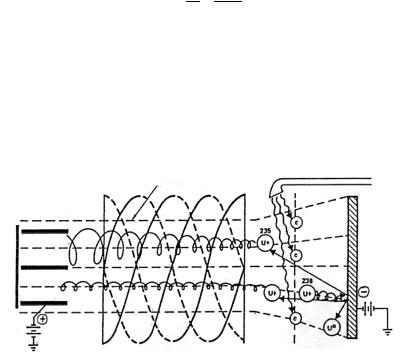
The plasma technology of isotope separation is based on the effect of ion cyclotron resonance. The effect is described below.
If any charged particles (ions, for instance) pass through a constant magnetic field B, they begin rotating along spiral orbits around force
lines of the magnetic field under action of the centrifugal force F :
F = q ×[V ´ B];
where q –electrical charge of ions; V - velocity of ion movement.
58
Orbital radius R and angular frequency of spiral rotation can be derived from the following relationships:
F = q × V × B = |
m × V2 |
|||||
|
; |
|
||||
|
||||||
|
|
|
|
R |
||
R = |
m × V |
= |
(2 × m × E)1/2 |
; |
||
|
|
|||||
|
q × B |
q × B |
||||
w =
The angular frequency w is (ICF) of isotope with mass m.
V = q × B .
R m
called as an ion cyclotron frequency
|
Isotope |
|
Isotope separation |
|
Microwave ion |
|
||||||||||||
|
collectors |
|
area |
|
|
source |
|
|||||||||||
|
|
|
|
|
|
|
|
|
|
|
|
|
|
|
|
|
|
|
|
|
|
|
|
|
|
|
|
|
|
|
|
|
|
|
|
|
|
|
|
|
|
|
|
|
|
|
|
|
|
3 |
|
|
|
|
|
|
|
|
|
|
|
|
|
|
|
|
|
|
|
|
|
|
|
|
|
|
|
2 |
|
|
|
|
|
|
|
|
|
|
|
|
|
|
|
|
|
|
|
|
|
|
|
|
|
|
|
|
3 |
|
|
|
|
|
|
|
|
|
|
|
|
|
|
|
|
|
|
|
|
4 |
|
|
||
|
|
|
|
|
|
|
|
|
|
|
|
|
|
|
|
|
||
|
|
1 |
|
|
|
|
|
|
|
|
||||||||
|
|
|
|
|
|
|
|
|
|
|
3 |
|
|
|
|
|
||
|
|
|
|
|
|
|
|
|
|
|
|
|
|
|
|
|
|
|
|
|
|
|
|
|
|
|
|
|
|
|
|
|
|
|
|
|
|
|
|
2 |
|
|
|
|
|
|
|
|
|
|
|
|
|
|
|
|
|
|
|
|
|
|
|
|
|
|
|
|
|
|
|
|
|
|
|
|
|
|
7 |
|
|
|
|
6 |
|
|
|
5 |
|
|
|
|
|
|
|
|
|
|
|
|
|
|
|
|
|
|
|
||||||
|
|
|
|
|
|
|
|
|
|
|
|
|
|
|
|
|||
|
|
|
|
Fig. 1.5. Layout of the plasma isotope separation |
||||||||||||||
1 – collectors of the waste; 2 – collectors of the |
product; 3 – force lines; |
|||||||||||||||||
4 – metal plate (source of neutral particles); 5 – |
electrical heating area; |
|||||||||||||||||
6 – antenna of the alternating electrical field; 7 |
– charging of the collec- |
|||||||||||||||||
tors to enhance isotope separation efficiency. |
|
|
|
|
|
|
|
|
||||||||||
59
A principal layout of the plasma isotope separation is shown in Fig. 1.5.
If the alternating electrical field with the frequency equaled to the ICF value of 235U ions, for instance, is applied to the flow of spirally rotating ions, then energy of the alternating electrical field can be absorbed by 235U ions only. Just this is the effect of ion cyclotron resonance. Selective increasing the energy of 235U ions can extend their spiral trajectories and, thus, create the opportunity for spatial separation of 235U and 238U ions. The ICF values of two main uranium isotopes differ from each other on about 1,2%. The difference can allow it to arrange selective acquisition of 235U and 238U ions on the properly placed and charged collectors.
1.3. Technologies for fabrication of fuel rods and fuel assemblies
Presently, uranium dioxide UO2 is the most widely used type of ceramic nuclear fuel. Uranium dioxide fuel (UOX-fuel) is currently loaded into practically all types of nuclear power reactors including thermal light-water and heavy-water reactors as well as fast breeder reactors).
Uranium dioxide is a dark-brown, highly hard and brittle substance. Uranium dioxide does not interact with alkaline and aqueous solutions up to 3000С but it can be well dissolved by acidic solutions (nitric acid and mixture of nitric acid with hydrochloric or hydrofluoric acid).
Main advantages of uranium dioxide:
1.High melting temperature (27800С).
2.High chemical stability in contacts with main coolants of nuclear power reactors (light water, heavy water, sodium and carbon dioxide).
3.Satisfactory compatibility with main cladding materials of nuclear power reactors (stainless steels, zirconium-based alloys) within the reactor temperature ranges.
4.Acceptable radiation resistance under high neutron fluxes (~1014 n/cm2×s) and fluences (up to ~1022 n/cm2, i.e. for about three years).
5.Manufacturing feasibility of high-density UOX-fuel pellets (up to 95% of its theoretical density that equals 10,96 g/cm3).
60