Материал: Апсе ENVIRONMENTAL PROTECTION 2014
3.Coal miners – 1100 days.
4.Grade school drop-out – 800 days.
5.Unemployment – 500 days per one year of unemploy ment.
Loss-of-Life-Expectancy for health ailments
1.Heart diseases – 1607 days.
2.Cancer – 1247 days.
3.Overweight – 1020 days.
4.Stroke – 510 days.
5.Pneumonia, influenza – 105 days.
Loss-of-Life-Expectancy for circumstantial situations
1.Being male versus female – 2800 days.
2.Being black versus white – 2000 days.
3.All accidents – 360 days.
4.Married to smoker – 50 days.
5.Ionizing irradiation:
a.Radon in house - 29 days.
b.Living near NPP – 10 hours.
6.Nuclear power industry:
a.Evaluated by the Union of Concerned Scientists – 2 days.
b.Evaluated by the Nuclear Regulatory Commission – 1 hour.
Loss-of-Life-Expectancy for electricity generation technologies
1.Coal-fired plants – 23 days.
2.Oil-fired plants – 4 days.
3.Natural gas-fired plants – 2,5 days.
4.Nuclear power plants:
a.Evaluated by the Union of Concerned Scientists – 2 days.
b.Evaluated by the Nuclear Regulatory Commission – 1 hour.
So, it becomes evident that natural radiation background and nuclear power plants are very far from being the main factors for a human life shortening of American people.
2.4. Principle of radiation equivalency
Russian nuclear specialists put forward the principle of radiation equivalency between natural uranium, on the one hand, consumed by nuclear power plants for energy generation and the radiowastes, on the another hand, as harmful by-products of this process.
121
The essence of the radiation equivalency principle can be defined by the following considerations. Natural uranium is used to fabricate nuclear fuel. Nuclear fuel burning-up at NPP is able to yield the wholesome products (electrical and thermal energy, secondary fuel) as well as the undesirable by-products (radiowastes with fission products and minor actinides as main components). So, initial material is a natural uranium which can be converted into nuclear fuel and burnt-up in nuclear power reactors. The burning-up process is accompanied by generation of the wholesome and harmful products. The problem is to organize the nuclear fuel burn-up and the radiowastes management by such a way that ecological danger from the radiowastes became approximately the same as ecological danger from natural uranium for a relatively short time period. In other words, if МU mass of natural uranium is burnt-up at NPP with undesirable accumulation of the radiowastes (МRAW – mass of the radiowastes), then potential biological danger of both masses must be made equivalent to each other by using a certain scheme of NM flows within a nuclear energy system. Since radioactivity is the most dangerous property of the radiowastes, the radiation equivalency principle is proposed, i.e. radioactivities (or radiotoxicities in a more general sense) of natural uranium and the radiowastes accumulated in the uranium energy utilization should be balanced. This principle can keep total radioactivity of the Earth at a constant, unchangeable level.
Large-scale system of lead-cooled fast reactors fueled with mixed uranium-plutonium nitride (BREST-type reactors) is under intense development now in Russia as one of the most promising options for real implementation of the radiation equivalency principle. Numerical and theoretical studies have demonstrated that fast BREST-type reactors possess the property of inherent safety, i.e. any reactivity-induced accidents (like Chernobyl catastrophe) can be excluded deterministically. No physical phenomena and erroneous actions of NPP operators are able to initiate these severe accidents.
Unique neutron abundance and high neutron flux in fast BRESTtype reactors make it possible to organize full recycle of main fissile materials (uranium and plutonium isotopes), effective transmutation of minor actinides (neptunium, americium and curium isotopes) and some long-lived fission products (99Tc and 129I). Optimal configuration of material flows in the emerging nuclear energy system of fast BRESTtype reactors and the SNF reprocessing facilities can reach the balanced
122
situation between potential biological danger of the accumulated radiowastes and potential biological danger of the consumed natural uranium after 200-300 years of the system operation.
2.5. Two approaches to evaluating the radiation effects on human organism
There are two contrary approaches to determining the dependency of harmful irradiation consequences for a human health on the absorbed radiation dose.
The first approach presumes that any level of the radiation dose, no matter how small, absorbed by a human body can contribute to the risk of health ailments, and the amount of radiation damages is directly proportional to the radiation dose. Presently, the overwhelming majority of environmentalists has adopted the linear hypothesis for dependency of radiation damage on the radiation dose. This approach is named as the “non-threshold” theory. Though the scope of experim ental data on radiation damages from small radiation doses is evidently insufficient for unconditional corroboration of the non-threshold theory, nevertheless, the non-threshold approach is regarded now as a basic one and widely used in the regulatory radiation safety guidelines for all operations with radioactive materials. Foundation for such a conservative (i.e. with a certain reserve) approach is quite clear and still acceptable now: even if we are mistaken, we are mistaken in the better direction, namely in the direction towards the stronger (maybe, excessively stronger) protection of the humankind against any negative consequences of any ionizing irradiation.
The weakest point of the non-threshold theory is a shortage or even full absence of reliable experimental data about radiation effects from small radiation doses. Available now experimental information allows us to say with a great confidence about linear dependency of radiation damages on the radiation doses only for the doses above 1 Sv. The dose range from zero to one sievert remains an unexplored area, field for a lot of various guess-works and speculations.
Opponents of the non-threshold theory put forward the following counter-arguments:
1. Some experimental studies with animals have revealed that complete isolation from natural radiation background increased their mortality.
123
Moreover, the low-dose irradiation can be actually beneficial for some animals and plants.
2.Many low-level impacts can produce a favorable effect on a human health while the same but high-level impacts can be very harmful. For example, one pellet of a soporific drug saves from insomnia while taking of many the same pellets is the most widely used form of suicide. The morning cold-water douche can trigger the restorative mechanisms in a human body, and they overcome the initial negative cold effect with a great reserve. At the same time, even relatively short staying in cold winter water can lead to the lethal outcome.
The following conclusions can be derived from these counterarguments.
1.Full exclusion of natural radiation background can produce a negative biological effect on a human organism. Probably, low-dose irradiation is able to suppress some pathological phenomena and intensify some restorative forces.
2.If the radiation dose increases from zero to the level of natural radiation background, then a certain strengthening effect (like cold-water douche) arises, the harm caused by complete exclusion of natural background drops down and, maybe, changes its sign. In other words, low-level radiation doses can produce a positive healthy effect. It is interesting to note here that mountain-dwellers who live under substantially higher natural radiation background (radioactive rocky formations plus cosmic rays) distinguish, as a rule, with their robust health and enviable longevity.
3.If the radiation dose continues increasing above the level of natural background, then its sanitary effect is accompanied by the gradually enhancing negative consequences. At a certain dose, the positive impact reaches its maximal value, the negative factors begin prevailing. The “dose-damage” curve (Fig. 2.1) crosses the zero val ue, and the corresponding dose is a true radiation threshold beyond which ionizing radiation can produce negative effects only.
4.When the radiation dose increases up to one sievert, the “dose-damage” curve will coincide with linear dependency of the non-threshold theory.
So, the “dose-damage” curve can be presented in the form shown in Fig. 2.1.
124
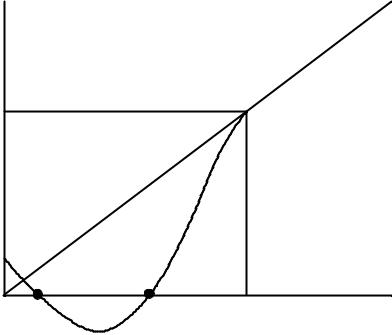
Radiation damage |
|
|
|
|
Non-threshold |
|
|
theory |
|
|
Dose |
Natural |
Thres- |
1 Sv |
back- |
hold |
(100 rem) |
ground |
Threshold |
|
|
theory |
|
Fig. 2.1. Two approaches to evaluating the radiation damage
Control questions to Chapter 2
1.What ecological effects can nuclear enterprises produce?
2.Call main components of natural radiation background.
3.Call main ecological effects produced by mining and HM-treatment of uranium ore.
4.Call main ecological effects produced by nuclear power plants during their normal operation.
5.What is the main ides of the radiation equivalency principle?
6.What are the differences between the threshold and non-threshold approaches to evaluating the radiation damages for a human organism?
125