Материал: Апсе ENVIRONMENTAL PROTECTION 2014
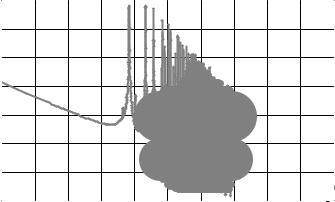
Similarly to 238U, isotope 231Pa is a fertile isotope that can not be fissioned by thermal neutrons but it can breed fissile materials. Energy
dependencies of neutron radiative capture cross-sections are shown in Fig. 6.1 for 238U and 231Pa.
|
|
|
|
Table 6.2 |
|
Nuclear properties of uranium isotopes |
|
|
|||
|
|
|
|
|
|
Properties |
232U |
234U |
235U |
238U |
|
Half-life, years |
68.9 |
2.45·105 |
7.04·108 |
4.47·109 |
|
Yield of a-particles, |
8.0·1011 |
2.3·108 |
7.9·104 |
1.2·104 |
|
1/(g×s) |
|
|
|
|
|
Mean energy of |
5.3 |
4.76 |
4.4 |
4.19 |
|
a-particles, MeV |
|
||||
|
|
|
|
|
|
Yield of spontaneous |
|
5.02·10-3 |
2.99·10-4 |
1.36·10-2 |
|
fission neutrons, |
1.3 |
|
|||
1/(g×s) |
|
|
|
|
|
Fission cross-section |
77.15 |
0.465 |
583.2 |
1.2·10-5 |
|
(En = 0.0253 eV) |
|
|
|
|
|
Table 6.3
232U decay products (a-emitters)
Properties |
228Th |
224Ra |
220Rn |
216Po |
212Bi |
212Po |
Half-life |
1.91 years |
3.62 d |
55.6 s |
0.145 s |
1.01 h |
3·10-7 s |
|
5.42 |
5.69 |
|
|
6.09 |
|
Eα, MeV |
(71.7%) |
(94.9%) |
6.29 |
6.78 |
(9.7%) |
8.78 |
(relative intensity) |
5.34 |
5.45 |
(100%) |
(100%) |
6.05 |
(100%) |
|
(27.6%) |
(5.1%) |
|
|
(25.2%) |
|
176
barn |
1,0E |
04 |
|
|
|
|
|
|
|
1E+4 |
231Pa |
|
|
|
|
|
|||
1,0E |
03 |
|
|
|
|
|
|||
-sections,барн |
1E+3 |
|
|
|
|
|
|
|
|
1,0E1E+202 |
|
|
|
|
|
|
|
||
1,0E1E+101 |
|
|
|
|
|
|
|
||
захвата |
|
|
|
|
|
|
|
||
1,0E1E+00 |
|
|
|
|
|
|
|
||
cross |
|
238U |
|
|
|
|
|
||
captureСечение |
1,0E1E--101 |
|
|
|
|
|
|
||
|
|
|
|
|
|
|
|||
1,0E1E--202 |
|
|
|
|
|
|
|
||
Radiative |
|
|
|
|
|
|
|
||
1,0E1E--303 |
|
|
|
|
|
|
|
||
|
,0E |
|
1,0E-02 1,0E-01 |
1,0E+00 1,0E+01 1,0E+02 1,0E+03 1,0E+04 1,0E+05 |
1,0E+06 |
,0E 07 |
|||
|
1E-03 |
1E-1 |
1E+1 |
1E+3 |
1E+5 |
|
1E+7 |
||
|
|
|
|
Энергия нейтрона, эВ |
|
|
|
||
|
|
|
|
|
Neutron energy, eV |
|
|
|
|
Fig. 6.1. Energy dependencies of neutron radiative capture crosssections for 238U and 231Pa.
The following two important aspects should be noted here. Firstly, within thermal energy range, 231Pa is a superior neutron absorber as compared with 238U. For example, radiative capture cross sections of
thermal neutrons (En = 0.0253 eV) for these two isotopes are equal to: σc(231Pa) = 227 barns, σc(238U) = 3 barns. So, the presence of 231Pa in
fuel composition can promote effective generation of fissile isotopes
232U and 233U. Secondly, there is a rather large energy distance between capture resonances of 238U and 231Pa. Capture resonances of 231Pa be-
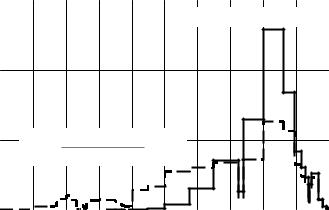
long to relatively low energies, below 100 eV (Fig. 6.1). This means the presence of 231Pa in fuel composition can depress thermal region in energy spectrum of neutrons (Fig. 6.2).
It can be seen that, although neutron energy spectrum in VVER-1000 contains a certain fraction of thermal neutrons, introduction of 231Pa into fuel composition can remove the thermal fraction completely. That is why stainless steel may be used here as a structural material. Indeed, the absence of thermal fraction in neutron spectrum does not result in additional neutron loss but fuel rods can keep their ability for working up to the higher values of fuel burn-up than those with zirconium-based alloys.
177
Спектр нейтронов, отн. ед. Neutron spectrum, relative units
0,3299
20% 233U + 80% 231Pa
0,2199
0,1099 ВВЭРVVER--1000:
4,4% 235U + 95,6% 238U
-0,01 |
,00E |
1,00E+00 |
,00E 01 |
1,00E+02 |
,00E |
1,00E+04 |
,00E 05 |
1,00E+06 |
,00E 07 |
1,00E-03 1,00E-02 |
|||||||||
1E-3 |
1E-01 |
|
1E+1 |
|
1E+03 |
|
1E+5 |
|
1E+7 |
ЭнергияNeutron нейтронаenergy, eV, эВ
Fig. 6.2. Effect of 231Pa on neutron spectrum
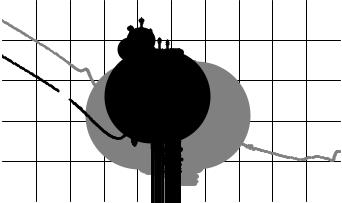
Now let us consider nuclear properties of 232U, product of neutron capture by 231Pa and rapid β-decay of 232Pa (T1/2 (232Pa) = 1,3 days). Like 235U, isotope 232U is a fissile nuclide. Dependencies of fission crosssections on neutron energy are presented in Fig. 6.3 for 235U and 232U.
It can be seen that, within thermal energy range, fission crosssections of 232U are substantially lower than those for 235U while radiative capture cross-sections of these isotopes are comparable each other.
For example, radiative capture cross sections of thermal neutrons (En = 0.0253 eV) for these two isotopes are equal to: σc(232U) = 73 barns,
σc(235U) = 99 barns. So, neutron-multiplying properties of 232U are inferior to those of 235U within thermal energy range.
This conclusion can be confirmed by Fig. 6.4 which demonstrates energy dependency of (νef - 1), i.e. the number of excess fission neutrons per one absorbed neutron. 235U looks superior to 232U within thermal energy range but quite another situation takes place in resonance range. So, it may be expected that introduction of 231Pa into uraniumbased fuel composition with aim to increase fuel burn-up will be more efficient just in resonance neutron spectrum.
178
FissionСечениеcrossделения-sections,барнbarn
1E+4,0 04
235U
1E+3,0 03
1E+2,0 02
232U 

1E+1,0 01
1E+0,0 00
1E,0E-01
1E,0E--03 1,0E-02 1E,0E--101 1,0E+00 1E+11,0E+01 1,0E+02 1E+31,0E+03 1,0E+041E+51,0E+05 1,0E+061E+71,0E+07
ЭнергияNeutron нейтронаenergy, eV, эВ
Fig. 6.3. Dependency of fission cross-sections on neutron energy for isotopes 235U and 232U
|
|
3 3 |
|
|
|
|
|
|
|
2,5 |
|
|
|
|
|
|
|
2 2 |
|
|
|
|
|
νef |
– 1 |
1,5 |
235U |
|
|
|
|
|
|
1 1 |
|
|
|
|
|
|
|
|
|
|
|
|
|
|
|
0,5 |
232U |
|
|
|
|
|
|
0 0 |
|
|
|
|
|
|
|
|
|
|
|
|
|
|
|
-0,5 |
|
|
|
|
|
|
|
1,00E-03 |
1,00E-02 1,00E-01 |
1,00E+00 1,00E+01 |
1,00E+02 1,00E+03 |
1,00E+04 1,00E+05 |
1,00E+06 1,00E+07 |
|
|
1E-3 |
1E-1 |
1E+1 |
1E+3 |
1E+5 |
1E+7 |
ЭнергияNeutronнейтронаenergy, eV, эВ
Fig. 6.4. Energy dependency of the number of excess fission neutrons per one absorbed neutron for isotopes 235U and 232U
179
6.3. NM proliferation protection in open NFC
Presently, there are different points of view on future development of nuclear fuel cycles. Some countries (USA, Canada, Germany and Sweden) are implementing in practice an open (or once-through) nuclear fuel cycle that does not foresee a radiochemical SNF reprocessing in the visible future. One of the reasons for this choice is a wish of decreasing a risk of nuclear weapon proliferation. SNF may be only converted into the forms suitable for long-term controlled storage. However, such a strategy of nuclear power development has already resulted in large SNF stockpiles, potentially dangerous nuclear materials. So, the preferable option for future development of nuclear power consists in transition to the closed fuel cycles with SNF reprocessing, separation of radioactive fission products and recycling of residual fuel.
Low-enriched uranium (LEU) is a fresh fuel for open nuclear fuel cycle. Plutonium in spent fuel assemblies is protected by intense gamma-radiation of fission products. That is why unirradiated nuclear materials are more vulnerable for unauthorized proliferation.
Isotope uranium denaturing may be regarded as an effective method for upgrading self-protection of unirradiated uranium-bearing materials. In principle, uranium may be denatured by the following two ways: direct introduction of intense radioactive isotope 232U into uranium fuel composition or direct introduction of relatively weaker radioactive isotope 231Pa into uranium fuel composition. 231Pa is a neutron predecessor of 232U, main isotope of uranium denaturing. So, only short-term preirradiation of fresh fuel assemblies in the research reactors may be sufficient to produce proliferation resistant fuel assemblies, suitable even for export deliveries.
6.3.1. Uranium denaturing as a way for formation of internal α-radiation source
Along with progress in development of high-efficiency enriching technologies, potential threat of LEU diversion and re-enrichment up to the weapon-grade level excites more and more apprehensions. These reasons indicate that, besides reduction of uranium enrichment below
180