Материал: Апсе ENVIRONMENTAL PROTECTION 2014
20% 235U, according to the IAEA recommendations, other measures may be also required to upgrade LEU self-protection against its unauthorized re-enrichment. Taking into consideration the growing worldwide scope of LEU utilization, including LEU with enrichment in the vicinity of the upper boundary (~20% 235U), high LEU vulnerability to unauthorized re-enrichment must be recognized. Particular apprehensions are related with 20%-uranium. So, some additional actions should be undertaken to protect LEU against its unauthorized re-enrichment. The effects of 232U introduction into LEU are caused by the following specific properties of this uranium isotope:
1.Good neutron-multiplying properties of 232U and its neutron predecessor 231Pa make it possible to extend time period of continuous reactor operation without refueling up to the values comparable with the reactor lifetime. As a result, unauthorized extraction of plutonium from spent fuel assemblies becomes unfeasible.
2.It is impossible to remove 232U from denatured uranium without application of the very sophisticated and expensive isotope separation technologies.
3.232U is a neutron source from spontaneous fission reactions and a source of high-energy α-particles. Alpha-particles emitted by 232U are able to dissociate molecules of uranium hexafluoride and, thus, could make it practically unfeasible to re-enrich denatured uranium up to the weapon-grade level. Besides, α-particles are able to initiate (α,n)- reactions with impurities of light elements and, thus, intensify internal neutron generation. Thus, export deliveries of LEU-based fuel assem-
blies to foreign NPP receive an additional proliferation barrier.
Even if only 10 ppm 232U is introduced into 20%-uranium, then 232U becomes a main contributor to total intensity of α-radiation. This effect plays a definitive role in forming the inherent radiation barrier against
unauthorized re-enrichment of 20%-uranium up to weapon-grade level. Since 232U nuclei are lighter than 235U nuclei, 232U content, as far as the
re-enrichment proceeds, increases with subsequent intensification of α- radiation. If 0.001÷0.1% 232U is introduced into 20%-uranium, then α- activity of the re-enriched product can increase by two orders of magnitude. Besides, “light” 232U supplants “heavy” 235U and, thereby, limits final 235U content in the r-enriched product. 232U decay products can contribute additionally to total α-activity of the r-enriched uranium.
181
6.3.2. Evolution of neutron background in re-enrichment of denatured uranium, evaluation of energy yield
Time-dependent evolution of neutron emission rate in the process of 20%-uranium re-enrichment was numerically evaluated, and the follow-
ing results were obtained.
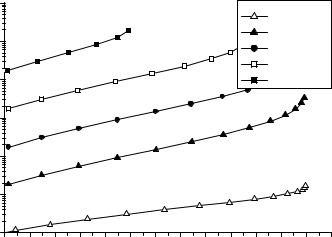
If 232U is absent at all in 20%-uranium, then 234U is a main neutron emitter through (α,n)-reactions with light impurities (Fig. 6.5). However, in this case, neutron emission rate is lower than neutron emission rate from spontaneous fission reactions of 238U (13,6 n/kg·s) by one order of magnitude. Such low value of neutron yield is quite insufficient for uranium self-protection.
If 20%-uranium was produced from the regenerated LWR uranium, which already contained trace amounts of 232U, then neutron emission rate from (α,n)-reactions with light impurities can increase up to 3,5 n/kg·s in the process of 20%-uranium re-enrichment up to weapon-grade
level. 234U remains a main neutron source at negligibly small contributions of 232U and 236U.
If relatively small amount of 232U is introduced into 20%-uranium, regardless of its origin either from natural uranium or from the regenerated LWR uranium, then the situation drastically changes. Amongst all uranium and plutonium isotopes, 232U is the most intense α-emitter. Therefore, (α,n)-reactions with light impurities begin playing a dominant role in formation of neutron background. If only 0.001% 232U is admixed to 20%-uranium, then neutron background upgrades by two orders of magnitude. If 0.1% 232U is admixed to 20%-uranium, then neutron background from the re-enriched product exceeds emission rate of spontaneous fission neutrons of 238U by a factor of 590. This neutron background can continue upgrading thanks to 232U decay products. In a year the neutron background can increase additionally by a factor of 3.
182
|
100 |
|
|
|
|
|
|
|
|
|
|
0% 232U |
|
|
|
|
|
|
|
|
|
|
|
|
|
|
|
||
|
10 |
|
|
|
|
|
|
|
|
|
|
0.001% 232U |
||
|
|
|
|
|
|
|
|
|
|
|
0.01% 232U |
|
||
n/(g*s) |
|
|
|
|
|
|
|
|
|
|
|
0.1% 232U |
|
|
1 |
|
|
|
|
|
|
|
|
|
|
1% 232U |
|
||
|
|
|
|
|
|
|
|
|
|
|
|
|
|
|
yield, |
0.1 |
|
|
|
|
|
|
|
|
|
|
|
|
|
|
|
|
|
|
|
|
|
|
|
|
|
|
|
|
Neutron |
0.01 |
|
|
|
|
|
|
|
|
|
|
|
|
|
|
|
|
|
|
|
|
|
|
|
|
|
|
|
|
|
1E-3 |
|
|
|
|
|
|
|
|
|
|
|
|
|
|
1E-4 |
|
|
|
|
|
|
|
|
|
|
|
|
|
|
25 |
30 |
35 |
40 |
45 |
50 |
55 |
60 |
65 |
70 |
75 |
80 |
85 |
90 |
|
|
|
|
|
|
Content of 235U, % |
|
|
|
|
|
|||
Fig. 6.5. Neutron emission rate by (α,n)-reactions in the re-enrichment process
Threat of any unauthorized applications of uranium-bearing NM is defined by the possibility for the CFR to be initiated and followed by huge energy yield. The effects produced by inherent neutron background, which significantly increased in the re-enrichment process of denatured 20%-uranium up to weapon-grade level, on the CFR energy yield of gun-type NED were numerically evaluated, and some interesting results were obtained under the following assumptions:
-the CFR energy yields were determined for critical mass of weapon-grade uranium;
-central spherical charge was surrounded with neutron reflector
made of tungsten carbide, 10-cm thick.
If 20%-uranium contains above 50 ppm 232U, then, even if the assemblage velocity V = 1000 m/s, premature initiation of th CFR (predetonation) occurs with probability above 99%. Main parameters of the CFR initiated in the denatured and re-enriched 20%-uranium are pre-
183
sented in Table 6.4 for various 232U contents (> 50 ppm) and for various assemblage velocities.
Table 6.4 CFR parameters in the denatured and re-enriched uranium
232U content in 20%-uranium, |
0.1% |
0.5% |
1% |
||
|
% HM |
||||
|
|
|
|
||
235U content in re-enriched |
72.3 |
57.4 |
49.6 |
||
uranium, % HM |
|||||
|
|
|
|||
Neutron background, 106 n/s |
0.892 |
1.85 |
3.01 |
||
|
Kmax |
1.462 |
1.424 |
1.406 |
|
|
t0 , 10-3 s |
1.01 |
1.1 |
1.17 |
|
V = 300 |
ti / t0 |
0.105 |
0.073 |
0.057 |
|
m/s |
tf / t0 |
0.122 |
0.1 |
0.091 |
|
|
Y/YNOM *), 10-3 |
1.82 |
1.0 |
0.75 |
|
|
t0 , ×10-4 s |
5.07 |
5.5 |
5.87 |
|
V = 600 |
ti / t0 |
0.149 |
0.103 |
0.08 |
|
m/s |
tf / t0 |
0.173 |
0.141 |
0.128 |
|
|
Y/YNOM , 10-3 |
5.18 |
2.8 |
2.1 |
|
|
t0 , ×10-4 s |
3.05 |
3.3 |
3.52 |
|
V = 1000 |
ti / t0 |
0.192 |
0.133 |
0.104 |
|
m/s |
tf / t0 |
0.223 |
0.182 |
0.166 |
|
|
Y/YNOM , ×10-3 |
11.1 |
6.03 |
4.57 |
|
*Relative energy yields Y/YNOM were evaluated for the confidence probability of 0.9.
As is seen, relative energy yields Y/YNOM covered the range from 0.001 to 0.01. At moderate values of assemblage velocity (300 m/s) the CFR energy yields were equal tro several thousandth parts of nominal energy yield. If the denatured and re-enriched uranium was stored for one year, then the CFR energy yield dropped down even to the larger degree. In this case, the CFR energy yields decreased to the levels comparable with “fizzle” yields, when the CFR was prem aturely initiated just at the moment of the charge criticality.
184
Thus, growth of neutron background in the re-enrichment process of 20%-uranium denatured by admixing 0.1÷0.5% 232U up to weapon-
grade level can decrease the CFR energy yield by three orders of magnitude. In essence, the gun-type NED charged with such denatured and reenriched uranium is a “dirty” bomb only.
6.3.3. Higher fuel burn-up of proliferation-proof LWR fuel at introducing 231Pa
One of specific features in operation of nuclear power reactors consists in a necessity to perform regular refuelings. This necessity is caused by the following effects: depletion of fissile materials, FP accumulation and possible rupture of fuel cladding with intense release of radioactive materials. LWR, the mostly spread type of power reactors, requires refueling every 1-2 years, when fuel burn-up reaches 4-6% HM.
Extension of fuel life-time up to relatively long time periods (several decades, for instance) can reduce drastically the number of refuelings or exclude them at all. Reduction or full exclusion of refueling procedures decreases the demands for fresh fuel and decreases quantity of SNF discharged per unit of produced energy. Those reactors, which are capable to operate for a sufficiently long time without any refueling, may be used as the only energy source in remote regions, at the floating NPP, as energy source for space investigations (research bases on the Moon or Mars, cosmic flights into the outer space). Our studies demonstrated that introduction of 231Pa into LWR fuel composition could extend significantly the fuel life-time and reach ultra-high fuel burn-up.
It should be noted that achievability of ultra-high fuel burn-up was studied here only from the standpoint of neutron-multiplying properties of advanced fuel compositions. The problems of suitable structural materials, evolution of their strength properties and durability for a long fuel life-time are not analyzed here. At present, maximal fuel burn-up (about 30% HM) was achieved in the research fast reactor BOR-60. It may be expected that the higher values of fuel burn-up could be achieved if the following operations would be multiply carried out: partial fuel burn-up (near to the practically achievable value of 30% HM),
185