Материал: Апсе ENVIRONMENTAL PROTECTION 2014
application of DUPIC-technology for removal of gaseous and volatile FP, re-fabrication of fresh fuel pellets.
6.3.4. Neutron-multiplying properties in nuclide transformation chains
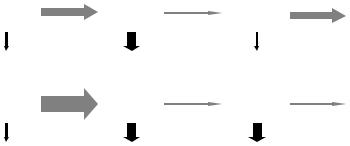
In this section we compared time evolutions of neutron-multiplying properties in two isotopic chains: traditional chain that starts from 232Th
(232Th → 233U → 234U → …) and nontraditional chain that starts from 231Pa (231Pa → 232U → 233U → …) (see Fig. 6.6). Radiative capture
cross-sections σc and fission cross-sections σf were calculated for a typical neutron spectrum of VVER-1000.
|
|
σс = 3 |
б |
|
|
б |
|
|
σс = 19 |
б |
||
|
232Th |
b |
|
233U |
σс = 6 b |
|
234U |
b |
||||
|
|
|
|
|
|
|
|
|
|
|||
|
б |
|
|
|
|
|
б |
|
б |
|
|
|
σf = 0,03 b |
σf = 43 b |
σf = 0,5 b |
|
|
|
|||||||
|
|
|
|
|
|
|
|
|
|
|
|
|
|
|
σс = 43 |
bб |
|
|
σс = 9 бb |
|
|
σс = 6бb |
|||
|
231Pa |
|
|
|
|
|
232U |
|
|
233U |
|
|
σf = 0,4 bб |
σf = 14 bб |
σf = 43 бb |
|
|
|
|||||||
Fig. 6.6. Chains of nuclide transformations
It can be seen that neutron-multiplying properties in non-traditional chain are gradually improved: the starting isotope 231Pa is a neutron absorber, fission cross-section of the second isotope 232U prevails over its capture cross-section, and the third isotope 233U is a well-fissile material. So, non-traditional chain represents the combination of two consecutive fissionable isotopes (232U and 233U) while, in traditional chain, the third isotope 234U is a neutron absorber only.
Thus, in non-traditional chain, parasitic neutron absorption by FP and depletion of fissile materials during the reactor operation can be partially compensated by 231Pa feeding. This makes it possible to talk about a possibility for substantial extension of fuel life-time and achievability of ultra-high fuel burn-up. By the way, in traditional LWR
186
fuel, the negative effects caused by FP accumulation and depletion of fissile materials are compensated by 238U(n,γ)239Pu chain significantly
weaker than by 231Pa(n,γ)232U(n,γ)233U chain in non-traditional fuel because of lower capture cross-sections: σc(238U) = 0.9 barns, σc(231Pa) =
43barns.
So, it can be concluded that non-traditional chain (231Pa → 232U →
233U → …) appears to be more attractive from the standpoi nt of neu- tron-multiplying properties (as a consequence, from the standpoint of extended fuel life-time or achievability of ultra-high fuel burn-up) in comparison with traditional chain (232Th → 233U → 234U → …) due to the following two main reasons:
1. Combination of two consecutive well-fissionable isotopes (232U and
233U).
2. High rate of their generation from the starting isotope 231Pa, whose neutron capture cross-section is larger substantially than that for the starting nuclide 232Th in traditional chain of isotopic transformations.
It is noteworthy that 231Pa may be regarded, to a certain extent, as a burnable neutron poison: for fuel life-time 231Pa is burnt up to 80% and converted into well-fissionable isotopes, neutron capture cross-section of 231Pa is substantially larger than that of fertile isotope 232Th.
As is known, the existing light-water reactors are characterized by thermal neutron spectrum. In advanced LWR designs, for example, in LWR with supercritical coolant parameters (SCLWR), different regions of the reactor core are characterized by different neutron spectra depending on coolant density. Thermal spectrum prevails within the core region containing dense coolant (γ ≈ 0.72 g/cm3) while resonance neutron spectrum dominates within the core region containing coolant of the lower density (γ ≈ 0.1 g/cm3).
Reasonability of 231Pa introduction into fuel composition for the cases of thermal and resonance neutron spectra is analyzed in the next section.
6.3.5. Reasonability of 231Pa introduction in a thermal neutron spectrum
Numerical analyses of fuel depletion process were carried out with application of the computer code SCALE-4.3 and evaluated nuclear
187
data file ENDF/B-V for elementary cells of VVER-1000. The only exception consisted in the use of martensite steel MA956 (elemental composition: 74,5% Fe, 20% Cr, 4,5% Al, 0,5% Ti and 0,5% Y2O3) instead of zircalloy as a fuel cladding material. Substitution of martensite steel for zirconium-based cladding is caused by the higher values of fuel
burn-up.
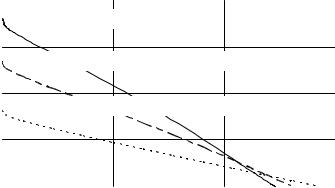
Traditional (232Th-233U) and non-traditional (231Pa-232Th-233U) fuel compositions were compared for the case of thermal neutron spectrum (coolant density – 0.72 g/cm 3). Infinite neutron multiplication factor K∞ is shown in Fig. 6.7 as a function of fuel burn-up. It can be seen that substitution of 231Pa for 232Th decreases K∞ at the beginning of cycle, i.e. decreases an initial reactivity margin to be compensated. This effect is caused by different capture cross-sections of these isotopes - 231Pa is a significantly stronger neutron absorber than 232Th. In parallel, thanks to the larger capture cross-section of 231Pa, intense breeding of two consecutive well-fissionable isotopes (232U and 233U) takes place. So, gradual introduction of 231Pa into fuel composition results in the smoother relaxation of neutron multiplication factor in the process of fuel burnup.
|
размноженияfactorнейтронов |
1,8 |
|
|
|
multiplication |
|
12% 233U + 88% |
232Th |
|
|
1,6 |
12% 233U + 86% |
232Th + 2% 231Pa |
|
||
|
|
||||
1,4 |
12% 233U + 82% |
232Th + 6% 231Pa |
|
||
|
|
||||
Коэффициент |
1,2 |
|
|
|
|
Neutron |
|
|
|
||
|
|
|
|
||
|
|
1,0 |
|
|
|
|
|
0 |
5 |
10 |
15 |
|
|
|
FuelВыгораниеburn-up,, % HMт.а. |
|
|
Fig. 6.7. 231Pa effects on fuel burn-up in thermal neutron spectrum
188
Acceptable fraction of 231Pa in non-traditional fuel composition is limited by the value of neutron multiplication factor (above unity) at the beginning of cycle. So, the effects caused by introduction of 231Pa may take place only in those fuel compositions where fraction of main fissile isotope is sufficiently large. For example, fraction of main fissile isotope 233U may be increased up to the level corresponding to the situation when neutron multiplication factor at the beginning of cycle is equal to about 1.10 at full replacement of 232Th by 231Pa.
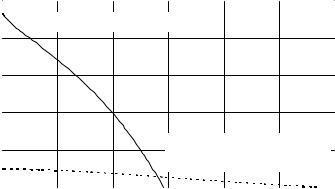
The calculations showed that this condition may be satisfied at maximal 233U fraction about 30%. Evolution of neutron multiplication factor in the process of fuel burn-up is presented in Fig. 6.8 for traditional and non-traditional fuel compositions.
multiplication нейтронов |
2,0 |
|
|
|
|
|
|
|
1,8 |
30% 233U + 70% 232Th |
|
|
|
||||
|
|
|
|
|
|
|||
1,6 |
|
|
|
|
|
|
||
|
|
|
|
|
|
|
||
Коэффициент |
factor |
1,4 |
|
|
|
|
|
|
1,2 |
|
|
30% 233U + 70% 231Pa |
|
||||
Neutron размножения |
|
|
(50% 235U + 50% 231Pa) |
|||||
|
|
|
||||||
|
|
|
|
|
|
|
||
|
|
1,0 |
|
|
|
|
|
|
|
|
0 |
10 |
20 |
30 |
40 |
50 |
60 |
|
|
|
|
FuelВыгораниеburn-up, % тHM.а. |
|
|
||
Fig. 6.8. Achievability of ultra-high fuel burn-up by introducing 231Pa (thermal neutron spectrum)
As is seen from Fig. 6.8, traditional thorium-based fuel (30% 233U + 70% 232Th) provides rather high reactivity margin (K∞(BOC) ≈ 1,9) with achievable value of fuel burn-up about 29% HM. Introduction of
189
231Pa into fuel composition decreases initial reactivity margin but, at the same time, increases fuel burn-up. If 232Th is completely replaced by 231Pa, i.e. (30% 233U + 70% 231Pa) fuel composition is analyzed, then neutron multiplication factor remains practically unchanged in the vicinity of unity for a full duration of fuel life-time. This means that the negative effects from neutron absorption by FP and depletion of fissile
isotope are almost completely compensated by breeding of secondary fissile isotopes from 231Pa. In this case, about 80%-part of 231Pa is con-
verted into secondary fissile isotopes which can provide ultra-high fuel burn-up (near to 57% HM).
If fuel loading in such a reactor is similar to the fuel loading of VVER-1000 (about 66 tons), then achievable value of fuel life-time is near to 40 years for the reactor power of 3000 MWt. It is interesting to note that 235U as well as 233U may be used to achieve ultra-high fuel burn-up. Moreover, 235U option looks very attractive because of two reasons: firstly, 235U resources are more available than resources of 233U, and, secondly, achievement of the same fuel burn-up will require lower quantity of 231Pa, artificial isotope to be produced in the dedicated nuclear power facilities.
6.3.6. Reasonability of 231Pa introduction in a resonance neutron spectrum
Traditional (232Th-233U) and non-traditional (231Pa-232Th-233U) fuel compositions were compared for the case of resonance neutron spectrum (coolant density – 0.1 g/cm 3). Infinite neutron multiplication factor K∞ is shown in Fig. 6.9 as a function of fuel burn-up.
Comparison of the curves presented in Figs. 6.7 and 6.9 allows us to conclude that introduction of 231Pa into fuel composition is more preferable from the standpoint of higher fuel burn-up in the case of resonance neutron spectrum. This conclusion can be explained by better neutronmultiplying properties of 232U just in resonance neutron spectrum as compared with thermal neutron spectrum (see Fig. 6.4).
190