Материал: Апсе ENVIRONMENTAL PROTECTION 2014
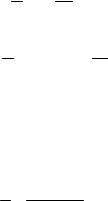
tent XF are main input parameters of the process. Main output parameters of the process are mass of enriched uranium P (product), relative 235U content in the product XP, mass of depleted uranium W (waste or tails) and relative 235U content in the waste XW.
F (feed), XF(235U)
¯
System of separative steps
¯
Depleted uranium - W (waste), XW(235U)
+
Enriched uranium - P (product), XP(235U)
Mathematical definition of material balance in the uranium enrichment process can be written as a system of the following two equations:
1. |
Balance of uranium mass: |
F = P + W. |
2. |
Balance of 235U mass: |
XF × F = XP × P + XW × W. |
This is a system of two equations with three unknown variables (F, P and W). Fortunately, by dividing both equations by P, the system can be transformed into the resolvable system of two equations with two unknown variables F/P and W/P:
F =1 + W ;
P P
XF × F = XP + XW × W .
P P
By solving the system, the following characteristics of the isotope separation process can be determined:
a. Factor of natural uranium consumption per the product mass unit:
F = XP - XW ;
P XF - XW
36

b. Factor of the waste production per the product mass unit:
W = XP - XF ;
P XF - XW
c. Division factor of the feed flow q:
F = P + W = q × F + (1 - q) × F;
Q = P = XF - XW .
F XP - XW
Some numerical examples:
a. Production of weapon-grade uranium from natural uranium:
XF = 0,71%; XP = 90%; XW = 0,25%.
Then
F = XP - XW = 89, 75 »195.
P XF - XW 0, 46
This means that production of 25 kg (one Significant Quantity for weapon-grade uranium) requires about 5000 kg of natural uranium contained, in average, in about 5000 t of natural uranium ore.
b. Production of reactor-grade uranium from natural uranium:
XF = 0,71%; XP = 4%; XW = 0,25%.
Then
q = P = XF - XW = 0, 46 » 0,12. F XP - XW 3, 75
37

This means that about 120 kg of enriched reactor-grade uranium (4% 235U) and 880 kg of depleted uranium (0,25% 235U) can be obtained
from 1000 kg of natural uranium.
The following parameters can be introduced as they can be helpful for characterization of the uranium enrichment process:
1. Relative concentrations of 235U in the feed, product and waste:
R = |
|
XF |
; R′ = |
XP |
; R′′ = |
XW |
. |
|
− XF |
1 − XP |
1 − XW |
||||
1 |
|
|
|
||||
2. The single-stage separation factor:
a = R′ = XP / (1 - XP ) . R XF / (1 - XF )
3. The single-stage depletion factor:
b = |
R |
= |
XF |
/ (1 |
- XF ) |
|
|
|
. |
||||
R¢¢ |
XW / (1 - XW ) |
|||||
4.The single-stage enrichment gain: ε′ = α −1.
5.The single-stage depletion gain: ε′′ = β −1.
1.2.1. Separation work
The methodology for quantitative evaluation of the efforts expended to separate 235U and 238U from each other has been developed by English physicists R. Peierls and P. Dirac. They proposed to use a certain function U that can characterize a total value of any uranium isotope composition. For example, total value of the feed material is defined by multiplying the feed mass F by a certain dimensionless function V(XF )
that depends only on a specific concentration of the desired isotope 235U, i.e.
UF = F × V(XF ).
38
The V(X) function is called the separation potential function. Be-
fore the uranium enrichment process started, total value of the feed material UF = F × V(XF ). After the uranium enrichment process ended, total value of the obtained materials is a sum of the product value UP = P × V(XP ) and the waste value UW = W × V(XW ) , i.e. total value of isotopic composition increased on:
DU = (UP + UW ) - UF = P × V(XP ) + W × V(XW ) - F × V(XF ). |
(1) |
The value gain U is chosen as a main characteristic of the separative work scope needed to divide the initial binary isotope composition into two new materials, namely enriched uranium and depleted uranium.
The separation potential function V(X) is dimensionless, and so the separative works are measured on the feed, product and waste mass units (kilograms, for instance). Also, as it follows from the definition, the separative work scope is independent on the applied isotope separation technology.
If the following mathematical operations are performed, then the exact formula for the separation potential function V(X) can be derived:
1. Equation (1) must be re-written into the form containing the feed mass F only:
DU = F ×[q × V(XP ) + (1 - q) × V(XW ) - V(XF )]. |
(2) |
2. The separation potential functions V(XP ) and V(XW ) must be expanded in the Taylor series in the vicinity of XF point including only the first three terms of the expansion.
Then, by assuming that the single-stage separative work is independent on the feed concentration XF , the following second-order differential equation can be obtained for the separation potential function:
39

|
d |
2V(X) |
= |
1 |
|
|
; |
|
|
|
dX2 |
X2 × (1 - X)2 |
|||||
|
|
|
|
|
||||
with the solution: |
|
|
|
|
|
|
|
|
|
V(X) =(2X -1) ln |
|
X |
. |
||||
|
|
|
||||||
|
|
|
|
1 |
- X |
|
|
|
Derivation of mathematical formula for the separation potential function
The feed mass F comes to the single-stage inlet, and two new materials leave the single-stage outlet, namely the product P = q× F and the waste W = (1 - q) × F . As a result, equation (2) was obtained.
If the separation potential functions V(XP ) and V(XW ) are expanded in the Taylor series in the vicinity of XF point by such a way:
V(XP ) » V(XF ) + |
dV |
×(XP |
- XF ) + 0,5 × |
d2V |
× (XP - XF )2 ; |
|
||||
|
|
dX2 |
|
|||||||
|
|
dX |
|
|
|
|
||||
V(XW ) » V(XF ) + |
dV |
×(XW |
- XF ) + 0,5 × |
d2V |
× (XW - XF )2 |
; |
||||
|
|
|||||||||
|
dX |
|
|
dX2 |
|
|
|
|||
and substituted into equation (2), then the following equation is obtained:
DU = V(XF ) ×[q × F + (1 - q) × F - F] + |
|
||||
+ |
dV |
×[q × F ×(XP - XF ) + (1 - q) × F × (XW - XF )] + |
(3) |
||
|
|||||
|
dX |
|
|||
+0,5 × |
d2V |
×[q × F ×(XP - XF )2 + (1 - q) × F × (XW - XF )2 |
]. |
||
|
|||||
|
|
|
dX2 |
|
|
By using the mass balance relationships, it is easy to show that the first two terms of equation (3) are equal to zero. Indeed:
40