Материал: Апсе ENVIRONMENTAL PROTECTION 2014

F × q + (1 - q) × F - F º 0;
F × q × (XP - XF ) + F × (1 - q) × (XW - XF ) = P × (XP - XF ) + W × (XW - XF ) º 0.
Then
2
DU = 0,5 × d V2 ×[q × F ×(XP - XF )2 + (1 - q) × F × (XW - XF )2 ]. (4) dX
Let assume that very little enrichment and depletion gains occurred at any one of multiple stages of the isotope separation process, i.e. the single-stage enrichment and depletion gains ε′ and ε′′ are much lower than unity. Then, by using definitions of these gains, the following approximate expressions can be obtained:
e¢ = |
XP / (1 - XP ) |
-1 = |
|
XP - XF |
; |
|
||
|
XF × (1 - XP ) |
|||||||
|
|
XF / (1 - XF ) |
|
|
||||
XP - XF = e¢× XF × (1 - XP ) » e¢ × XF × (1 - XF ); |
||||||||
e¢¢ = |
XF / (1 - XF ) |
-1 = |
|
XF - XW |
|
; |
||
|
|
|
|
|||||
|
XW / (1 - XW ) |
|
XW × (1 - XF ) |
|||||
XF - XW = e¢¢× XW × (1 - XF ) » e¢¢× XF × (1 - XF ).
These expressions being substituted into equation (4) for U can transform the equation into the following:
DU = 0,5 × d2V × X2 × (1 - X )2 × F ×[q × e¢2 + (1 - q) × e¢¢2 ].
dX2 F F
One else assumption must be used, namely the single-stage separative work is independent on the feed concentration XF and defined only by the stage design and by the applied technology. If so, the following second-order differential equation is obtained:
41

d2V |
× X2 |
× (1 - X)2 |
=1, or |
d2V |
= |
1 |
. |
|
|
X2 × (1 - X)2 |
|||||
dX2 |
|
|
dX2 |
|
|||
General solution of this equation can be written in the following form:
V(X) = (2X -1) × ln |
X |
+ A × X + B. |
|
||
|
1 - X |
|
It can be easily shown that any values of A and B factors do not change the separative works scope at all because the (A and B)-related terms can produce no effect on U value:
DUA,B = A × (P × XP + W × XW - F × XF ) + B × (P + W - F) º 0.
Therefore, the following last assumption can be accepted: A = B = 0. Finally, the separative works scope can be calculated by using the formula:
DU = P × V(XP ) + W × V(XW ) - F × V(XF );
where
V(X) = (2X -1) ln X .
1 - X
If kilograms are chosen as the feed, product and waste mass units, then the separative works scope can be also measured in the SWkilograms, and, by definition, 1 SW-kilogram = 1 SWU (separative work unit).
Specific scope of the separative works ηSWU can be defined as the works scope needed to produce 1 kg of enriched uranium:
hSWU = DU ,SWU / kg. P
As it was shown above:
42
F = P × |
XP - XW |
; W = P × |
XP - XF |
. |
|
|||
|
|
|
|
|||||
|
XF - XW |
XF - XW |
||||||
So: |
|
XP - XW |
|
|||||
DU = P × V(XP ) + P × |
XP - XF |
× V(XW ) - P × |
× V(XF ); |
|||||
|
|
|||||||
|
|
XF - XW |
|
XF - XW |
||||
and
h |
= V(X |
P |
) + V(X |
W |
) × |
XP - XF |
- V(X |
F |
) × |
XP - XW |
. |
||
|
|
||||||||||||
SWU |
|
|
|
XF |
- XW |
|
|
XF |
- XW |
||||
|
|
|
|
|
|
|
|
|
|||||
The concepts of the separative works and their units of measure have been developed at Oak Ridge National Laboratory (USA) to provide a scientific foundation for prices and commercial accounts to be paid for the offered enriching services. All the expenses related with uranium enrichment are referred to the really performed separative works. Dependencies of the separative works needed to produce 1 kg of enriched uranium from natural uranium are available now in a tabular form as functions of relative 235U content in the feed and waste uranium.
Some data on the single-stage separation factor and specific energy consumption are presented in Table 1.4 for different uranium enrichment technologies.
Table 1.4
Comparison of uranium enrichment technologies on the separation factor and specific energy consumption
Technology |
Separation factor |
Energy consumption, |
|
kWh/SWU |
|||
|
|
||
Electromagnetic |
20-40 |
4000 |
|
Gas diffusion |
1,0043 |
2300-2600 |
|
Gas centrifuges |
1,25 |
100-300 |
|
Separation nozzle |
1,025 |
3000-3500 |
|
Laser |
3-15 |
10-50 |
|
Chemical |
1,0025 |
400-700 |
|
Plasma |
3,5-10 |
200-600 |
43
1.2.2. Properties of uranium hexafluoride and technologies for its production
The most of the uranium enrichment technologies apply gaseous uranium hexafluoride UF6 as an initial (feeding) material. This uranium compound is characterized by a series of very attractive properties, especially important for the uranium enriching process:
1. Natural fluorine is a one-isotope element containing only one stable isotope 19F. If natural fluorine would contain one else stable isotope
(18F, for instance), then the isotope separation process would deal with four components (235U18F6, 238U18F6, 235U19F6 and 238U19F6) with molecu-
lar masses of 343, 346, 349 and 352 a.m.u., respectively. This means that the lighter fraction (343 and 346 a.m.u.) would contain some amount of 238U while the heavier fraction (349 and 352 a.m.u.) would contain some amount of 235U.
2. Fluorine is a comparatively light chemical element. Relative difference of molecular 235UF6 and 238UF6 masses is equal to 3/349 ≈
0,0086. This value is lower than relative difference of atomic 235U and 238U masses (3/235 ≈ 0,0128) but not very much.
3.Uranium hexafluoride can exist in the solid, liquid and gaseous
states under moderate temperature and pressure conditions (Fig. 5). Triple point at UF6 state diagram corresponds to the temperature of 640С and the pressure of 1138 mmHg (about 1,5 atmosphere).
4.Uranium hexafluoride can be sublimated from the solid state into the gaseous state omitting the liquid state by a slight warming-up. And vice versa, gaseous uranium hexafluoride can be condensed into the solid stat by a slight cooling-down.
Thus, physical properties of uranium hexafluoride are very suitable to develop sufficiently simple in design, comfortable and compact facilities for the uranium isotope enrichment.
However, uranium hexafluoride is characterized by the following disadvantages:
1.Strong chemical activity. Uranium hexafluoride can intensely interact with air and water vapor with the formation of uranium tetrafluoride UF4 as a powder that can deposit on inner surfaces of technological circuitry.
44
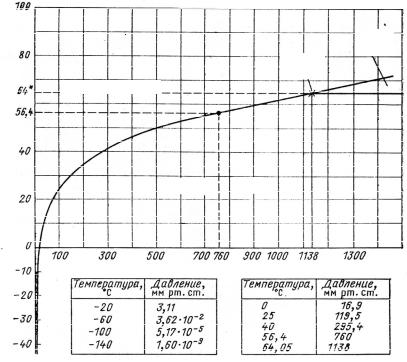
2. As a consequence, a necessity arises to use only tightly hermetical pipes and vessels, maintain their dehydration, degreasing and the surgi- cal-like cleanness. The most stable structural materials for operations with gaseous uranium hexafluoride are nickel, aluminum, magnesium, copper, and their alloys, teflon of organic materials.
Temperature,°C
Liquid
phase
Triple point
Gaseous phase
Solid phase
Pressure, mm Hg
Temperature,°C |
|
Pressure,mm Hg |
|
Temperature,°C |
|
Pressure,mm Hg |
Fig. 1.1. Diagram of uranium hexafluoride states
Conversion of uranium oxides into uranium hexafluoride
In the open NFC the uranium concentrate U3O8, product of the extraction affinage, is an initial material for its conversion into uranium hexafluoride.
Uranium concentrate U3O8 is usually fluorinated by means of the following two-step process:
45