Материал: Крючков Фундаменталс оф Нуцлеар Материалс Пхысицал Протецтион 2011
3He-counters are fit for neutron measurements in strong g-fields. They
are highly reliable, stable and durable.
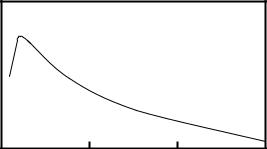
Active analyses for the contents of fissile isotopes (235U, 239Pu, 241Pu) in samples require a source of neutrons with the energy below the fission thresholds of even-even isotopes (238U, 240Pu). Such neutrons are emitted by 241AmLi-sources. Fig. 5.16 shows the neutron spectrum of a 241AmLisource. The power of 241AmLi-sources used for nondestructive assays is 104–10 5 n/s.
Real cases generally give an excessive number of the sample-emitted background neutrons from (α, n)-reactions, this making it impossible to find the NM content by counting single neutrons. Active analyses have the same intensive background created by neutrons from the (α, n)-reactions inside the source.
As noted, one can separate the neutrons generated by the fission of isotopes in the NM sample from the neutrons of (α, n)-reactions by detection of time-coinciding pulses.
If the number of neutrons emitted in a fission equals n, the probability of detecting k neutrons is given by the equation:
P(n, k ) = |
n! |
|
×ε k × (1 |
- ε )n−k . |
(5.20) |
|
(n - k )!k! |
||||||
|
|
|
|
|||
N(E)
0 |
0.5 |
1.0 |
1.5 |
Energy, MeV
Fig. 5.16. Neutron spectrum for a 241AmLi-source
If two neutrons have been emitted, the probability Р(2,0) of no neutrons to be detected is equal to 0.64; the probability Р(2,1) of detecting one neutron is 0.32; and the probability Р(2,2) of having two neutrons detected
256
is 0.04. Therefore, the probability of detecting an actual coincidence of two neutrons from one fission is relatively small. A great deal of coincidences observed in a sequence of pulses will be random and caused by coincidences between the neutrons of (α, n)-reactions, the neutrons of (α, n)-reactions and fission neutrons or neutrons from different fissions.
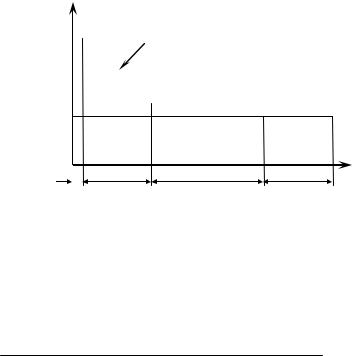
To identify and determine the number of real and random coincidences, Rossi-alpha distribution is used. This distribution is obtained when the timer is started at the instant the pulse arrives. The timer counts the time and each subsequent pulse is memorized in the cell that matches its arrival time. When the preset time of counts is over, the timer stops and is switched on again as the new pulse launches the counting. Fig. 5.17 presents a Rossi-alpha distribution. The probability of the coincidence count after the fission event is decreased exponentially over time. Where neutrons of (α, n)-reactions or background neutrons coincide, the probability of such random coincidences in any time interval is the same.
Number of cases
t = 0
exp(-t/τ)
R
A A
 P G D G
Time
Fig. 5.17. Rossi-alpha distribution represents the number of neutron detection cases as the function of the time that has elapsed after the first fission neutron was detected
The number of true double coincidences is found by the formula:
= [(R + A)count - Acount ] ×exp(G ×T )
R [ ] [ ] , (5.21) exp(-P /τ ) × 1- exp(-G / τ ) × 1- exp(-(D + G) / τ )
257
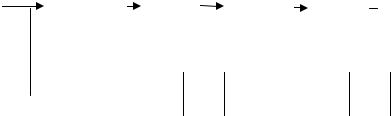
where R is the number of true coincidences; A is the number of random coincidences; P is the time of the pulse count delay, G is the coincidence count time; D is the long delay; τ is the time of the neutron life in the detector, and D >>τ; Т is the total neutron count rate.
A neutron coincidence counting circuit is shown in Fig. 5.18.
In |
Predelay |
|
Gate |
|
|
Long delay |
|
Gate |
|
|
|||||
|
|
|
|
|
|
|
|
||||||||
|
|
P |
|
G |
|
|
D |
|
G |
|
|
||||
|
|
|
|
|
|
|
|
||||||||
|
|
|
|
|
|
|
|
|
|
|
|
|
|
|
|
|
|
|
|
|
|
|
|
|
|
|
|
|
|
|
|
|
|
|
|
|
|
|
|
|
|
|
|
|
|
|
|
|
|
|
|
|
|
|
|
|
|
|
|
|
|
|
|
|
|
|
СС |
|
|
|
СС |
|
||
General |
|
|
|
|
|
|
|
|
|
|
counter |
|
|
|
|
|
|
|
|
|
|
|
|
|
|
|
|
|
|
|
|
|
|
|
|
|
|
|
|
|
|
|
|
|
|
|
|
|
|
|
|
|
|
|
|
|
|
R+A |
|
|
|
A |
|
||
|
|
|
counter |
|
|
|
counter |
|
||
|
|
|
|
|
|
|
|
|
|
|
Fig. 5.18. Separation of fission neutron coincidences
Practical uses of such circuits are confined to count rates of below 20– 30 kHz as large corrections are required to take into account dead time of electronics. Further evolutions of measuring technology were based on using a shift register.
A shift register comprises a set of timer-controlled triggers. The sequence of pulses coming in for the time G is memorized. Each subsequent pulse opens its own gate so there is no need to wait for one gate to close to have another gate opened. It makes it possible to operate count rates of hundreds of kHz and more. Coincidences start to be detected not straight away but just in a short interval after the pulse P arrives (preliminary delay). During this time (3–6 µs), the coincidence source rate is distorted due to overlapping pulses and the electronics dead time. Following the preliminary delay, the shift register opens the R+A gate, the width of which is normally 32–64 µs. True and random coincidences are detected during this time. Then, after the long delay D, the gate А opens. As the quantity D is normally equal to 1000 µ, which exceeds considerably the neutron lifetime in the detector (30–100 µs), the scaler А detects only random coincidences.
258
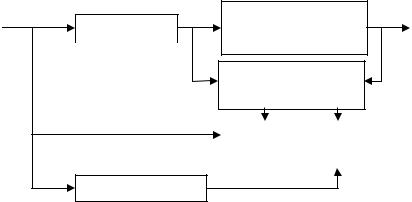
A simplified shift register circuit is given in Fig. 5.19.
In
Predelay |
Shift register for R+A- |
|
gate |
||
|
UP-DOWN (bidirectional) counter
R+A |
|
A |
counter |
|
counter |
|
|
|
Long delay
Fig. 5.19. A shift register circuit
Measurements using the above shift register can produce only two quantities: random and true double coincidences. Some contaminated or heterogeneous samples require one more quantity, triple coincidence (triplet) count rate, to be measured.
Measurements of single neutrons, doublets and triples may help determine the quantity of the 240Pu effective mass, the neutron multiplication factor in the sample and the yields of (α, n)-neutrons without the need to calibrate the measuring system.
Instrumentation for NM neutron measurements
There is a variety of measuring systems for a range of applications fit to analyze different types of samples, including containers with PuO2 powder, pellets and rods filled with mixed uranium-plutonium fuel, metal slugs, intact fuel assemblies, and drums with scrap and waste. Unlike chemical analyses where the sample is adapted to the instrument, nondestructive assays have equipment adapted to the sample.
Neutron analysis is used to control highly dense NM with results thereof having the potential of depending greatly on the matrix material.
Coincidence count results are used to determine the NM quantity in samples in passive and active neutron measurements.
259
Passive neutron methods are employed extensively to test plutonium samples which emit their own neutrons as the result of spontaneous fission and during (α, n)-reactions (Table 5.11) in different forms: in fuel slugs, rods, powders, granules, scrap, waste and PuO2+UO2 mixtures. To interpret such measurement results, one needs to know the plutonium isotopic
composition (spontaneous fission occurs largely in even isotopes such as Pu: 238Pu, 240Pu and 242Pu).
Active neutron methods serve to control uranium samples for the content of 235U as the uranium isotope spontaneous fission rates are low. Use of an AmLi-source in the sample causes induced fission with the number of fissions found by counting neutron coincidences. High penetrating power of neutrons enables determination of the total 235U content in the entire volume.
|
|
|
|
|
Table 5.11 |
|
|
|
Yield of NM-emitted neutrons |
|
|
||
|
|
|
|
|
|
|
|
Spontaneou |
Yield of |
α-decay |
Yield of |
α,n yield in |
|
|
s fission |
spontaneoeus- |
|
|||
Isotope |
period, |
α-particles, |
|
|||
period, |
fission neutrons, |
oxide, n/s×g |
|
|||
|
years |
α/s×g |
|
|||
|
years |
n/s×g |
|
|
||
|
|
|
|
|
||
238U |
8.2×10¹⁵ |
1.36×10⁻² |
4.47×10⁹ |
1.2×10⁴ |
8.3×10⁻⁵ |
|
238Pu |
4.77×10¹⁰ |
2.59×10³ |
87.74 |
6.33×10¹¹ |
1.34×10⁴ |
|
239Pu |
5.48×10¹⁵ |
2.18×10⁻² |
2.41×10⁴ |
2.3×10⁹ |
3.81×101 |
|
240Pu |
1.16×10¹¹ |
1.02×10³ |
6.56×10³ |
8.4×10⁹ |
1.41×10² |
|
242Pu |
6.84×10¹⁰ |
1.72×10³ |
3.76×10⁵ |
1.4×10⁸ |
2.0 |
|
Passive coincidence count is based largely on the following principles:
∙the NM sample is placed in a cavity surrounded by neutron counters;
∙coincidences of pulses generated by spontaneous-fission neutrons are detected;
∙the coincidence count rate is directly proportional to the mass of the fissile material:
260