Материал: part17

Внимание! Если размещение файла нарушает Ваши авторские права, то обязательно сообщите нам

Page 686​

DICOM PS3.17 2020a - Explanatory Information​

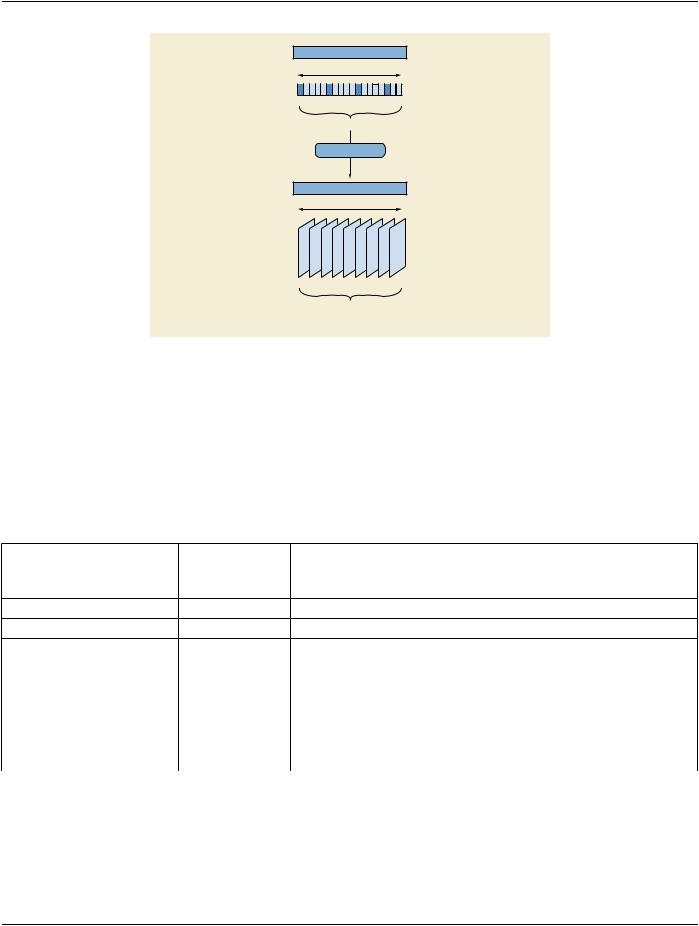
In the reconstruction from rotational projections the figure C.7.6.16-2 of Section C.7.6.16.2.2.1 “Timing Parameter Relationships” in​ PS3.3 should be interpreted carefully. All the frames forming one X-Ray 3D Angiographic volume have been reconstructed simultan-​ eously, therefore all of them have a same time reference and the same acquisition duration.​

The projections have been acquired over a period of time, all of them contributing to each 3D frame. Therefore, it's recommended to​ encode the 3D frame acquisition duration as the elapsed time from the first to the last projection frame time that contributed to that​ volume.​

Table TTT.2.1-9. Frame Content Macro Recommendations​

Attribute Name​

Tag​

Recommendation​

Frame Content Sequence​

(0020,9111)​

Providesdetailsforeachframe.TheDateandTimeAttributesareidentical​


for all frames and are set to the date/time of the first projection frame due​


to the nature of the volume creation. The Stack information can be used​


to group frames into sub-volumes, if needed.​

>Frame Reference DateTime​

(0018,9151)​

Use the date and time of the first 2D frame used for the reconstruction of​


this 3D frame. Same value for all the frames of the same reconstruction.​

>Frame Acquisition DateTime​

(0018,9074)​

Use the same value as the Frame Reference DateTime (0018,9151).​

>Frame Acquisition Duration​

(0018,9220)​

Usethedurationoftherotationalacquisition.Samevalueforalltheframes​


of the same reconstruction.​

>Dimension Index Values​

(0020,9157)​

From 1 to M or M to 1 depending whether the frames are to be displayed​


in the storage order or reverse, M being the number of frames of the​


reconstructed volume.​

>Stack ID​

(0020,9056)​

Use the value "1" for all the frames, since they belong to the same​


reconstructed volume.​

>In-Stack Position Number​

(0020,9057)​

From1toM,whereMisthenumberofframesofthereconstructedvolume.​

TTT.2.1.3.1.13 Derivation Image Macro Recommendations​

The volume is directly reconstructed from the original set of projections and therefore not "derived" in this sense. Thus this macro is​ not applicable in this scenario as the contents of the Contributing Sources Sequence (0018,9506) and the X-Ray 3D Acquisition Se-​ quence (0018,9507) are sufficient to describe the relationship to the originating image.​

TTT.2.1.3.1.14 Frame Anatomy Macro Recommendations​

This macro encodes the anatomical context. It can be important to parameterize the presentation of the volumes. For a single volume​ this macro is encoded "shared". Typically the anatomy of the volume is only available if the information is already provided within the​ originating projection image, either by detection algorithm or by user input.​

TTT.2.1.3.1.15 X-Ray 3D Frame Type Macro Recommendations​

This macro encodes the general characteristics of the volume slices like color information for presentation, volumetric properties for​ geometrical manipulations etc. In case of a single volume, this macro is encoded "shared" as each slice of the volume has identical​ characteristics. If multiple volumes are encoded in a single instance, this macro may be encoded "per frame".​

TTT.2.1.4 Example​

TTT.2.1.4.1 Reconstruction Using All Frames of An Enhanced XA Image​

This basic example is the reconstruction of a volume by a back-projection from all frames of a rotational acquisition which have been​ encoded as an Enhanced XA Instance. The rotational acquisition takes 5 seconds to acquire all the projections.​

Note​

The example would be very similar if the rotational acquisition was encoded as an XA Image.​

The dimension organization is based on the spatial position of the 3D frames. The frames are to be displayed in the same order as​ stored.​

- Standard -​

DICOM PS3.17 2020a - Explanatory Information​

Page 687​

The UIDs of this example correspond to the diagram shown in Figure TTT.2.1-1​

Image Type

(0008,0008)

= ORIGINAL\PRIMARY\VOLUME\NONE


SOP Instance UID

(0008,0018)

= UID “Z”


Modality

(0008,0060)

= XA


Pixel Presentation

(0008,9205)

= MONOCHROME


Volumetric Properties

(0008,9206)

= VOLUME


Volume Based Calculation Technique

(0008,9207)

= NONE


...


Contributing Sources Sequence

(0018,9506)


Contributing sources (only one in this example)


Item 1


>Contributing SOP Instances Reference Sequence

(0020,9529)


Item 1


>>Reference Series Sequence

(0008,1115)


Item 1


>>>Referenced Instance Sequence

(0008,114a)


Item 1


>>>>Referenced SOP Class UID

(0008,1150)

= XA Image or Enhanced XA Image


>>>>Referenced SOP Instance UID

(0008,1155)

= UID “C”


>>>Series Instance UID

(0020,000e)

= UID “B”


>>Study Instance UID

(0020,000d)

= UID “A”


>... (other attributes from the contributing image sources)


...


X-Ray 3D Acquisition Sequence

(0018,9507)


Acquisition context #1


Item 1


>Source Image Sequence

(0008,2112)


one source image for this acquisition context


Item 1


>>Referenced SOP Class UID

(0008,1150)

= XA Image or Enhanced XA Image


>>Referenced SOP Instance UID

(0008,1155)

= UID “C”


>... (other attributes of this acquisition context)


>Per Projection Acquisition Sequence

(0008,9538)


data or projection #1 of this acquisition context


Item 1


>>... (other attributes)


Item 2


data or projection #2 of this acquisition context


>>... (other attributes)


...


...


X-Ray 3D Reconstruction Sequence

(0018,9530)


Reconstruction #1


Item 1


>Acquisition Index

(0020,9518)

=1


>... (other attributes related to this reconstruction)


...


Frame of Reference UID

(0020,0052)

= UID “D”


Dimension Organization Sequence

(0020,9221)


One dimension


Item 1


>Dimension Organization UID

(0020,9164)

=UID “E”


Dimension Index Sequence

(0020,9222)


Item 1


>Dimension Organization UID

(0020,9164)

= UID “E”


>Dimension Index Pointer

(0020,9165)

= (0020,0032)


>Functional Group Pointer

(0020,9167)

=(0020,9113)


Dimension Organization Type

(0020,9311)

= 3D

...


Figure TTT.2.1-2a. Attributes of 3D Reconstruction using all frames​

- Standard -​

Page 688​

DICOM PS3.17 2020a - Explanatory Information​

Shared Functional Group Sequence

(5200,9229)


Common to all frames of the X-Ray 3D


Item 1


...


>Pixel Measures Sequence

(0028,9110)


Item 1


>>Slice Thickness

(0018,0050)


>>Pixel Spacing

(0028,0030)


>Plane Orientation Sequence

(0028,9116)


Item 1


>>Image Orientation (Patient)

(0020,0037)


>Frame Anatomy Sequence

(0020,9071)


Item 1


>>Frame Laterality

(0020,9072)


>>Anatomic Region Sequence

(0008,2218)


>Frame VOI LUT Sequence

(0028,9132)


Item 1


>>Window Center

(0028,1050)


>>Window Width

(0028,1051)


>X-Ray 3D Frame Type Sequence

(0018,9504)


Item 1


>>Frame Type

(0008,9007)

= ORIGINAL\PRIMARY\VOLUME\NONE


>>Pixel Presentation

(0008,9205)

= MONOCHROME


>>Volumetric Properties

(0008,9206)

= VOLUME


>>Volume Based Calculation Technique

(0008,9207)

= NONE


>>Reconstruction Index

(0020,9536)

= 1 (all rames share the same reconstruction data)


...


...


Per-Frame Functional Groups Sequence

(5200,9230)


...


Frame “i” of the X-Ray 3D


Item i


>Frame Content Sequence

(0020,9111)


Item 1


>>Frame Reference DateTime

(0018,9151)

= DateTime of the 1st frame of source


>>Frame Acquisition DateTime

(0018,9074)

= DateTime of the 1st frame of source


>>Frame Acquisition Duration

(0018,9220)

= 5000.0


>>Dimension Index Values

(0020,9157)

= i (consecutive numbers from 1 to M)


>>Stack ID

(0020,9056)

= 1 (all frames belong to the same stack)


>>In-Stack Position Number

(0020,9057)

= i (consecutive numbers from 1 to M)


>Plane Position Sequence

(0020,9113)


Item 1


>>Image Position (Patient)

(0020,0032)


...


Figure TTT.2.1-2b. Attributes of 3D Reconstruction using all frames (continued)​

TTT.2.2 Case #2: Reconstruction From A Sub-set of Projection Frames​

This application case is related to a reconstruction from a sub-set of projection frames.​

TTT.2.2.1 User Scenario​

The image acquisition system performs one rotational acquisition. Not all of the acquired frames, but every Nth frame is used to recon-​ struct the volume, e.g., to speed-up the reconstruction.​

TTT.2.2.2 Encoding Outline​

Only selected frames of the original XA instance or Enhanced XA instance are used to reconstruct the volume.​

The X-Ray 3D instance references the original XA instance or Enhanced XA instance and uses Attributes to define the context on​ how and which of the original image frames are used to create the volume.​

- Standard -​

DICOM PS3.17 2020a - Explanatory Information​

Page 689​

XA 2D Projection SOP Instance “C”

Contrast Frames

1

6

11

16

Acquisition Context #1

Reconstruction #1

X-Ray 3D SOP Instance “Z”

Contrast Volume

1...

...M

Reconstruction #1

- From Acquisition Context #1

Figure TTT.2.2-1. Encoding of one 3D reconstruction from a sub-set of projection frames​

TTT.2.2.3 Encoding Details​

TTT.2.2.3.1 X-Ray 3D Angiographic Image IOD​

TTT.2.2.3.1.1 X-Ray 3D Angiographic Acquisition Module Recommendations​

This module encodes the important technical and physical parameters of the source SOP instances and the frames used to create​ the X-Ray 3D Angiographic instance.​

Table TTT.2.2-1. X-Ray 3D Angiographic Acquisition Module Recommendations​

Attribute Name​

Tag​

Recommendation​

X-Ray 3D Acquisition Sequence​

(0018,9507)​

One item since there is only one acquisition context that contributed to the​


reconstruction of the X-Ray 3D Angiographic image pixel data contents.​

>Source Image Sequence​

(0008,2112)​


>>Referenced Frame Number​

(0008,1160)​

Only include the frame numbers used for the reconstruction.​

>Per Projection Acquisition​

(0018,9538)​

The content of the X-Ray 3D General Positioner Movement Macro only​

Sequence​


provides an overview of the Positioner data. When not all frames of the​


originating projection image are used, it is recommended to provide the​


patient-basedPositionerPrimaryandSecondaryAnglesinthePerProjection​


Acquisition Sequence (0018,9538).​

The contents of the Per Projection Acquisition Sequence (0018,9538) need​ tobecarefullyalignedwiththelistofframenumbersintheReferencedFrame​ Numbers (0008,1160) Attribute in the Source Image Sequence (0008,2112).​

TTT.2.2.3.1.2 Frame Content Macro Recommendations​

This module encodes the timing information of the frames, as well as dimension and stack index values.​

- Standard -​

Page 690​ DICOM PS3.17 2020a - Explanatory Information​

Table TTT.2.2-2. Frame Content Macro Recommendations​

Attribute Name​

Tag​

Recommendation​

Frame Content Sequence​

(0020,9111)​

Provides details for each frame.​

>Frame Acquisition Duration​

(0018,9220)​

Usetheelapsedtimefromthefirsttothelastprojectionframe​


time used for this reconstruction.​

TTT.2.2.4 Example​

Thisspecificexampleisthereconstructionofavolumebyaback-projectionfromevery5th frameofarotationalacquisitionandencoded​

as an Enhanced XA Image.​

Note​

The example would be very similar if the rotational acquisition was encoded as an XA Image.​

...

X-Ray 3D Acquisition Sequence

(0018,9507)


Item 1


>Source Image Sequence

(0008,2112)


Item 1


>>Referenced SOP Class UID

(0008,1150)


>>Referenced SOP Instance UID

(0008,1155)


>>Referenced Frame Number

(0008,1160)


>... (other attributes of this acquisition context)


>Per Projection Acquisition Sequence

(0008,9538)


Item 1


>>... (other attributes)


Item 2


>>... (other attributes)


...


Acquisition context #1

one source image for this acquisition context

=XA Image or Enhanced XA Image

=UID “C”

=1\6\11\16\...

data of frame #1 from this source

data of frame #6 from this source

Figure TTT.2.2-2. Attributes of 3D Reconstruction using every 5th frame​

TTT.2.3 Case #3: Reconstruction From A Sub-region of All Image Frames​

This application case is related to a regular reconstruction of the full field of view of a rotational acquisition followed by a specific re-​ construction of a sub-region that contains an object of interest (e.g., interventional device implanted, stent, coils etc.).​

TTT.2.3.1 User Scenario​

The image acquisition system performs one rotational acquisition after the intervention, on the region of the patient where an implant​ has been placed.​

Two3Dvolumesarereconstructed;oneofthefullfieldofviewoftheprojectionimages,anotherofasub-regionofeachoftheacquired​ frames, e.g., to extract the object of interest into a smaller volume. The second volume is likely performed at higher resolution and​ likely applies different 3D reconstruction techniques, for instance to highlight the material of the implant. The purpose is to overlap​ the two volumes and enhance the visibility of the object of interest over the full field volume.​

TTT.2.3.2 Encoding Outline​

The rotational acquisition can either be encoded as XA Image or as Enhanced XA Image.​

Each reconstruction is encoded in a different X-Ray 3D Angiographic instance.​

Not all parts of each frame of the original XA instance or Enhanced XA instance are used to reconstruct the second volume.​

The X-Ray 3D instance references the original XA instance or Enhanced XA instance and uses Attributes to define the context on​ how and which part of the original image frames are used to create the Volume.​

- Standard -​

Источник: https://studfile.net/preview/14585770/