Материал: part17

Внимание! Если размещение файла нарушает Ваши авторские права, то обязательно сообщите нам

Page 696​

DICOM PS3.17 2020a - Explanatory Information​

Attribute Name​


Tag​

Recommendation​

>Per Projection Acquisition Sequence​

(0018,9538)​

The content of this sequence needs to be carefully aligned with​


the list of frame numbers in the Referenced Frame Numbers​


(0008,1160) Attribute in the Source Image Sequence​


(0008,2112).​

TTT.2.4.3.2.3 Frame Content Macro Recommendations​

This module encodes the timing information of the frames, as well as dimension and stack index values.​

Table TTT.2.4-4. Frame Content Macro Recommendations​

Attribute Name​

Tag​

Recommendation​

Frame Content Sequence​

(0020,9111)​

Provides details for each frame.​

>Frame Acquisition Duration​

(0018,9220)​

Use the elapsed time from the first projection frame time of the​


first rotation to the last projection frame time of the last rotation​


used for this reconstruction.​

TTT.2.4.4 Example​

Thisexampleisthereconstructionofavolumebyaback-projectionfromallframesofarotationalacquisitionwithtworotationsencoded​ as two XA Images.​

- Standard -​

DICOM PS3.17 2020a - Explanatory Information​

Page 697​

SOP Instance UID

(0008,0018)


...


Contributing Sources Sequence

(0018,9506)


Item 1


>Contributing SOP Instances Reference Sequence

(0020,9529)


Item 1


>>Reference Series Sequence

(0008,1115)


Item 1


>>>Referenced Instance Sequence

(0008,114a)


Item 1


>>>>Referenced SOP Class UID

(0008,1150)


>>>>Referenced SOP Instance UID

(0008,1155)


>>>Series Instance UID

(0020,000e)


>>Study Instance UID

(0020,000d)


>Acquisition Datetime

(0008,002A)


>Acquisition Protocol Name

(0018,9423)


>... (other attributes from the contributing image sources)


Item 2


>Contributing SOP Instances Reference Sequence

(0020,9529)


Item 1


>>Reference Series Sequence

(0008,1115)


Item 1


>>>Referenced Instance Sequence

(0008,114a)


Item 1


>>>>Referenced SOP Class UID

(0008,1150)


>>>>Referenced SOP Instance UID

(0008,1155)


>>>Series Instance UID

(0020,000e)


>>Study Instance UID

(0020,000d)


>Acquisition Datetime

(0008,002A)


>Acquisition Protocol Name

(0018,9423)


>... (other attributes from the contributing image sources)


...


X-Ray 3D Acquisition Sequence

(0018,9507)


Item 1


>Source Image Sequence

(0008,2112)


Item 1


>>Referenced SOP Class UID

(0008,1150)


>>Referenced SOP Instance UID

(0008,1155)


>... (other attributes of this source: kVp, mA, FOV, filter...)


Item 2


>Source Image Sequence

(0008,2112)


Item 1


>>Referenced SOP Class UID

(0008,1150)


>>Referenced SOP Instance UID

(0008,1155)


>... (other attributes of this source: kVp, mA, FOV, filter...)


...


X-Ray 3D Reconstruction Sequence

(0018,9530)


Item 1


>Acquisition Index

(0020,9518)


>... (other attributes related to this reconstruction)


...


Shared Functional Group Sequence

(5200,9229)


Item 1


...


>X-Ray 3D Frame Type Sequence

(0018,9504)


Item 1


>>Reconstruction Index

(0020,9536)


>>...


...


= UID “Z”

Two contributing sources in this example

=XA Image or Enhanced XA Image

=UID “C1”

=UID “B1”

=UID “A”

=Date and time of the Instance “C1”

=Protocol 1

=XA Image or Enhanced XA Image

=UID “C2”

=UID “B2”

=UID “A”

=Date and time of the Instance “C2”

=Protocol 2

Acquisition context #1

one source image for this acquisition context

=XA Image or Enhanced XA Image

=UID “C1”

Acquisition context #2

one source image for this acquisition context

=XA Image or Enhanced XA Image

=UID “C2”

Reconstruction #1 =1\2

Common to all frames of the X-Ray 3D

= 1 (all frames share the same reconstruction data)

Figure TTT.2.4-3. Attributes of 3D Reconstruction using multiple rotation images​

TTT.2.5 Case #5: One Rotation, One 2D Instance, Multiple Reconstructions, One X-Ray 3D​ Instance​

This application case is related to a rotational acquisition of several cardiac cycles with related ECG signal information.​

- Standard -​

Page 698​

DICOM PS3.17 2020a - Explanatory Information​

TTT.2.5.1 User Scenario​

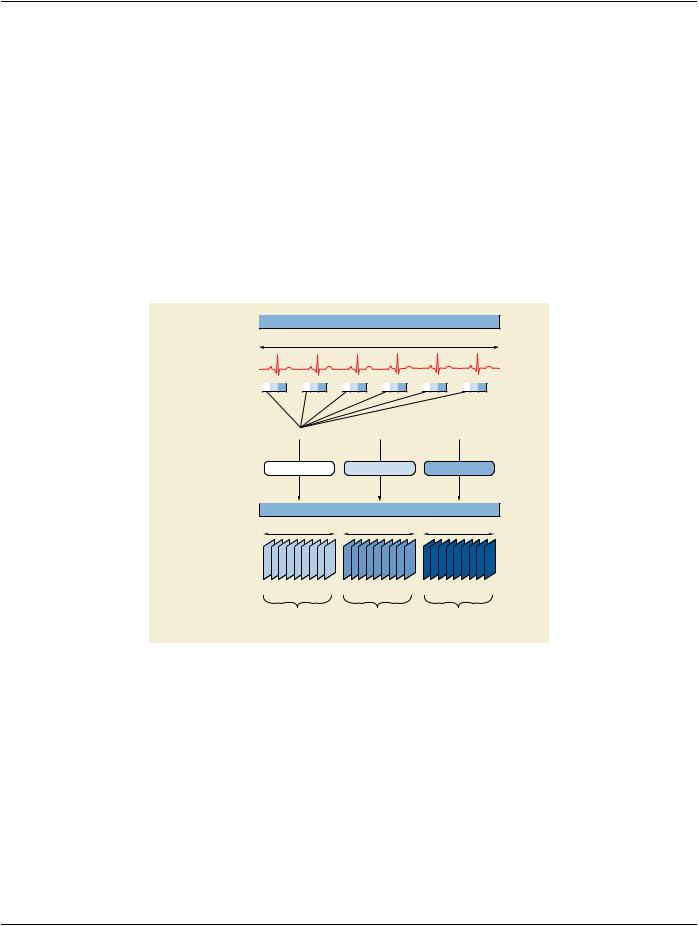
The image acquisition system performs one 2D rotational acquisition of the heart in a cardiac procedure. The gantry is continuously​ rotating at a constant speed. The ECG is recorded during the rotation, and the cardiac trigger delay time is known for each frame of​ the rotational acquisition allowing it to be assigned to a given cardiac phase.​

Several 3D volumes are reconstructed, one for each cardiac phase.​

TTT.2.5.2 Encoding Outline​

The rotational acquisition can either be encoded as XA Image or as Enhanced XA Image. The XA instance (let's call it "C") is encoded​

in the Series "B" of the Study "A".​

Eachreconstructionisrelatedtoonecardiacphasecorrespondingtoasub-setofframesoftherotationalacquisition.Therefore,each​ cardiac phase represents one acquisition context.​

Each reconstruction leads to one volume, all volumes are encoded in one single X-Ray 3D Angiographic instance ("Z"). Each volume​ is for a different cardiac phase. All volumes share the same stack id.​


XA 2D Projection SOP Instance “C”


ECG-triggered acquisition


...

...

...

...

...

...


1...


...N


Acquisition Context #1

Acquisition Context #2

Acquisition Context #3


Reconstruction #1

Reconstruction #2

Reconstruction #3


X-Ray 3D SOP Instance “Z”


Cardiac phase A

Cardiac phase B

Cardiac phase C

Frame Number:

1...

...M

M+1...

...2xM

2xM+1...

...3xM

In-Stack Position Number:

1...

...M

1...

...M

1...

...M


Reconstruction #1


Reconstruction #2


Reconstruction #3


- From Acquisition Context #1

- From Acquisition Context #2

- From Acquisition Context #3


- Stack ID #1


- Stack ID #1


- Stack ID #1


Figure TTT.2.5-1. Encoding of various 3D reconstructions at different cardiac phases​

Note​

1.​Thisfigureshowsonlythefirstthreecardiacphases.Animplementationmaychosehowmanyphasesitwillreconstruct.​

2.​Projection frames are assigned to a phase based on their cardiac trigger delay time. The rotation speed and acquisition​ pulseratewillnotnecessarilyalignuniformlywiththecardiaccycle(especiallyiftheheartbeatisirregular).Thusdifferent​ phases may end up with different number of projections assigned to them. The reconstructed volumes will have the​ same space.​

- Standard -​

DICOM PS3.17 2020a - Explanatory Information​

Page 699​

TTT.2.5.3 Encoding Details​

TTT.2.5.3.1 2D X-Ray Angiographic Image IOD​

This scenario is based on the encoding of a single rotational acquisition in one 2D instance, together with the information of the ECG​ and/or the cardiac trigger delay times of each frame of the rotational image.​

TTT.2.5.3.2 X-Ray 3D Angiographic Image IOD​

TTT.2.5.3.2.1 Image Pixel Module Recommendations​

Thismoduleencodesthedescriptionofthepixelsoftheslicesofthevolumes,eachslicebeingoneframeoftheX-Ray3DAngiographic​ instance. The pixel data encodes all the frames of the first cardiac phase followed by all the frames of the second cardiac phase and​ so on. Within one cardiac phase, the order of the frames is aligned with the Image Position (Patient) Attribute.​

TTT.2.5.3.2.2 Multi-frame Dimension Module Recommendations​

This module encodes the dimensions for the presentation order of the image frames.​

Table TTT.2.5-1. Multi-frame Dimension Module Recommendations​

Attribute Name​

Tag​

Recommendation​

Dimension Organization Sequence​

(0020,9221)​

There will be a single Dimension UID.​

Dimension Organization Type​

(0020,9311)​

The value will be "3D".​

Dimension Index Sequence​

(0020,9222)​

Two items are defined: the first one related to the cardiac phase, the​


second one related to the spatial position of the slices. All frames of​


the same reconstructed volume have the same cardiac phase.​

>Dimension Index Pointer​

(0020,9165)​

In the first item, the Attribute Nominal Percentage of Cardiac Phase​


(0020,9241)isused.Intheseconditem,theAttributeImagePosition​


(Patient) (0020,0032) is used.​

>Functional Group Pointer​

(0020,9167)​

Contains the tags (0018,9118) Cardiac Synchronization Sequence​


and (0020,9113) Plane Position Sequence respectively in the first​


and second item.​

>Dimension Organization UID​

(0020,9164)​

Same value for both items.​

TTT.2.5.3.2.3 X-Ray 3D Angiographic Acquisition Module Recommendations​

There are multiple acquisition contexts, one per cardiac phase. This module encodes the frame numbers of the source SOP instance​ that belong to each acquisition context and have the same cardiac phase.​

Table TTT.2.5-2. X-Ray 3D Angiographic Acquisition Module Recommendations​

Attribute Name​

Tag​

Recommendation​

X-Ray 3D Acquisition Sequence​

(0018,9507)​

One item for each acquisition context (i.e., each cardiac phase).​

>Source Image Sequence​

(0008,2112)​


>>Referenced Frame Number​

(0008,1160)​

The frame numbers of the source SOP instance that belong to this​

acquisition context (i.e., that have the same cardiac phase).​ Note​

The number of projection frames may be different for each​ acquisition context. See Note 2 of Section TTT.2.5.2.​

TTT.2.5.3.2.4 X-Ray 3D Reconstruction Module Recommendations​

This module encodes the identification of the reconstructions performed to create the X-Ray 3D Angiographic Instance.​

- Standard -​

Page 700​ DICOM PS3.17 2020a - Explanatory Information​

Table TTT.2.5-3. X-Ray 3D Reconstruction Module Recommendations​

Attribute Name​

Tag​

Recommendation​

X-Ray 3D Reconstruction Sequence​

(0018,9530)​

One item for each single reconstruction, i.e., for each cardiac phase.​

>Acquisition Index​

(0020,9518)​

Number of the acquisition context for this reconstruction. As there is​


one reconstruction for each cardiac phase, the acquisition index is​


equal to the reconstruction index.​

>Reconstruction Description​

(0018,9531)​

Free text description of the purpose of the reconstruction. It's​


recommended to identify the cardiac phase.​

TTT.2.5.3.2.5 Frame Content Macro Recommendations​

This module encodes the timing information of the frames, as well as dimension and stack index values. All frames forming a volume​ of one cardiac phase have the same time reference, and a single dimension index value for the first dimension. All volumes for all​ cardiac phases share the same stack id because they span the same space.​

Table TTT.2.5-4. Frame Content Macro Recommendations​

Attribute Name​

Tag​

Recommendation​

Frame Content Sequence​

(0020,9111)​


>Frame Reference DateTime​

(0018,9151)​

Use the date and time of the first 2D frame used for the reconstruction​


of this 3D frame. In practice it will be the time of the first projection of​


this cardiac phase.​

>Frame Acquisition DateTime​

(0018,9074)​

Use the same value as the Frame Reference DateTime (0018,9151).​

>Frame Acquisition Duration​

(0018,9220)​

Use the elapsed time from the first to the last projection frame time​


used for the reconstruction of this 3D frame.​

>Cardiac Cycle Position​

(0018,9236)​

Use the most representative position in the cardiac cycle.​

>Dimension Index Values​

(0020,9157)​

ThefirstvalueofthisAttributecontainsthesameindexforalltheframes​


of the same volume (i.e., same cardiac phase). The second value​


indexes the spatial position of each frame in the volume.​

>Stack ID​

(0020,9056)​

Same ID for all the frames of all cardiac phases.​

>In-Stack Position Number​

(0020,9057)​

From 1 to M for each cardiac phase, where M is the number of frames​


in each reconstructed phase.​

The spatially corresponding frames in different cardiac phases share​ the same In-Stack Position Number.​

TTT.2.5.3.2.6 Cardiac Synchronization Macro Recommendations​

This module encodes a value representing the cardiac phase of the 3D frames (i.e., the time of the frame relative to the R-peak).​

Table TTT.2.5-5. Cardiac Synchronization Macro Recommendations​

Attribute Name​

Tag​

Recommendation​

Cardiac Synchronization Sequence​

(0018,9118)​


>Nominal Percentage of Cardiac Phase​

(0020,9241)​

All the frames belonging to the same reconstruction will have​


the same value. This Attribute is used as a dimension index.​

>Nominal Cardiac Trigger Delay Time​

(0020,9153)​

Use the average time in ms from the time of the previous​


R-peak to the value of the Frame Reference DateTime​


(0018,9151).​

TTT.2.5.3.2.7 X-Ray 3D Frame Type Macro Recommendations​

This macro encodes the context of the volume slices. In this scenario of multi-volume encoding, it is encoded "per frame", since the​ slices belong to different volumes depending on the cardiac phase.​

- Standard -​

Источник: https://studfile.net/preview/14585770/