Материал: Oxford American Handbook of Urology ( PDFDrive )
URETERAL INJURIES: MANAGEMENT 437
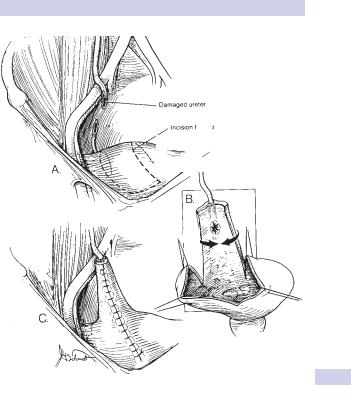
Damaged ureter
Incision for flap
A
B
C
Figure 10.8 A Boari flap. This figure was published in Walsh PC, et al. Campbell’s Urology, 8th edition, p. 3703–3714. Copyright Elsevier 2002.
438 CHAPTER 10 Trauma to the urinary tract
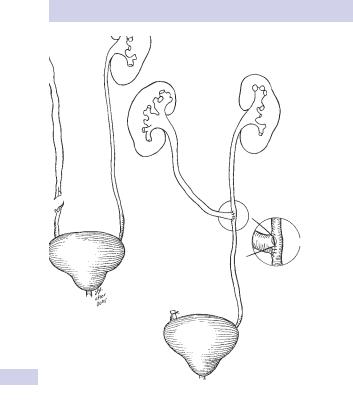
Figure 10.9 Transureteroureterostomy. This figure was published in Walsh PC, et al. Campbell’s Urology, 8th edition, p. 3703–3714. Copyright Elsevier 2002.
This page intentionally left blank

440 CHAPTER 10 Trauma to the urinary tract
Bladder and urethral injuries associated with pelvic fractures
Pelvic fractures are usually due to crush injuries, where massive force is applied to the pelvis. Associated head, chest, intra-abdominal (spleen, liver, mesentery of bowel), pelvic (bladder, urethra, vagina, rectum), and genital injuries are common and these injuries plus the massive blood loss from torn pelvic veins and arteries account for the substantial (20%) mortality after pelvic fracture.
Urologists must often work closely with orthopedists and/or trauma surgeons called to treat other associated injuries.
Abdominal and pelvic imaging in pelvic fracture
•Retrograde urethrography is performed to detect urethral injury when blood is present at the meatus.
•If the urethra appears intact, a Foley catheter is inserted. If gross hematuria is noted, a retrograde cystogram is done to assess integrity of the bladder.
•Abdominal/pelvic CT establishes presence/absence of associated pelvic (rectum, bladder) and abdominal organ injury (liver, bowel, spleen).
Is urethral catheterization of a pelvic fracture safe for the patient?
If there is no blood present at the meatus, a gentle attempt at urethral catheterization should be made. While it has traditionally been suggested that this could convert a partial urethral rupture into a complete rupture, recent evidence has not supported this concern.
If resistance is encountered, stop, and obtain a retrograde urethrogram. If the retrograde urethrogram demonstrates a normal urethra, proceed with another attempt at catheterization, using plenty of lubricant and a Coude’ tip catheter or a flexible cystoscope. If there is a urethral rupture, insert a suprapubic catheter via a formal open approach, to allow inspection of the bladder (and repair of injuries if present).
If CT demonstrates marked bladder distension with no gross evidence of rupture, a percutaneous SP tube is reasonable.
Bladder injuries associated with pelvic fractures
All patients presenting with gross hematuria and pelvic fracture (Fig. 10.10) should undergo cystography—roughly 30% will be found to have bladder rupture. Most normal individuals with traumatic bladder ruptures are symptomatic and present with suprapubic pain.
•10% of pelvic fractures are associated with bladder injury.
•90% of bladder ruptures are associated with pelvic fracture.
•60% of bladder ruptures are extraperitoneal.
•30% are intraperitoneal.
•10% are combined extraperitoneal and intraperitoneal.
BLADDER AND URETHRAL INJURIES 441
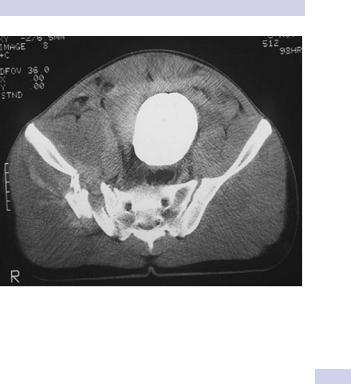
Figure 10.10 Normal CT cystogram in a patient with gross hematuria and right iliac wing fracture. Notice the large pelvic hematoma displacing the bladder and the complete visualization behind the distended bladder, thus obviating the need for additional post-drainage views or plain films.
Patients with (a) microhematuria and pelvic fracture or (b) gross hematuria without pelvic fracture are much less likely to have bladder rupture (<5%) and thus require bladder imaging only if they have significant suprapubic pain, low urine output, altered sensorium, or other clinical indicators suggestive of bladder rupture (e.g., free fluid on abdominal ultrasound or CT).
Urethral injuries associated with pelvic fractures
The posterior urethra is injured with roughly the same frequency as the bladder in subjects who sustain a pelvic fracture (roughly 10%). Ten percent of patients with a pelvic fracture and bladder rupture also have a posterior urethral rupture.
Symptoms and signs of bladder or urethral injury in pelvic fracture
•Blood at meatus—in 40–50% of patients (no blood at meatus in 50–60%)
•Gross hematuria
•Inability to void
•Perineal or scrotal bruising