Материал: The_Future_of_Hydrogen-IEA-2020
The Future of Hydrogen |
Chapter 1: Introduction |
precursor to air pollution. Like hydrogen, there is long experience of using ammonia industrially. It has been used as a refrigerant since the early 19th century and it has also been used in largescale fertiliser production for over a century. Ammonia is routinely stored and transported, including in ocean-going tankers, and is sometimes injected directly into the soil in agriculture. Methylcyclohexane, a potential candidate LOHC, is flammable and dangerous to ingest, and its production requires toluene (which is toxic), but as a liquid, methylcyclohexane is less hazardous compared with gases, which can be inhaled. Dibenzyltoluene is considered to be an alternative LOHC option and is safer. Neither are currently handled in very large quantities, except in specific chemical facilities, but safe handling in pipelines or ships is not thought to pose a significant safety problem with appropriate controls in place.
References
AFC TCP (Advanced Fuel Cells Technology Collaboration Partnership) (2018), AFC TCP 2018 Survey on the Number of Fuel Cell Electric Vehicles, Hydrogen Refuelling Stations and Targets, provided to the IEA by AFC TCP.
Chehade, Z. et al. (2019), “Review and analysis of demonstration projects on Power-to-X pathways in the world”, International Journal of Hydrogen Energy, in press.
GCCSI (Global CCS Institute) (2019), The Global Carbon Capture and Storage Intelligence Database, https://co2re.co/ (accessed 9 April 2019).
IEA (International Energy Agency) (2019), World Energy Investment 2019, Paris, www.iea.org/wei2019/. IEA (2018a), RD&D Statistics, Paris, www.iea.org/statistics/RDDonlinedataservice/ (accessed 5 April 2019). IEA (2018b), World Energy Investment 2018, Paris, www.iea.org/wei2018/.
IEA ( (2018c), World Energy Outlook 2018, Paris, www.iea.org/weo2018/. IEA (2015), Technology Roadmap Hydrogen and Fuel Cells, Paris.
IPCC (Intergovernmental Panel on Climate Change) (2018), “Global Warming of 1.5°C: An IPCC Special Report on the impacts of global warming of 1.5°C above pre-industrial levels and related global greenhouse gas emission pathways, in the context of strengthening the global response to the threat of climate change, sustainable development, and efforts to eradicate poverty”, World Meteorological Organization, Geneva, Switzerland.
IPHE (International Partnership for Hydrogen and Fuel Cells in the Economy) (2019), Country Updates, www.iphe.net/ (accessed 8 April 2019).
Ridjan (2016), “Terminology used for renewable liquid and gaseous fuels based on the conversion of electricity: a review”, Journal of Cleaner Production, Vol. 112, pp. 3709–20,
doi: 10.1016/j.jclepro.2015.05.117.
Society of Automotive Engineers of China (2016), Hydrogen Fuel Cell Vehicle Technology Roadmap [English Version], Strategy Advisory Committee of the Technology Roadmap for Energy Saving and New Energy Vehicles, www.ihfca.org.cn/file/FCV%20Tech%20Roadmap.pdf.
Stephens-Romero, S. et al. (2009), “Determining air quality and greenhouse gas impacts of hydrogen infrastructure and fuel cell vehicles”, Environmental Science and Technology, Vol. 43, Issue 23, pp. 9022–9, https://doi.org/10.1021/es901515y.
World Energy Council (2018), Hydrogen an Enabler of the Grand Transition, Future Energy Leaders Hydrogen Taskforce, World Energy Council.
PAGE | 36
IEA. All rights reserved.

The Future of Hydrogen |
Chapter 2: Producing hydrogen and hydrogen-based products |
Chapter 2: Producing hydrogen and hydrogen-based products
•Around 70 Mt of dedicated hydrogen are produced today, 76% from natural gas and
almost all the rest (23%) from coal. Annual hydrogen production consumes around 205 billion m3 of natural gas (6% of global natural gas use) and 107 Mt of coal (2% of global coal use), with coal use concentrated in the People’s Republic of China (“China”). As a
consequence, global hydrogen production today is responsible for 830 MtCO2/yr – corresponding to the annual CO2 emissions of Indonesia and the United Kingdom combined.
•Electrolysis currently accounts for 2% of global hydrogen production, but there is significant scope for electrolysis to provide more low-carbon hydrogen. Surplus electricity from variable renewables has low costs, but the number of hours during which this surplus occurs is generally low. Falling costs mean that dedicated renewables for hydrogen production in regions with excellent resource conditions could, however, now become a reliable low-cost hydrogen source. If all current dedicated hydrogen production were produced through water electrolysis (using water and electricity to create hydrogen), this would result in an annual
electricity demand of 3 600 TWh – more than the annual electricity generation of the European Union. Water requirements would be 617 million m3, or 1.3% of the water consumption of the global energy sector today; this is roughly twice the current water consumption for hydrogen from natural gas.
•There are huge regional variations in hydrogen production costs today, and their future economics depend on factors that will continue to vary regionally, including prices for fossil fuels, electricity and carbon. Natural gas without CCUS is currently the most economic option for hydrogen production in most parts of the world, with costs being as low as
USD 1/kgH2 in the Middle East. Among low-carbon options, electrolysis requires electricity prices of USD 10–40/MWh and full load hours of 3 000–6 000 to become cost-competitive with natural gas with CCUS (depending on local gas prices). Regions with good renewable resources or nuclear power plants may find electrolysis an attractive option, especially if they currently depend on relatively high cost natural gas imports.
•Conversion of hydrogen into other hydrogen-based fuels could be attractive where few other low-carbon alternatives are available, but is not economic at current prices. The conversion of hydrogen to ammonia benefits from existing infrastructure and demand; it also does not need carbon as an input. For synthetic liquid fuels from electrolytic hydrogen, however, electricity costs of USD 20/MWh translate into costs of USD 60–70/bbl without
taking account of any capital expenditure or CO2 feedstock costs. For synthetic methane the equivalent figure is USD 10–12/MBtu. Carbon pricing or equivalent policies would be needed to reduce the cost gap between synthetic hydrocarbons and fossil fuels.
PAGE | 37
IEA. All rights reserved.

The Future of Hydrogen |
Chapter 2: Producing hydrogen and hydrogen-based products |
Hydrogen can be produced using a range of energy sources and technologies. Global hydrogen production today is dominated by the use of fossil fuels. Electrolytic hydrogen – that is, hydrogen produced from water and electricity – plays only a minor role (although it was a major source of industrial hydrogen in the 1920s to 1960s, using electricity generated from hydropower, before being displaced by natural gas). With declining costs for renewable power (in particular solar PV and wind), interest is now growing in water electrolysis for hydrogen production and in the scope for further conversion of that hydrogen into hydrogen-based fuels or feedstocks, such as synthetic hydrocarbons and ammonia, which are more compatible than hydrogen with existing infrastructure.
This chapter explores the various ways of making hydrogen and hydrogen products. It begins with an analysis of the existing sources and methods of production of hydrogen. It then considers key sources of hydrogen production, looking in turn at natural gas, water and electricity, coal, and biomass in terms of both technology options and costs. The chapter then provides an overview of the scope for converting hydrogen into fuels and feedstocks that are easier than hydrogen to store, transport and use.
Production of hydrogen today
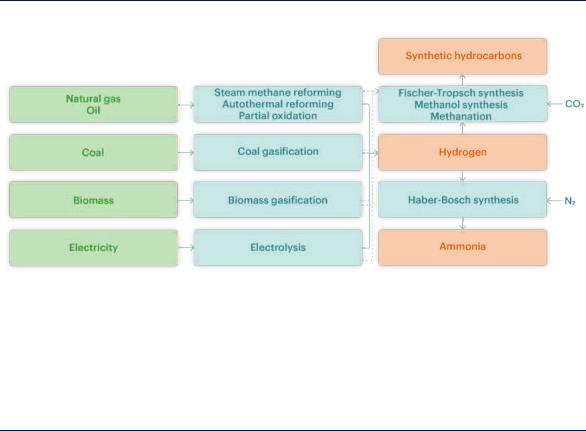
Hydrogen can be extracted from fossil fuels and biomass, or from water, or from a mix of both (Figure 7). Around 275 Mtoe of energy are used for the production of hydrogen today (2% of global total primary energy demand). Natural gas is currently the primary source of hydrogen production, and steam methane reformers using natural gas are the workhorse of dedicated hydrogen production in the ammonia and methanol industries and in refineries. Natural gas accounts for around three-quarters of the annual global dedicated hydrogen production of around 70 million tonnes of hydrogen (MtH2), using around 205 billion cubic metres (bcm) of natural gas (6% of global natural gas use). Coal comes next, due to its dominant role in China: it accounts for an estimated 23% of global dedicated hydrogen production and uses 107 Mt of coal (2% of global coal use). Oil and electricity account for the remainder of the dedicated production.
The dependence on natural gas and coal means that hydrogen production today generates significant CO2 emissions: 10 tonnes of carbon dioxide per tonne of hydrogen (tCO2/tH2) from natural gas,6 12 tCO2/tH2 from oil products, and 19 tCO2/tH2 from coal. This results in total CO2 formation of about 830 MtCO2/yr, corresponding to the combined CO2 emissions of Indonesia and the United Kingdom. Most of this CO2 is emitted to the atmosphere, although in ammonia/urea plants the concentrated CO2 streams from steam methane reforming (SMR) (around 130 MtCO2 each year) are captured and used in the production of urea fertiliser.7
Reforming is the most widespread method for producing hydrogen from natural gas. There are three methods: steam reforming (using water as an oxidant and a source of hydrogen), partial oxidation (using oxygen in the air as the oxidant), or a combination of both called autothermal reforming (ATR).8 Steam reforming is used to extract hydrogen from natural gas and – much
6Fugitive emissions during natural gas production, processing and transport are important to consider when comparing different hydrogen production routes as they represent a significant share of the CO2 mitigation potential (Tlili et al., 2019).
7The carbon contained in the urea fertiliser is, however, released again as CO2 when the fertiliser is applied by farmers to the soil.
8Steam reforming requires heat (“endothermic”), while partial oxidation releases heat (“exothermic”). ATR uses both air and water as oxidants, so it does not require or release heat.
PAGE | 38
IEA. All rights reserved.
The Future of Hydrogen |
Chapter 2: Producing hydrogen and hydrogen-based products |
less frequently – from liquefied petroleum gas and naphtha. Partial oxidation is used to extract hydrogen from heavy fuel oil and coal. In all cases, a synthesis gas mostly made of carbon monoxide and hydrogen is formed, then converted to hydrogen and CO2 if pure hydrogen is the main product. Other processes include gasification (where the raw material, such as coal or biomass, is converted into a synthesis gas that is then transformed into hydrogen and CO2) and electrolysis (where hydrogen is produced by splitting water into hydrogen and oxygen). Though known for a long time, electrolysis plays only a minor role in total hydrogen production today, mostly in the chlor-alkali industry where hydrogen is a by-product.
Figure 7. Potential pathways for producing hydrogen and hydrogen-based products
Notes: N2 = nitrogen. The dotted lines represent the flow of hydrogen-containing synthesis gas (mixture of hydrogen and carbon monoxide) from hydrocarbon fuels for further conversion into other synthetic hydrocarbons, such as coal-to-liquids or gas-to-liquids. Though not discussed in this chapter, this direct conversion route of hydrocarbons via synthesis gas into other synthetic hydrocarbons is likely more favourable in terms of emissions (especially when coupled with CCUS) or costs compared with producing pure hydrogen from hydrocarbons first and then combining this hydrogen again with CO2 for the production of synthetic hydrocarbons, particularly if the CO2 input is of fossil origin.
Source: IEA 2019. All rights reserved.
Various options exist to produce hydrogen, with SMR, coal gasification and water electrolysis being the prevalent ones today.
Hydrogen from natural gas
SMR is the most widespread technology for hydrogen production from natural gas at large scale, though ATR is also in use. Natural gas in SMR is both a fuel and a feedstock (together with water). Typically 30–40% of it is combusted to fuel the process, giving rise to a “diluted” CO2 stream, while the rest of it is split by the process into hydrogen and more concentrated “process” CO2. SMR is likely to remain the dominant technology for large-scale hydrogen production in the near term because of its favourable economics and the large number of SMR units in operation today.
Technology options for low-carbon hydrogen
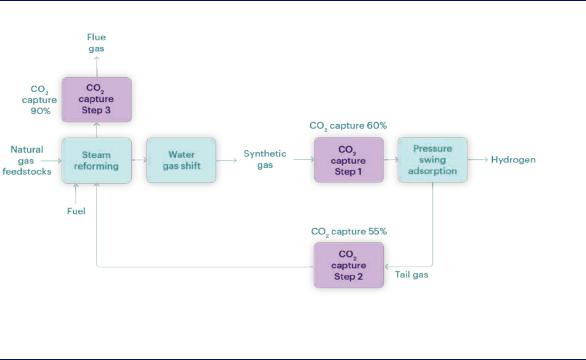
CCUS can be applied both to SMR and ATR hydrogen production. Using CCUS with SMR plants can lead to a reduction in carbon emissions of up to 90%, if applied to both process and energy emission streams. Several SMR-CCUS plants are already operational today, producing around
PAGE | 39
IEA. All rights reserved.
The Future of Hydrogen |
Chapter 2: Producing hydrogen and hydrogen-based products |
0.5 MtH2/yr between them. There are several ways in which CO2 capture can take place at an SMR plant. CO2 can be separated from the high-pressure synthesis gas stream, reducing emissions by up to 60% (Figure 8). This typically costs around USD 53 per tonne of carbon dioxide (tCO2) for merchant plants (that is, plants where hydrogen production is not integrated with the production of ammonia or methanol), based on current natural gas prices in Europe. CO2 can also be captured from the more diluted furnace flue gas. This can boost the level of overall emission reduction to 90% or more, but it also increases costs to around USD 80/tCO2 in merchant plants, and to USD 90–115/tCO2 in integrated ammonia/urea and methanol plants, which have more diluted CO2 streams (see IEAGHG, 2017a and 2017b).
Figure 8. Production process of hydrogen from gas with CCUS
Source: IEAGHG (2017a), “Reference data and supporting literature reviews for SMR based hydrogen production with CCS”.
CCUS is crucial to decarbonising the large SMR fleet in operation today.
ATR is an alternative technology in which the required heat is produced in the reformer itself. This means that all the CO2 is produced inside the reactor, which allows for higher CO2 recovery rates than can be achieved with SMR. ATR also allows for the capture of emissions at lower cost than SMR because the emissions are more concentrated. A number of studies have shown that the costs of SMR with capture rates exceeding 90% are higher than that of a comparable ATR system (H21, 2018). A large share of global ammonia and methanol production already combines SMR with ATR technology, and the announced HyNet and H21 projects in the United Kingdom have plans to use ATR with CCUS instead of SMR. Other options for using natural gas to produce hydrogen exist, but are still only at either demonstration or laboratory scale today (Box 3).
PAGE | 40
IEA. All rights reserved.