Материал: UPSTREAM
5Read the sentences. If a sentence is correct put a tick ( ). If it has a word which should not be there, write this word on the line.
1 A visit to the Rio will never be complete .......
2 if you don’t take part in the carnival .......
3 celebrations. It is the world’s most biggest .......
4 street party in where you can enjoy fantastic .......
5 costumes, bright decorations and a lots of .......
dancing.
(5 marks)
Communication
6 |
Find the question which matches the answers. |
|||
|
|
|
|
Not really. |
|
1 |
(hotel)? |
< I do, actually. |
|
|
2 |
(beach)? |
< |
Why not? |
|
|
|||
|
|
It depends. |
||
|
|
|
|
|
|
3 |
(bike ride)? |
< |
Yes, sure. |
|
I can’t. |
|||
|
|
|
||
|
|
|
Oh right, yes. |
|
|
|
|
|
|
|
4 |
(rubbish)? |
< No problem. |
|
|
5 |
(weekend)? |
|
I don’t think so. |
< No, I’m not.
(5 marks)
7Complete the exchanges.
1 |
A: ........................................................................ |
|
|
for a game of tennis after work? |
|
|
B: No, I’m afraid not. I have to finish this report. |
|
2 |
A: ...................................................................... |
? |
|
B: Well, it costs í50 per day or í200 for a week. |
|
3 |
A: ...................................................................... |
? |
|
B: Yes, sir, we accept Visa, Mastercard and |
|
|
American Express. |
|
4 |
A: ...................................................................... |
? |
|
B: You can come and pick it up tomorrow |
|
|
morning. |
|
5A: There are too many cars on the roads these days.
B: It ........................................... |
for more people |
to take the bus. |
|
|
(5 marks) |
Self-Assessment Module 2
Listening
8 |
You will hear an interview with a member of an |
|
environmental protection group. Listen and mark the sentences T (for true) or F(for false).
1 Dan is an aggressive person. |
............. |
2The ‘Act Now’ group planted flowers
to show people how they feel. |
............. |
3 ‘Act Now’ is for children. |
............. |
4Dan wants to teach people how to use
fertilizers and pesticides. |
............. |
5‘Act Now’ arranges public protests and
demonstrations. |
............. |
6 Dan knows lots of famous people. |
............. |
7Dan and his group spend a lot of time
on the computer. |
............. |
|
(10 marks) |
Speaking (making decisions)
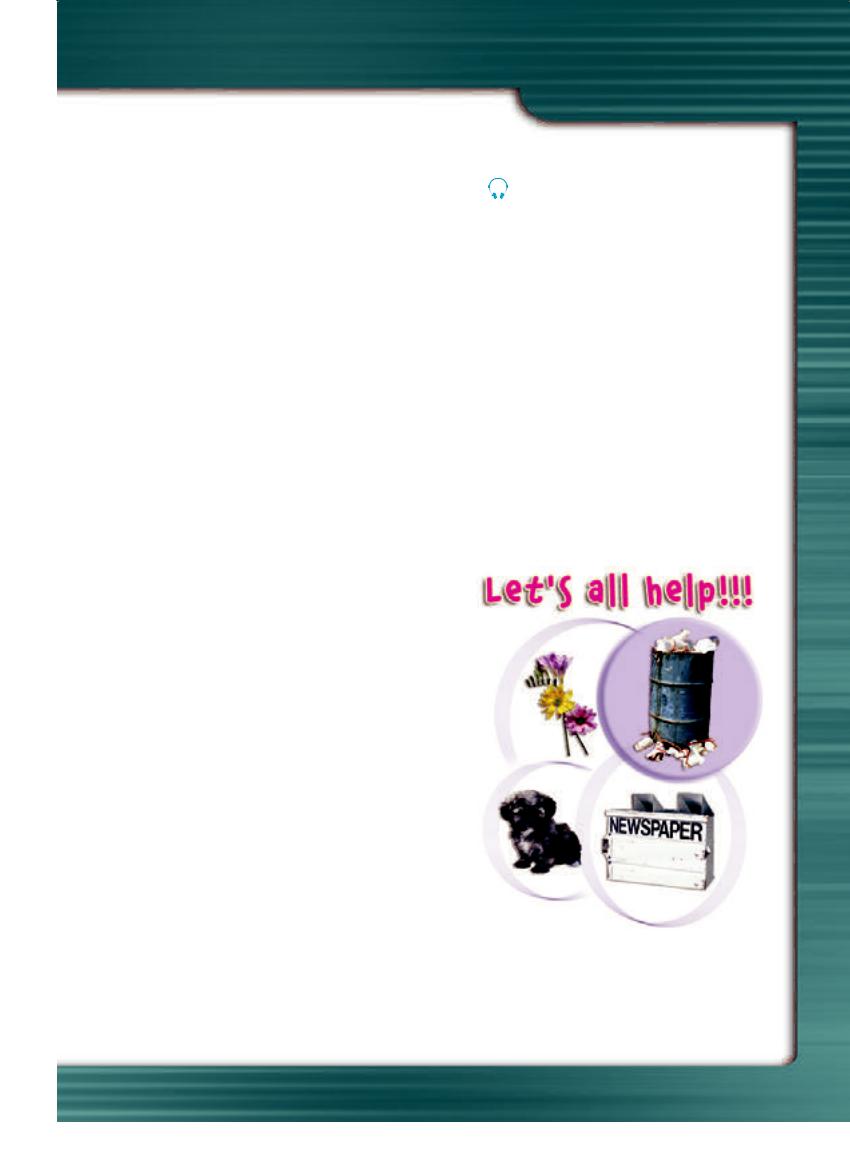
9Your school has decided to join in a project to help the environment. Look at the pictures and, in pairs, decide which activities you could participate in, giving reasons.
collect rubbish
plant flowers
stray dogs
|
|
recycling |
|
|
|
|
|
|
|
Useful phrases |
|
|
|
|
|
ñ I think ... |
|
ñ It would be a |
ñ So that ... |
ñ We should ... |
|
good idea to ... |
ñ Then ... |
ñ Why don’t we |
...? |
ñ That way ... |
|
|
|
|
|
(10 marks)
67
Self-Assessment Module 2
Reading
10 You are going to read some geographical information about different English-speaking countries. For questions (1-12), choose the country (A-C). There is an example at the beginning.
A JOURNEY
THROUGH THE ENGLISH-SPEAKING WORLD
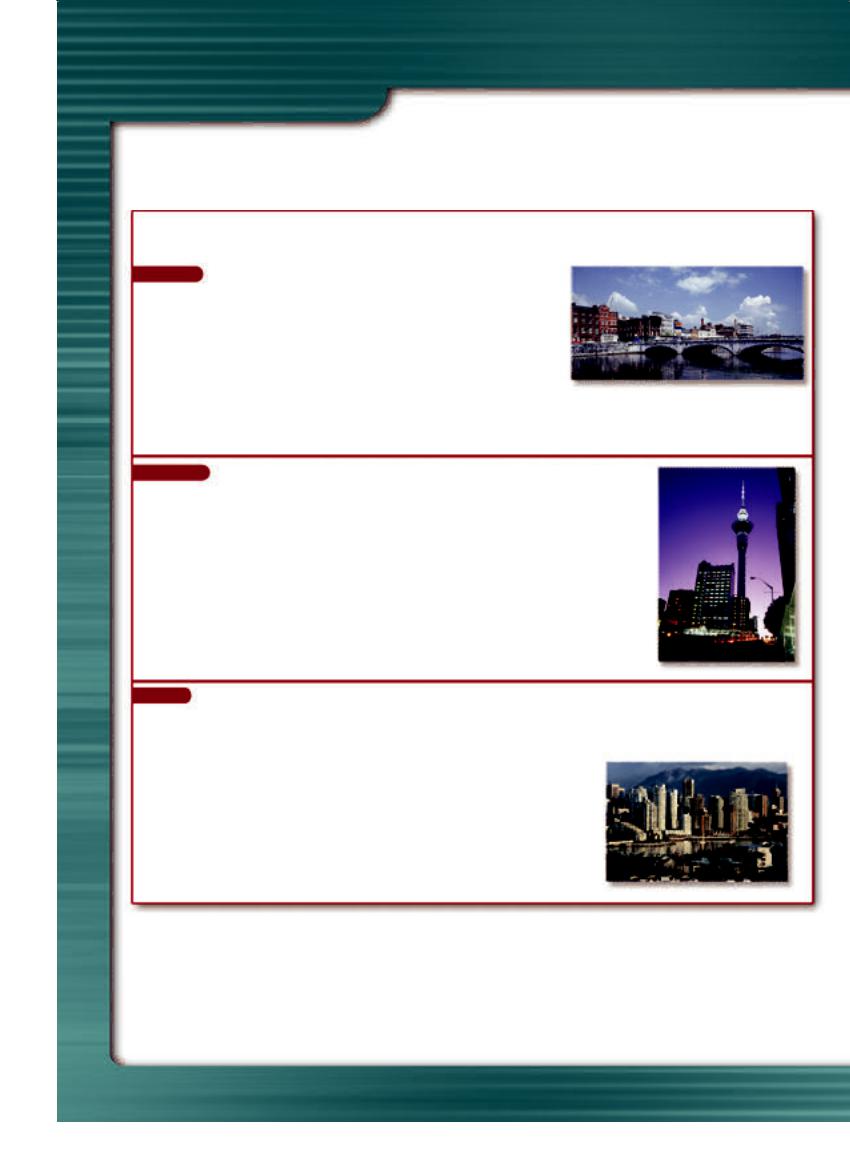
A Ireland
LAND: The Republic of Ireland takes up about 83% of the island of Ireland, which is located in northwestern Europe. Ireland is a small country with an area of just 70,285 km2. Although there are high mountains near the coasts, the central part of Ireland is flatter and used for farmland.
CLIMATE: Most of Ireland is mild and wet throughout the year, giving Ireland its green countryside and earning it the name The Emerald Isle.
PEOPLE: Dublin is both the capital and the largest city. However, only about 57% of the Irish people
today live in urban areas. The first Irish people probably came from Scandinavia to Scotland and then to Ireland about 8,000 years ago. Since then, Ireland has been invaded and colonised by Celts, Vikings, English and Scots. Today, most of Ireland’s 3,590,000 population are of Celtic origin. It was the Celts who first introduced the language we know today as Irish, which is one of the country’s official languages. English is the other official language.
B New Zealand
LAND: Located in the southwest Pacific Ocean, New Zealand is a small country of about 270,543 km2. It is made up of two main islands, the North Island and the South Island, as well as a number of smaller islands. The North Island is famous for its volcanoes and many hot springs as well as its many forests, hills and mountains. The South Island has many high, snow-capped mountains.
CLIMATE: Most of the country is mild and rainy throughout the year, with the South Island much cooler than the North. PEOPLE: Although Wellington is the capital city, it is not the largest. About one third of New Zealand’s population lives in Auckland, the largest city in New Zealand. Today, only about 15% of all New Zealanders live in rural areas.
Most of New Zealand’s 3,683,000 population are descendants of British settlers. There are also increasing numbers of people of Asian and Pacific island descent living in New Zealand. About 526,000 Maoris also live in New Zealand. Their ancestors came from the Polynesian Islands about 1,000 years ago. Today, the official language of New Zealand is English, although many Maoris speak their own language, Maori, as well.
C Canada
LAND: Canada, with an area of 9,970,610 km2, is the second largest country in the world, spread across the top of North America. Canada is perhaps best known for its vast size, and variety of natural wilderness areas. The high mountains in the west of Canada are covered with green forests and crystal clear lakes, while in the centre are flat lands known as prairies. Further south, there are rolling hills.
CLIMATE: The climate ranges from temperate in the south to arctic in the north. In fact, the far north arctic landscape is so cold that trees cannot grow there. In the north the winters are cold and summers are short and quite cool, whereas in the south the winters are cold, and the summers are warm. It is wet on the coasts and dry in the centre. PEOPLE: Ottawa is the capital of Canada, but Toronto is the largest city, with a population of over 4 million. More than one third of Canada’s population of 29,450,000 are the descendants of British immigrants and there are almost as many descendants of French immigrants. This is why both English and French are the official languages of Canada. Other large immigrant groups include German, Italian and Asian people. Native American Indians and Inuit make up only a small part of Canada’s population.
Which country(ies) |
|
|
|
|
|
ñ is smaller than only one other |
|
|
ñ has an area where there are no trees? 6 ....... |
|
|
country? |
0 |
C |
ñ are made up of many different |
|
|
ñ are islands? |
1 |
....... 2 ....... |
cultural groups? |
7 ....... |
8 ....... |
ñ has one official language? |
3 |
....... |
ñ have a population of about three |
|
|
ñ have a constant climate throughout |
|
|
million? |
9 ....... |
10....... |
the year? |
4 |
....... 5 ....... |
ñ have minority racial groups? |
11 ....... |
12....... |
(15 marks)
68
Writing
11 Your local council is going to publish a brochure called CleaningUpOurTown. The brochure will include short articles on how to improve the environment in your town. You have been asked to write a short article for this brochure on improving the quality of the water in the local rivers and lakes. Use the plan below to write your article.
(120-180 words)
Introduction
(Para 1) state problem: rivers and lakes polluted – people throw litter – factories dump industrial waste – can’t swim – can’t drink the water – must do something
Main Body
(Para 2) organise a clean up campaign – volunteers clean up rivers and lakes – put out more rubbish bins – less litter in water
(Para 3) fine factories that dump industrial waste into lakes and rivers – water pollution will decrease – cleaner water
Conclusion
(Para 4) restate opinion: local people and industry work together – clean up our lakes and rivers – can
swim and use the water again
(20 marks)
(Total = 100 marks)
Sing Along!
12 a.
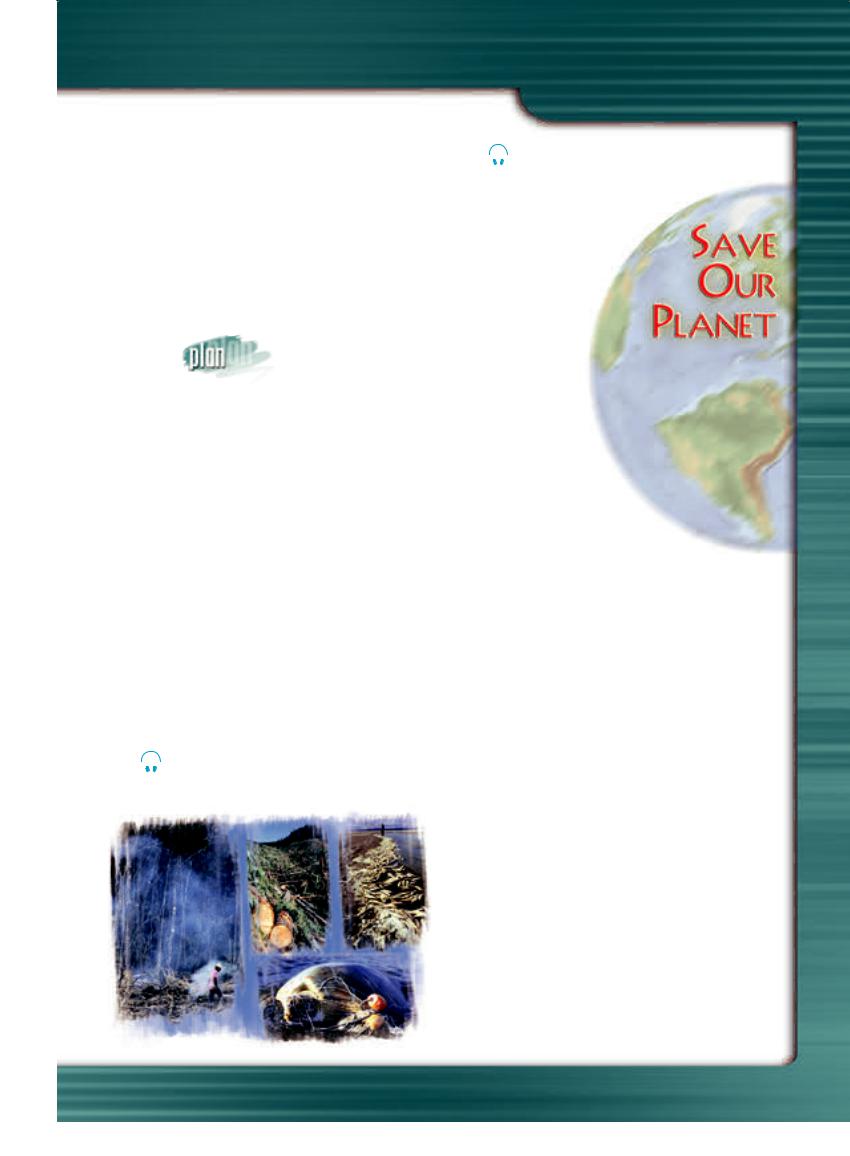
a. Look at the pictures and the title of the song. Which of these problems do you expect to hear about? Listen and check.
Self-Assessment Module 2
 b.
b. Listen again and fill in, then sing.
There’s so much pollution Poisoning the 1) .......................
There is so much 2) .......................
We can see it everywhere 3) ....................... is disappearing
While everyone stands by The world we love is dying
And we’re the |
|
4) ....................... |
why |
Why are we killing our world
Why aren’t we doing our share
We can save our planet
We can help it survive
All it needs is a little care
If we all work together |
|
Something can be done |
|
We need a 5) ....................... |
campaign |
Which involves everyone |
|
We can slow down global 6) |
....................... |
We can stop the acid rain |
|
We can heal our 7) ....................... |
|
We can help it live again |
|
Why are we killing our world ...
If we don’t act quickly
Our world will soon be dead
We must leave our 8) |
....................... at home |
And use bicycles instead |
|
We must stop using chemicals |
|
And 9) ....................... |
fossil fuels |
We must recycle all our 10) .......................
It’s so easy to do
We must stop killing our world ...
We must start doing our share ...
Progress Update
How do you rate your progress? Tick ( ) the box that applies to you.
|
Excellent |
Good |
OK |
Could do better |
|
**** |
*** |
** |
* |
Vocabulary & |
|
|
|
|
Grammar |
|
|
|
|
Listening |
|
|
|
|
|
|
|
|
|
Speaking |
|
|
|
|
|
|
|
|
|
Reading |
|
|
|
|
|
|
|
|
|
Writing |
|
|
|
|
|
|
|
|
|
Communication |
|
|
|
|
|
|
|
|
|
69

Life Matters
UNIT 5 Early to Bed ...
UNIT 6 Better Safe than Sorry

Module 3
Units 5-6
Before you start ...
When was the last time you went on holiday? Talk about it.
What can you do to protect the environment?
Listen, read and talk about ...
ñ |
daily routines |
ñ technology & leisure time |
|
ñ |
health problems & |
ñ |
technology at home |
|
symptoms |
ñ |
crime |
ñ |
stress & relaxation |
ñ |
computers |
ñfeelings
ñcharacter adjectives
ñways to relax
Learn how to ...
ñexpress preferences
ñdescribe your feelings
ñdescribe a person’s character
ñmake deductions
ñspeculating
ñgive advice
ñmake an appointment
ñexpress your loss of temper
ñdescribe symptoms
Practise ...
ñmodal verbs (must, ought to, need, mustn’t, have to, should, could, would, may, might)
ñpast & perfect modals
ñclauses of reason
ñquestion tags
ñthe passive
ñrelatives
ñrelative defining – non-defining clauses
Phrasal verbs
ñgive
ñgo
ñhold
ñkeep
Write ...
ña letter to a friend about a health problem you had
ña set of school rules
ña short article about a famous health spot
ña for and against essay
ñan inventor’s short biography
ña newspaper article
ña diary entry
ñan opinion essay