Материал: Uchebnik_dlya_sud_expertov

UNIT 5. TEST YOURSELF
1. ' , ' .
English is the medium of a great deal of the world’s knowledge, ___ 1 in such areas as
science and technology. And ___2____ to knowledge is the business of education. When we
___3____ why so many nations have in recent years made English an official language or
___4____it as their chief foreign language in schools, one of the most important reasons is always
____5_____ - in the broadest sense.
Since the 1960s, English |
6 |
|
the normal medium of instruction in higher education for |
|||||||||
many countries – |
7 |
several where the language has no |
8 |
. Advances courses in the |
||||||||
Netherlands, for example, are widely |
|
9 |
in English. No African country uses its indigenous |
|||||||||
language in higher education, English being used in |
10 |
|
of cases. The English language |
|||||||||
teaching business |
11 |
|
one of the major growth industries, around the world in the past 30 |
|||||||||
years. |
|
|
|
|
|
|
|
|
|
|
|
|
especially, investigate, access, chosen, educational, has become (2), official status, including, taught, the majority.
2. .
1.
2.
3.
3. !" .
1) a Lingua Franca
2) a mothertongue speaker
3) a global village
4) layering
5) loanwords
4. .
1)
2) $ |
" |
|
|
|
3) % $ |
|
____________ |
||
4)# $ "
5),
5. .
1.Under Norman rule the official language in England was French.
2.Since there is no time like the present, he thought it was time to present the present.
3.I did not object to the object.
31
GLOSSARY
1.achieve – , !
~one’s purpose (aim) – $ (" ) ~ a status – $ (&)
2.community – !', !', !', !", !'
~rallies – )
~of opinions – $ "
~of race – &$ " bilingual ~ - international ~ – & religious ~ –
3. convention – , &, $ , !,
implicitly accepted language ~s – ( ) international ~ – & , & )
signs and ~s – |
|
|
conventional – ", |
" |
|
~ understandings – |
- |
|
~ crimes – |
( |
) " |
4.domain – !, ,
in the ~ of science –
in the ~ of literature –
~ of transportation and accommodation – # &
~ name – ( )
5.increase – 1. , , ; 2. ,
~ in number – $ ( $) ~ in size – $ ,
~ the speed – $ $
~ one’s knowledge – )$
~ of knowledge – "
~ of (in) population – ( )
6.language – ,
articulate ~ – $ $
artificial (informational, logical) ~ – " (# ", ") finger ~ – &,
literary ~ – "
living (dead) ~ – & " ( ") official ~ – # $ " semi-official ~ – # $ " spoken ~ – " , $ the English ~ – " "
written ~ – $ $, $ $
~ of science –
7. Lingua Franca – !', !' & ,
32
#
single Lingua Franca – " & mother-tongue – " ,
8. means – ( ), ! (!)
~ of communication – ( ) ( )
~ of identification – ,
~ of protection –
by means of – ,
by all means – , , " "
9. particular – 1. !, ; 2. !, !, $ ,
#, #' !
~advantages –
~case – " "
my own ~ sentiment – ( ) in ~ - ,
go into ~s – $ particularly – , , $
10. power – , ', , ',
absolute (supreme) ~ – ( ) $ economic ~ – % $
political ~ – technological ~ - $ powers – ,
delegation of ~s – " large ~s – ) leading ~s – &
11. status – !' ,
diplomatic ~ – " global ~ - "
legal ~ – "
international ~ – & "
33
MODULE 2
COMMUNICATION
UNIT 1. WHAT IS COMMUNICATION?
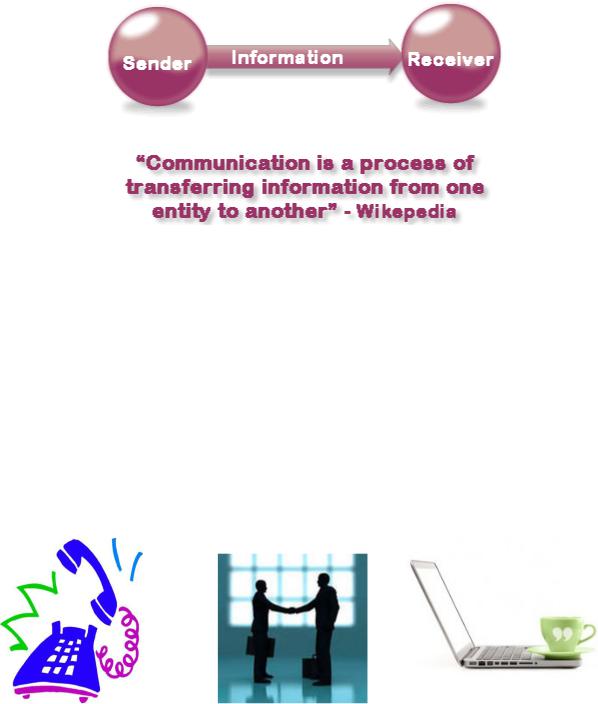
Sender is a person who sends information. Receiver is a person who gets information.
Information can be a lot of different things depending on the context. People sometimes view information and the medium to transfer it as one and the same. They aren't. Let's distinguish between the information being sent that the medium used to send it.
The information can be: words, gestures, drawings, paintings, songs, music.
The means can be: speeches, emails, blogs, forums, text messages, voice messages, poems, essays, books, newspapers, ads, articles, and practically anything you can speak through, write on or draw on.
Effective Communication is a process where a message is received and understood by the receiver in the manner that the sender intended it to be.
1. , . , -
. ( ' .
! |
|
|
34
D
1.
A:Hello. I'm Mia Conners.
B:Hi, Mia. I'm David Sinclair, and this is my partner Gina Evans. (Hold out a hand to shake)
A:Nice to meet you Mr. Sinclair and Ms. Evans. Thank you for taking the time to meet with me today.
B:It's our pleasure. And please, call us David and Gina. Can I take your coat?
A:Thank you.
B:No problem. Please take a seat and we'll be right with you. I just have to make a quick phone call.
……………
2. |
|
Leslie: |
Hello. |
Cameron: Hi, is this Leslie? |
|
Leslie: |
Yes. Who’s this? |
Cameron: It's Cameron here. Is Maria in? |
|
Leslie: |
No, she just stepped out for a moment. Can I take a message? |
Cameron: Yes, thanks. Please ask her to meet me at the Capitol 4 movie theatre at 7 pm |
|
|
tonight. |
Leslie: |
Sure. Just let me write that down. Oh, Cameron, could you hold for a second? I have |
|
to take another call. |
Cameron: |
No problem. |
3. |
|
Dear Andy:
How have you been? Your mother and I are fine. We miss you. Please sign off your computer and come downstairs for something to eat.
Love,
Dad
2. * !' ! ( ? %
, #' $ , ! $ , -
.
Speaking, writing, listening, reading, a formal vocabulary, a slang, an ear, full sentences, a hand, punctuation marks, a mouth, facial expression, a tone of voice, correct grammar, sentences, sentences and paragraphs, oral communication, an eye, written communication, to see, to write, to read, to listen.
35