Материал: Апсе ENVIRONMENTAL PROTECTION 2014
After relatively short cooldown, the crucible with all its content is transported to the ultimate disposal site.
2.Two-step technology.
The French AVM-process can be considered as a typical example of the two-step HLW vitrification technologies.
Main stages of the AVM-process:
a.Calcination of the evaporated HLW at 300-4000С.
b.Mixing the calcination product with the glass-producing additives.
c.The mixture is poured into a melting furnace.
d.Gradual warming up and formation of the glass-mass at 110011500С.
e.Periodical drainage of the glass-mass into steel containers.
f.Interim storage and ultimate disposal of the HLW containers.
Some alternative versions of the HLW vitrification technologies have been developed till now. The alternative technologies presume the HLW implantation into other stable materials, such as ceramics, glassceramics or mineral-like SYNROC materials. The term SYNROC is an abbreviated form from the words “Synthetic Rocks”, i.e. artificial but natural rock-like materials. Development of the SYNROC materials and the technology for the HLW implantation into them (the SYNROC technology) is based on the hope that the SYNROC materials could be characterized by the same physical and chemical properties (primarily, high long-term stability) as their natural analogues.
The SYNROC technology includes the following main stages:
1.Mixing the evaporated HLW with predecessors of the SYNROC materials. These predecessors are, as a rule, various refractory oxides. One typical example of the SYNROC predecessor composition is as follows: TiO2(71%), CaO(11%), ZrO2(7%), BaO(6%), Al2O3(5%).
2.Calcination of the mixture at 650-7500С.
3.Hot pressing of the mixed powder into the SYNROC pellets (temperature - 1100-12000С, pressure - 150-200 atmospheres).
4.Filling up the steel containers with the SYNROC pellets, interim storage and ultimate disposal of the HLW containers.
Multiple tests were carried out with the HLW-containing SYNROC materials, and the following main results were obtained:
1. Physical, chemical and corrosion-resistance properties of the SYNROC materials appeared to be very similar with those of natural
96
rock minerals, i.e. the SYNROC materials are able to maintain their stability under any environmental impacts for sufficiently long time periods.
2.The SYNROC materials can retain up to 20% HLW.
3.The water-leaching rate of the SYNROC materials covered the range of 10-6÷10 -5 gram from 1 cm2 of the sample surface a day (g/cm2·day).
The achievable HLW contents and the HLW leaching rates from the SYNROC materials are inferior to analogous properties of the borosilicate glass. The borosilicate glasses can retain up to 30% HLW. In general, the glasses are characterized by intrinsically disordered molecular lattice and, therefore, the glasses are able to keep wide spectrum of various radioisotopes. The SYNROC materials with their finely ordered crystalline lattice are able to keep only the radioisotope compounds
with certain atomic dimensions and with certain valencies. The waterleaching rate of the vitrified HLW is evaluated as 10-8÷10 -7 g/cm2·day.
So, the SYNROC materials are inferior only to the glasses in respect to the achievable HLW content and the water-leaching rate but, nevertheless, they remain to be the second candidate for the HLW immobilization.
After the HLW are immobilized in the glass-mass or in the SYNROC pellets, these solidified HLW forms are placed into the steel containers. The further HLW management foresees sufficiently long (up to 50 years) interim storage in the near-to-surface storage points with air or water cooling. The containers can be periodically retrieved to investigate the current state of the solidified HLW and, if necessary, to perform their additional treatment.
1.6.3. Ultimate disposal of high-level RAW in geological formations
The next stage is an ultimate disposal of the HLW containers in deep underground geological repositories. Geological formation can be regarded as a suitable place for ultimate disposal of the HLW containers only if the formation satisfies the following requirements:
1.Geographical properties of the formation:
a.Far distance from the densely populated areas.
b.Low seismicity and low probability of earthquakes.
c.Far distance from the level of ground waters.
97
d. The geological stratum must not enter the earth surface.
2.Physical properties of the formation:
a.Good heat conductivity and heat capacity.
b.Good mechanical strength and plasticity.
c.Good chemical stability and retentivity of radioisotopes.
The following three geological formations are estimated now as the most promising candidates for ultimate disposal of the HLW containers in deep underground repositories:
1.Salt mines.
2.Sedimentary clayey formations.
3.Rocky formations.
Unfortunately, it appeared impossible to distinguish one the most suitable geological formation from these candidatures even basing only on their physical properties. All the candidates are characterized by their own advantages and drawbacks.
Salt mines
Advantages:
1.Far distance from ground waters, i.e. hydrological conditions of the salt mines were so stable that the salts remained in their initial state for a geological-scale time period (some millions or even milliards of years) despite of their good solubility by light water.
2.Good plasticity.
3.High heat conductivity.
Drawbacks:
1.Good solubility by light water.
2.Potential usefulness for many industrial branches.
3.Radiolysis by ionizing radiations with intense release of harmful gaseous substance (chlorine, for instance).
Sedimentary clayey formations
Advantages:
1.Full water impermeability.
2.High retentivity of radioactive fission products (with the exception of
129I and 99Tc).
3. Good plasticity.
Drawbacks:
1.Low retentivity of 129I and 99Tc, radioisotopes with high migration ability.
98
2.Low heat conductivity.
3.Proximity to the earth surface.
Rocky formations
Advantages:
1.High water impermeability.
2.Good mechanical strength and chemical stability.
Drawbacks:
1.Low plasticity, i.e. high probability for the cracks to appear as potential pathways for the HLW migration into the biosphere.
2.Low heat conductivity.
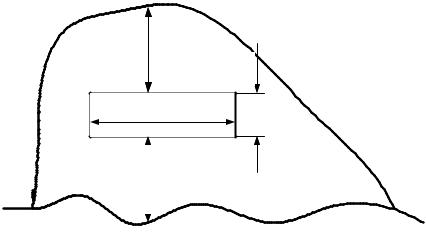
The most advanced all over the world project of the deep underground HLW repository is the Yucca Mountain project (Nevada, USA). Schematic layout of the Yucca Mountain repository is shown in Fig.
300 мm |
м |
|
7.6 |
7900 мm |
|
|
7.6 m |
|
200 мm |
|
||
|
|
|
|
|
|
|
|
|
|
|
|
LevelУровеньof groundгрунтовыхwaterвод
Fig. 1.8. Layout of the Yucca Mountain repository
Construction of the Yucca Mountain repository was begun in 1994. By April 1997 the main drifting works were finished with the following dimensions of the major tunnel: length – 7900 m; he ight – 7,6 m; distance from the level of ground water – 200 m downwa rds; distance from the mountain top – 300 m upwards. About $20 milliar ds were already
99
spent for these drifting works. In 2002 all the studies on geological, hydrological, geochemical and geothermal properties of the repository site were completed, and the US Nuclear Regulatory Commission received the application on start-up of the repository operation. As was previously planned, the loading process of the repository with the HLW containers must be begun in 2010 (total capacity of the Yucca Mountain repository was evaluated as 77,000 t HLW). However, the license on the repository operation was not issued by the NRC till now. Moreover, federal funding of the Yucca Mountain project was ended just in 2010.
The geological formation of the Yucca Mountain repository is a rocky tuff with large quantity of cracks. Vertical infiltration of light water from upwards into the major tunnel was measured and appeared equal to approximately one liter per one square meter of the tunnel bottom annually, i.e. 1 mm-thick water layer a year.
Some numerical evaluations demonstrated that major effect on potential contacts of ground water with radioisotopes and probability of their release into the biosphere from the fully loaded HLW repository Yucca Mountain is mainly defined by residual heat generation. The mountain part adjacent to the major tunnel can be warmed up to 1300С, i.e. above boiling temperature of ground water. So intense warming up can create the closed circuit of natural water convection from hot HLW repository to relatively cold rocks. There, water vapor condenses and flows down. That is why hydrological conditions of fully loaded repository cardinally differ from those in empty repository.
The following changes can occur in hydrological conditions of the fully loaded HLW repository:
1.Formation of the condensed water layer above the HLW repository by natural convection of hot vapor and cold water.
2.The rocky area adjacent to the HLW repository is impregnated with water.
3.Intense cracking of the tuff layers adjacent to the HLW repository by hot vapor and temperature gradient.
4.Chemical activity of hot water enhances. Consequently, corrosion rate of the HLW containers and solubility of radioisotopes can increase.
Central zone of the HLW repository can remain relatively dry because of maximal heat generation rate and rapid evaporation of the flowing down water. Atmosphere in peripheral zone of the HLW re-
100